

Soup, tomato, low sodium, with water
Whole food · Soups, Sauces, and Gravies

Photo: Wikipedia
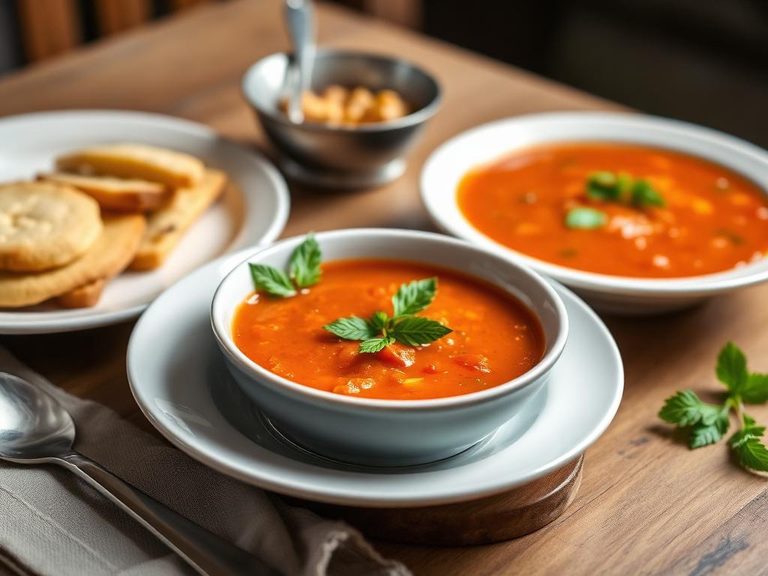
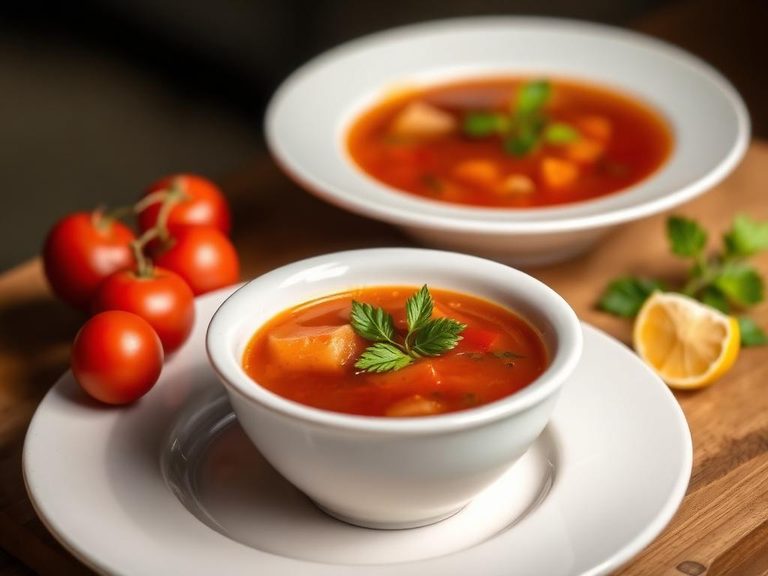
This is a light, clear broth made from tomatoes and water, with a delicate, slightly sweet and tangy flavor. Its texture is thin and smooth, often with soft, broken-down tomato pieces. It's a low-calorie, hydrating base, providing a modest amount of natural sugars and fiber from the tomatoes.
Calorie split: 10% protein · 82% carbs · 8% fat
↓ Full nutrition💚 Why it's loved
People appreciate its clean, comforting simplicity and versatility as a starter, a light meal, or a cooking base. It carries the nostalgic, warm flavor of tomatoes in a gentle, non-heavy form.
⚠️ Watch-outs & how to enjoy it better
Its thin consistency can feel unsubstantial, and the natural sugars may cause a mild blood-sugar spike for some if consumed alone. To counteract this, pair it with a source of protein (like beans or chicken) or a healthy fat (like a drizzle of olive oil) to increase satiety and slow sugar absorption.
Key benefits
- Very low in calories and fat.
- Provides hydration and electrolytes.
- Contains lycopene, an antioxidant from tomatoes.
- A light, easily digestible option for meals.
- Can be a low-sodium base for other recipes.
🍽️ Popular dishes
🌍 Where it's eaten
💡 Did you know?
Tomato soup was once considered poisonous in parts of Europe and America because the acidic fruit could leach lead from pewter plates, leading to poisoning.
Full nutrition (USDA data · scales with serving)
| Water | 91.4 g |
| Energy | 30.0 kcal |
| Energy | 124 kj |
| Protein | 0.79 g |
| Total lipid (fat) | 0.28 g |
| Ash | 0.99 g |
| Carbohydrate, by difference | 6.6 g |
| Fiber, total dietary | 0.60 g |
| Total Sugars | 4.0 g |
| Calcium, Ca | 8.0 mg |
| Iron, Fe | 0.54 mg |
| Magnesium, Mg | 7.0 mg |
| Phosphorus, P | 14.0 mg |
| Potassium, K | 112 mg |
| Sodium, Na | 33.0 mg |
| Zinc, Zn | 0.12 mg |
| Copper, Cu | 0.08 mg |
| Manganese, Mn | 0.06 mg |
| Selenium, Se | 2.5 ug |
| Vitamin C, total ascorbic acid | 6.3 mg |
| Thiamin | 0.02 mg |
| Riboflavin | 0.03 mg |
| Niacin | 0.51 mg |
| Vitamin B-6 | 0.04 mg |
| Folate, total | 0.00 ug |
| Folic acid | 0.00 ug |
| Folate, food | 0.00 ug |
| Folate, DFE | 0.00 ug |
| Choline, total | 6.3 mg |
| Vitamin B-12 | 0.00 ug |
| Vitamin B-12, added | 0.00 ug |
| Vitamin A, RAE | 10.0 ug |
| Retinol | 0.00 ug |
| Carotene, beta | 115 ug |
| Carotene, alpha | 0.00 ug |
| Cryptoxanthin, beta | 0.00 ug |
| Vitamin A, IU | 192 iu |
| Lycopene | 5345 ug |
| Lutein + zeaxanthin | 44.0 ug |
| Vitamin E (alpha-tocopherol) | 0.17 mg |
| Vitamin E, added | 0.00 mg |
| Vitamin D (D2 + D3), International Units | 0.00 iu |
| Vitamin D (D2 + D3) | 0.00 ug |
| Vitamin K (phylloquinone) | 1.5 ug |
| Alcohol, ethyl | 0.00 g |
| Caffeine | 0.00 mg |
| Theobromine | 0.00 mg |
Fat & fatty acid profile (per 100g)
| Fatty acids, total saturated | 0.08 g |
| SFA 4:0 | 0.00 g |
| SFA 6:0 | 0.00 g |
| SFA 8:0 | 0.00 g |
| SFA 10:0 | 0.00 g |
| SFA 12:0 | 0.00 g |
| SFA 14:0 | 0.01 g |
| SFA 16:0 | 0.04 g |
| SFA 18:0 | 0.01 g |
| Fatty acids, total monounsaturated | 0.09 g |
| MUFA 16:1 | 0.01 g |
| MUFA 18:1 | 0.04 g |
| MUFA 20:1 | 0.01 g |
| MUFA 22:1 | 0.01 g |
| Fatty acids, total polyunsaturated | 0.09 g |
| PUFA 18:2 | 0.07 g |
| PUFA 18:3 | 0.01 g |
| PUFA 18:4 | 0.00 g |
| PUFA 20:4 | 0.00 g |
| PUFA 20:5 n-3 (EPA) | 0.00 g |
| PUFA 22:5 n-3 (DPA) | 0.00 g |
| PUFA 22:6 n-3 (DHA) | 0.00 g |
| Cholesterol | 0.00 mg |
Amino acid profile (per 100g)
Estimated from Soup, bean with pork, canned, condensed — USDA does not publish this profile for Soup.
| Tryptophan | 0.06 g |
| Threonine | 0.24 g |
| Isoleucine | 0.29 g |
| Leucine | 0.48 g |
| Lysine | 0.40 g |
| Methionine | 0.07 g |
| Cystine | 0.07 g |
| Phenylalanine | 0.33 g |
| Tyrosine | 0.18 g |
| Valine | 0.32 g |
| Arginine | 0.31 g |
| Histidine | 0.15 g |
| Alanine | 0.29 g |
| Aspartic acid | 0.66 g |
| Glutamic acid | 1.1 g |
| Glycine | 0.28 g |
| Proline | 0.27 g |
| Serine | 0.29 g |
FAQ
Is this the same as canned tomato soup?
No. This is a simple, low-sodium broth made primarily with tomatoes and water. Canned tomato soup is typically a thicker, cream-based product with added salt, sugar, and other ingredients, resulting in a much higher calorie and sodium content.
Can I use this as a base for other recipes?
Absolutely. Its mild, low-sodium profile makes it an excellent, flavorful liquid base for stews, braises, grain cooking, or thinning out thicker sauces without adding excess salt.
What gives it its red color?
The vibrant red color comes from lycopene, a natural carotenoid pigment and antioxidant found in the skin and flesh of tomatoes.
Nutrient density (calculated · NRF9.3)
Nutrient Rich Foods index: beneficial nutrients (protein, fiber, vitamins, minerals) minus saturated fat, added sugar & sodium, per 100 kcal.
NRF9.3 index — Fulgoni, Keast & Drewnowski, 2009. Computed from USDA nutrients.
Weight-loss friendliness (composite index)
Energy density 0.30 kcal/g · 11% calories from protein · 0.6 g fiber · 4.0 g sugar per 100 g.
Composite of energy density (Rolls et al., 1999), protein & fiber satiety, minus sugar. A calculated heuristic — ranks satiety-per-calorie, not a clinical measure.
Dietary load (calculated from USDA values)
Potential renal acid load. Positive = acid-forming, negative = alkaline-forming.
Sodium-to-potassium ratio: 0.29 (lower is better — aim for ≤ 1)
Sodium:potassium per WHO potassium guidance. Computed from USDA nutrients.