

Soup, onion, canned, condensed
Whole food · Soups, Sauces, and Gravies

Photo: Wikipedia
This is a smooth, savory concentrate made from pureed onions, offering a deep, sweet, and umami-rich flavor base. Its velvety texture transforms into a comforting broth when diluted with water or milk. Nutritionally, it's a low-calorie pantry staple that delivers a modest protein boost and a touch of natural sweetness.
Calorie split: 24% protein · 52% carbs · 25% fat
↓ Full nutrition💚 Why it's loved
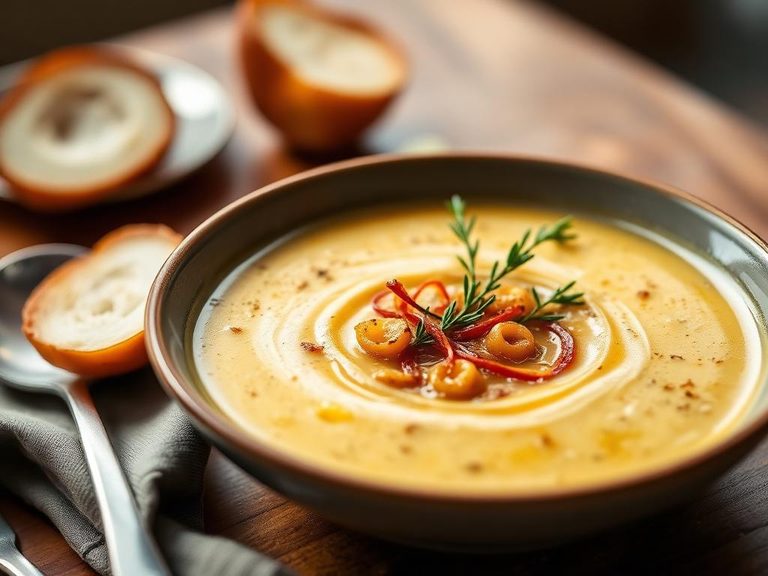
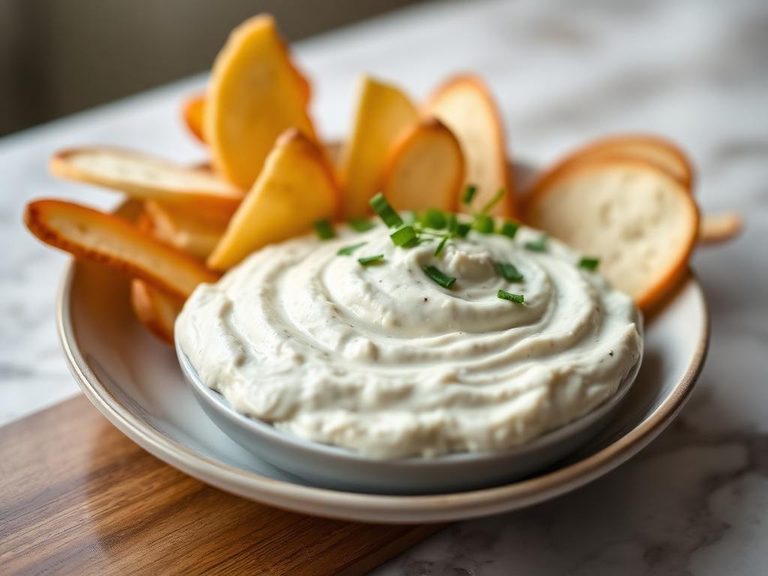
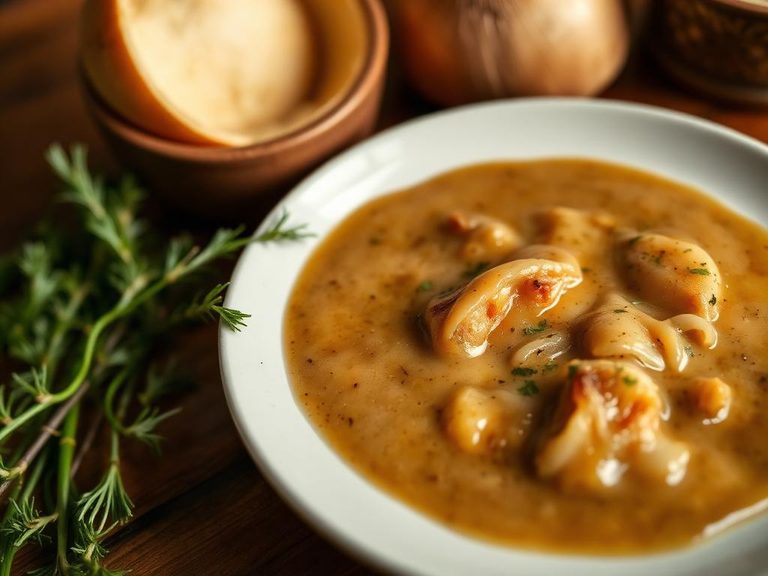
People love it for its incredible convenience and ability to instantly create a rich, caramelized onion flavor that would take much longer to develop from scratch. It's a beloved time-saver in home kitchens, forming the heart of classic comfort foods like French onion soup and creamy onion dip.
⚠️ Watch-outs & how to enjoy it better
The condensed form is often high in sodium, which can be a concern for those monitoring salt intake. To counteract this, use it as a flavor base and dilute it well, or seek low-sodium versions. Its natural sugars can also contribute to blood sugar spikes if consumed in large, undiluted portions; pairing it with protein (like cheese or beans) and fiber (like whole-grain bread) helps balance the meal.
Key benefits
- Low-calorie base for quick soups and sauces
- Provides a concentrated source of onion flavor
- Contains small amounts of plant-based protein
- Offers quick energy from natural carbohydrates
- A convenient, shelf-stable ingredient
🍽️ Popular dishes

🌍 Where it's eaten
💡 Did you know?
The Maillard reaction and caramelization that give this soup its deep flavor are the same processes that brown a steak or toast bread, but here they happen to the onions during the canning process itself.
Full nutrition (USDA data · scales with serving)
| Water | 86.3 g |
| Energy | 46.0 kcal |
| Energy | 192 kj |
| Protein | 3.1 g |
| Total lipid (fat) | 1.4 g |
| Ash | 2.5 g |
| Carbohydrate, by difference | 6.7 g |
| Fiber, total dietary | 0.70 g |
| Total Sugars | 2.7 g |
| Calcium, Ca | 22.0 mg |
| Iron, Fe | 0.55 mg |
| Magnesium, Mg | 2.0 mg |
| Phosphorus, P | 9.0 mg |
| Potassium, K | 56.0 mg |
| Sodium, Na | 516 mg |
| Zinc, Zn | 0.50 mg |
| Copper, Cu | 0.10 mg |
| Manganese, Mn | 0.20 mg |
| Selenium, Se | 3.5 ug |
| Vitamin C, total ascorbic acid | 1.0 mg |
| Thiamin | 0.03 mg |
| Riboflavin | 0.02 mg |
| Niacin | 0.49 mg |
| Pantothenic acid | 0.00 mg |
| Vitamin B-6 | 0.04 mg |
| Folate, total | 12.0 ug |
| Folic acid | 0.00 ug |
| Folate, food | 12.0 ug |
| Folate, DFE | 12.0 ug |
| Choline, total | 4.0 mg |
| Vitamin B-12 | 0.00 ug |
| Vitamin B-12, added | 0.00 ug |
| Vitamin A, RAE | 3.0 ug |
| Retinol | 3.0 ug |
| Carotene, beta | 1.0 ug |
| Carotene, alpha | 0.00 ug |
| Cryptoxanthin, beta | 0.00 ug |
| Vitamin A, IU | 11.0 iu |
| Lycopene | 0.00 ug |
| Lutein + zeaxanthin | 1.0 ug |
| Vitamin E (alpha-tocopherol) | 0.22 mg |
| Vitamin E, added | 0.00 mg |
| Vitamin D (D2 + D3), International Units | 0.00 iu |
| Vitamin D (D2 + D3) | 0.00 ug |
| Vitamin K (phylloquinone) | 0.40 ug |
| Alcohol, ethyl | 0.00 g |
| Caffeine | 0.00 mg |
| Theobromine | 0.00 mg |
Fat & fatty acid profile (per 100g)
| Fatty acids, total saturated | 0.21 g |
| SFA 4:0 | 0.00 g |
| SFA 6:0 | 0.00 g |
| SFA 8:0 | 0.00 g |
| SFA 10:0 | 0.00 g |
| SFA 12:0 | 0.00 g |
| SFA 14:0 | 0.00 g |
| SFA 16:0 | 0.14 g |
| SFA 18:0 | 0.07 g |
| Fatty acids, total monounsaturated | 0.61 g |
| MUFA 16:1 | 0.01 g |
| MUFA 18:1 | 0.60 g |
| MUFA 20:1 | 0.00 g |
| MUFA 22:1 | 0.00 g |
| Fatty acids, total polyunsaturated | 0.53 g |
| PUFA 18:2 | 0.50 g |
| PUFA 18:3 | 0.04 g |
| PUFA 18:4 | 0.00 g |
| PUFA 20:4 | 0.00 g |
| PUFA 20:5 n-3 (EPA) | 0.00 g |
| PUFA 22:5 n-3 (DPA) | 0.00 g |
| PUFA 22:6 n-3 (DHA) | 0.00 g |
| Cholesterol | 0.00 mg |
Amino acid profile (per 100g)
Estimated from Soup, bean with pork, canned, condensed — USDA does not publish this profile for Soup.
| Tryptophan | 0.06 g |
| Threonine | 0.24 g |
| Isoleucine | 0.29 g |
| Leucine | 0.48 g |
| Lysine | 0.40 g |
| Methionine | 0.07 g |
| Cystine | 0.07 g |
| Phenylalanine | 0.33 g |
| Tyrosine | 0.18 g |
| Valine | 0.32 g |
| Arginine | 0.31 g |
| Histidine | 0.15 g |
| Alanine | 0.29 g |
| Aspartic acid | 0.66 g |
| Glutamic acid | 1.1 g |
| Glycine | 0.28 g |
| Proline | 0.27 g |
| Serine | 0.29 g |
FAQ
How is condensed onion soup different from regular broth?
Condensed soup is cooked down to a thick, concentrated paste or gel. You must add liquid (water, milk, or stock) to reconstitute it into a soup or sauce base. Regular broth is already a thin, ready-to-use liquid.
Can I use it in recipes that call for raw onions?
It can work as a flavor substitute in cooked dishes like stews, casseroles, or meatloaf, but it won't provide the same texture or fresh, sharp bite as raw onions. It adds a sweet, cooked depth instead.
Is the nutritional information for the concentrate or the prepared soup?
The data (46 kcal per 100g) is for the condensed product straight from the can. Once diluted with water or milk as directed, the calories and nutrients per serving will be significantly lower.
Nutrient density (calculated · NRF9.3)
Nutrient Rich Foods index: beneficial nutrients (protein, fiber, vitamins, minerals) minus saturated fat, added sugar & sodium, per 100 kcal.
NRF9.3 index — Fulgoni, Keast & Drewnowski, 2009. Computed from USDA nutrients.
Weight-loss friendliness (composite index)
Energy density 0.46 kcal/g · 27% calories from protein · 0.7 g fiber · 2.7 g sugar per 100 g.
Composite of energy density (Rolls et al., 1999), protein & fiber satiety, minus sugar. A calculated heuristic — ranks satiety-per-calorie, not a clinical measure.
Dietary load (calculated from USDA values)
Potential renal acid load. Positive = acid-forming, negative = alkaline-forming.
Sodium-to-potassium ratio: 9.21 (lower is better — aim for ≤ 1)
Sodium:potassium per WHO potassium guidance. Computed from USDA nutrients.