

Soup, Matzo ball
Common food

Photo: Wikipedia
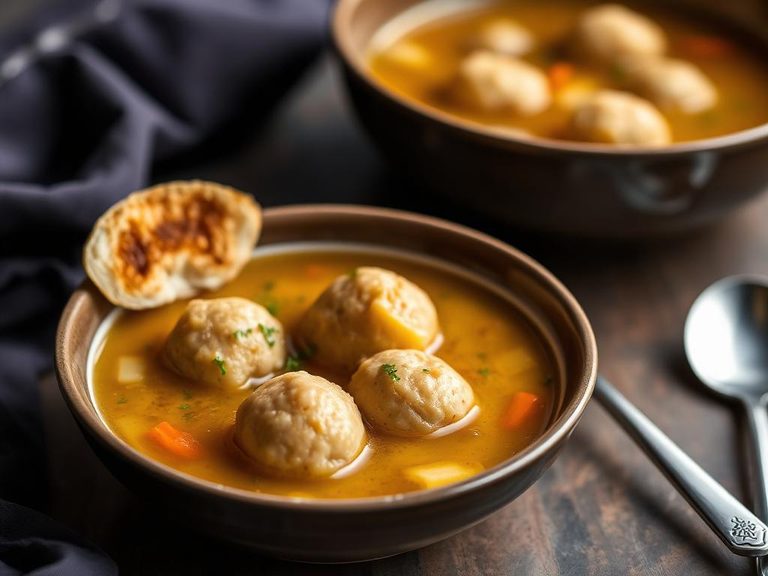
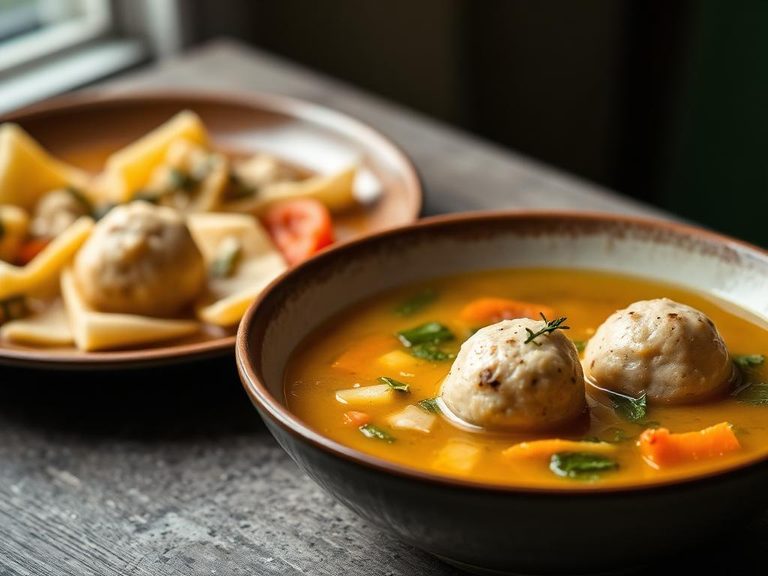
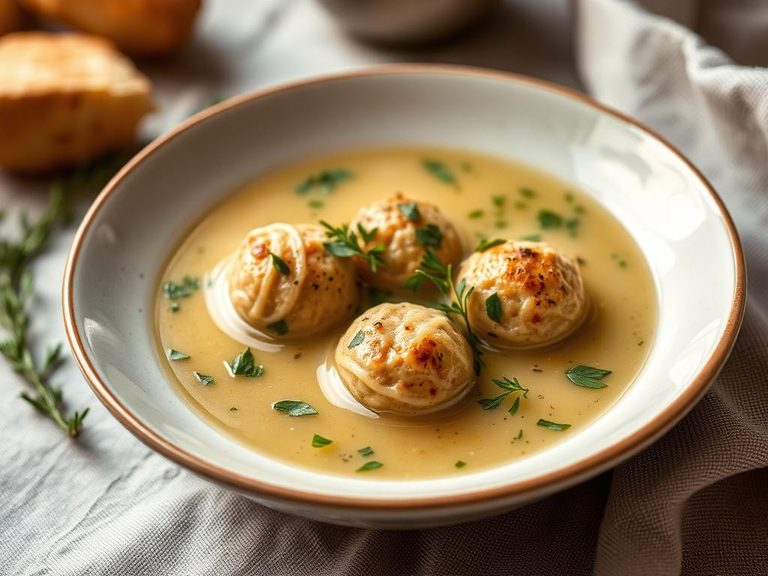
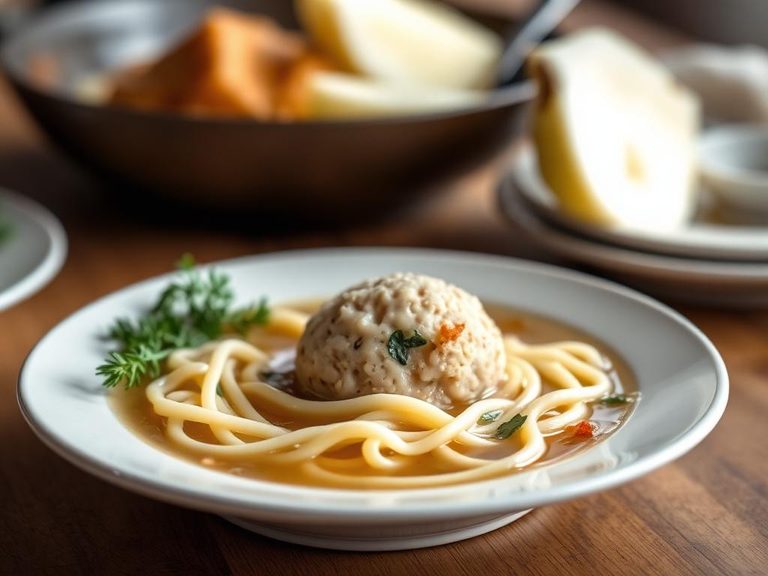
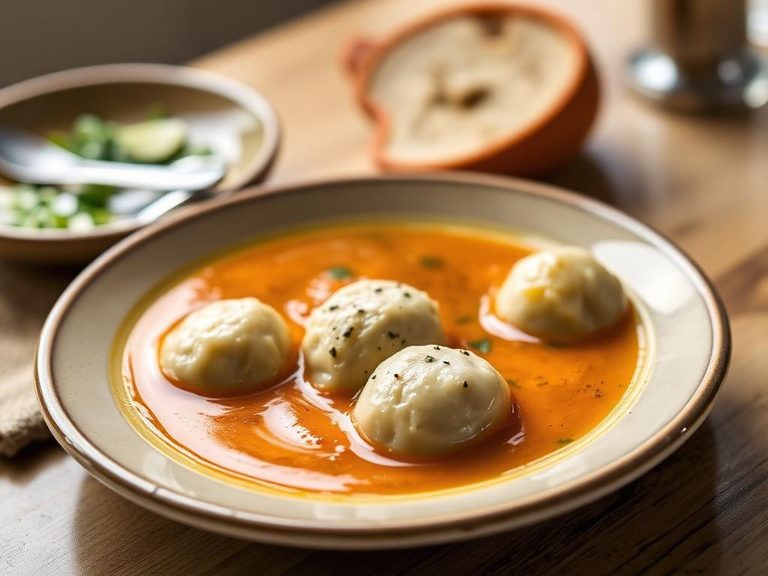
Matzo ball soup is a comforting, golden broth featuring tender, dumplings made from matzo meal, eggs, and fat. The matzo balls themselves are light and spongy, designed to soak up the savory chicken broth, while the soup is typically seasoned with dill and carrots. With only 73 kcal per 100g, it's a low-calorie, light meal that provides a modest amount of protein and carbohydrates.
Calorie split: 17% protein · 59% carbs · 24% fat
↓ Full nutrition💚 Why it's loved
People love it for its comforting, savory flavor and the satisfying texture of the matzo balls, which act like sponges for the rich broth. It's a cultural staple, especially in Jewish cuisine, often associated with holidays, family gatherings, and healing.
⚠️ Watch-outs & how to enjoy it better
The soup can be high in sodium, and the matzo balls are made from refined carbohydrates, which may cause blood sugar spikes. To counteract this, pair it with a side of protein or vegetables, and be mindful of portion sizes, especially if you're watching your sodium or carb intake.
Key benefits
- Low-calorie comfort food (73 kcal/100g)
- Provides quick energy from carbohydrates (10.68g/100g)
- Contains a modest amount of protein (3.09g/100g)
- Hydrating and easy to digest
- Traditional source of comfort and cultural connection
🍽️ Popular dishes
🌍 Where it's eaten
💡 Did you know?
The texture of matzo balls can be controlled by the amount of fat used; more fat makes them lighter and fluffier, while less fat makes them denser.
Full nutrition (USDA data · scales with serving)
| Water | 83.3 g |
| Energy | 73.0 kcal |
| Protein | 3.1 g |
| Total lipid (fat) | 2.0 g |
| Carbohydrate, by difference | 10.7 g |
| Fiber, total dietary | 0.90 g |
| Total Sugars | 1.1 g |
| Calcium, Ca | 19.0 mg |
| Iron, Fe | 0.60 mg |
| Magnesium, Mg | 8.0 mg |
| Phosphorus, P | 44.0 mg |
| Potassium, K | 88.0 mg |
| Sodium, Na | 264 mg |
| Zinc, Zn | 0.30 mg |
| Copper, Cu | 0.02 mg |
| Selenium, Se | 8.4 ug |
| Vitamin C, total ascorbic acid | 1.4 mg |
| Thiamin | 0.06 mg |
| Riboflavin | 0.10 mg |
| Niacin | 0.51 mg |
| Vitamin B-6 | 0.05 mg |
| Folate, total | 19.0 ug |
| Folic acid | 0.00 ug |
| Folate, food | 19.0 ug |
| Folate, DFE | 19.0 ug |
| Choline, total | 52.7 mg |
| Vitamin B-12 | 0.15 ug |
| Vitamin B-12, added | 0.00 ug |
| Vitamin A, RAE | 79.0 ug |
| Retinol | 27.0 ug |
| Carotene, beta | 525 ug |
| Carotene, alpha | 213 ug |
| Cryptoxanthin, beta | 2.0 ug |
| Lycopene | 0.00 ug |
| Lutein + zeaxanthin | 111 ug |
| Vitamin E (alpha-tocopherol) | 0.28 mg |
| Vitamin E, added | 0.00 mg |
| Vitamin D (D2 + D3) | 0.40 ug |
| Vitamin K (phylloquinone) | 3.2 ug |
| Alcohol, ethyl | 0.00 g |
| Caffeine | 0.00 mg |
| Theobromine | 0.00 mg |
Fat & fatty acid profile (per 100g)
| Fatty acids, total saturated | 0.55 g |
| SFA 4:0 | 0.00 g |
| SFA 6:0 | 0.00 g |
| SFA 8:0 | 0.00 g |
| SFA 10:0 | 0.00 g |
| SFA 12:0 | 0.00 g |
| SFA 14:0 | 0.01 g |
| SFA 16:0 | 0.40 g |
| SFA 18:0 | 0.13 g |
| Fatty acids, total monounsaturated | 0.68 g |
| MUFA 16:1 | 0.04 g |
| MUFA 18:1 | 0.64 g |
| MUFA 20:1 | 0.00 g |
| MUFA 22:1 | 0.00 g |
| Fatty acids, total polyunsaturated | 0.46 g |
| PUFA 18:2 | 0.39 g |
| PUFA 18:3 | 0.02 g |
| PUFA 18:4 | 0.00 g |
| PUFA 20:4 | 0.00 g |
| PUFA 20:5 n-3 (EPA) | 0.00 g |
| PUFA 22:5 n-3 (DPA) | 0.00 g |
| PUFA 22:6 n-3 (DHA) | 0.00 g |
| Cholesterol | 61.0 mg |
Amino acid profile (per 100g)
Estimated from Restaurant, Latino, black bean soup — USDA does not publish this profile for Soup.
| Tryptophan | 0.04 g |
| Threonine | 0.17 g |
| Isoleucine | 0.16 g |
| Leucine | 0.32 g |
| Lysine | 0.27 g |
| Methionine | 0.10 g |
| Cystine | 0.04 g |
| Phenylalanine | 0.16 g |
| Tyrosine | 0.13 g |
| Valine | 0.20 g |
| Arginine | 0.35 g |
| Histidine | 0.09 g |
| Alanine | 0.35 g |
| Aspartic acid | 0.38 g |
| Glutamic acid | 0.72 g |
| Glycine | 0.58 g |
| Proline | 0.36 g |
| Serine | 0.20 g |
FAQ
What are matzo balls made of?
Matzo balls are typically made from matzo meal, eggs, fat (like schmaltz or oil), and a liquid like water or broth.
Is matzo ball soup healthy?
It's a low-calorie, light meal, but it can be high in sodium and refined carbs. Pairing it with vegetables and protein can make it more balanced.
Can I make matzo balls gluten-free?
Traditional matzo balls are made with matzo meal, which is not gluten-free. However, you can use gluten-free matzo meal or other gluten-free flours as a substitute.
Nutrient density (calculated · NRF9.3)
Nutrient Rich Foods index: beneficial nutrients (protein, fiber, vitamins, minerals) minus saturated fat, added sugar & sodium, per 100 kcal.
NRF9.3 index — Fulgoni, Keast & Drewnowski, 2009. Computed from USDA nutrients.
Weight-loss friendliness (composite index)
Energy density 0.73 kcal/g · 17% calories from protein · 0.9 g fiber · 1.1 g sugar per 100 g.
Composite of energy density (Rolls et al., 1999), protein & fiber satiety, minus sugar. A calculated heuristic — ranks satiety-per-calorie, not a clinical measure.
Dietary load (calculated from USDA values)
Potential renal acid load. Positive = acid-forming, negative = alkaline-forming.
Sodium-to-potassium ratio: 3.00 (lower is better — aim for ≤ 1)
Sodium:potassium per WHO potassium guidance. Computed from USDA nutrients.