

Crackers, matzo
Common food
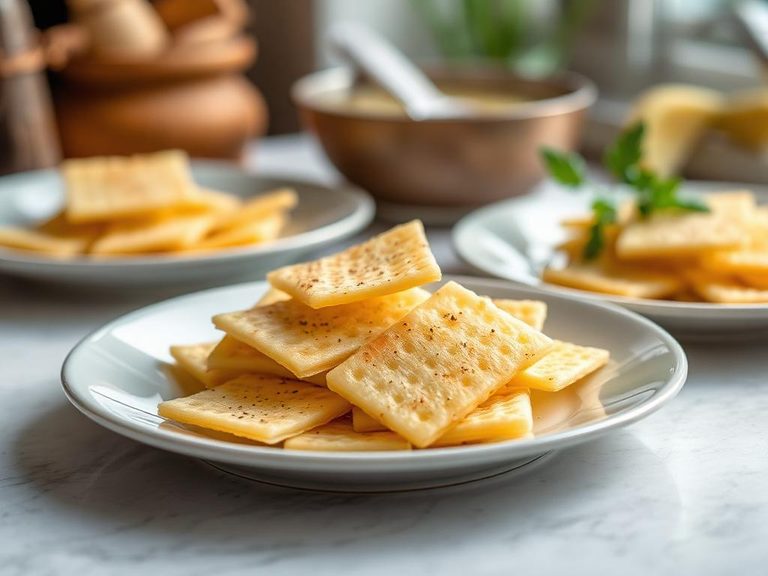
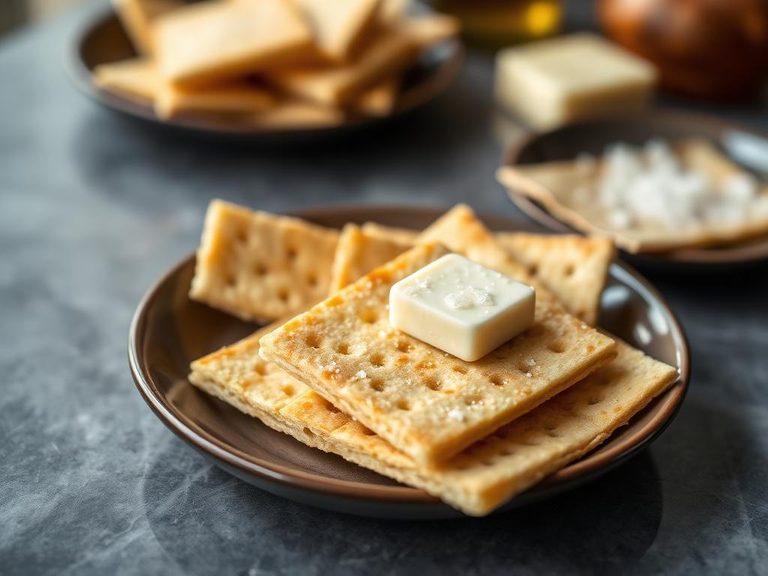
Matzo crackers are thin, unleavened flatbreads with a crisp, dry texture and a mild, toasty flavor. They are nutritionally dense in carbohydrates, providing a quick source of energy with very little fat. Their simple composition makes them a staple for specific cultural and religious observances.
Calorie split: 10% protein · 86% carbs · 3% fat
↓ Full nutrition💚 Why it's loved
People love matzo for its satisfying crunch and its deep cultural significance, especially during Passover, where it serves as a poignant reminder of history. Its neutral flavor makes it an incredibly versatile canvas for both sweet and savory toppings.
⚠️ Watch-outs & how to enjoy it better
Its high carbohydrate and low fiber/protein content can lead to rapid blood-sugar spikes if eaten alone. It is also a common wheat allergen and can be very dry, potentially causing discomfort if not eaten with a beverage. To counteract this, always pair matzo with a protein or fat source like hummus, cheese, or egg salad, and drink plenty of water.
Key benefits
- Provides a concentrated source of quick energy from complex carbohydrates.
- Very low in fat, making it a light, non-greasy snack option.
- Contains minimal sugar, avoiding the sweetness of many processed crackers.
- Its dry, crisp texture is ideal for holding dips and spreads without becoming soggy quickly.
🍽️ Popular dishes
🌍 Where it's eaten
💡 Did you know?
During Passover, strict observers use specially produced 'shmurah' matzo, where the wheat has been guarded from the time of harvest to prevent any fermentation.
Full nutrition (USDA data · scales with serving)
| Water | 4.3 g |
| Energy | 395 kcal |
| Protein | 10.0 g |
| Total lipid (fat) | 1.4 g |
| Carbohydrate, by difference | 83.7 g |
| Fiber, total dietary | 3.0 g |
| Total Sugars | 0.29 g |
| Calcium, Ca | 13.0 mg |
| Iron, Fe | 3.2 mg |
| Magnesium, Mg | 25.0 mg |
| Phosphorus, P | 89.0 mg |
| Potassium, K | 112 mg |
| Sodium, Na | 0.00 mg |
| Zinc, Zn | 0.68 mg |
| Copper, Cu | 0.06 mg |
| Selenium, Se | 36.9 ug |
| Vitamin C, total ascorbic acid | 0.00 mg |
| Thiamin | 0.39 mg |
| Riboflavin | 0.29 mg |
| Niacin | 3.9 mg |
| Vitamin B-6 | 0.12 mg |
| Folate, total | 17.0 ug |
| Folic acid | 0.00 ug |
| Folate, food | 17.0 ug |
| Folate, DFE | 17.0 ug |
| Choline, total | 10.8 mg |
| Vitamin B-12 | 0.00 ug |
| Vitamin B-12, added | 0.00 ug |
| Vitamin A, RAE | 0.00 ug |
| Retinol | 0.00 ug |
| Carotene, beta | 0.00 ug |
| Carotene, alpha | 0.00 ug |
| Cryptoxanthin, beta | 0.00 ug |
| Lycopene | 0.00 ug |
| Lutein + zeaxanthin | 18.0 ug |
| Vitamin E (alpha-tocopherol) | 0.06 mg |
| Vitamin E, added | 0.00 mg |
| Vitamin D (D2 + D3) | 0.00 ug |
| Vitamin K (phylloquinone) | 0.30 ug |
| Alcohol, ethyl | 0.00 g |
| Caffeine | 0.00 mg |
| Theobromine | 0.00 mg |
Fat & fatty acid profile (per 100g)
| Fatty acids, total saturated | 0.23 g |
| SFA 4:0 | 0.00 g |
| SFA 6:0 | 0.00 g |
| SFA 8:0 | 0.00 g |
| SFA 10:0 | 0.00 g |
| SFA 12:0 | 0.00 g |
| SFA 14:0 | 0.00 g |
| SFA 16:0 | 0.22 g |
| SFA 18:0 | 0.01 g |
| Fatty acids, total monounsaturated | 0.13 g |
| MUFA 16:1 | 0.00 g |
| MUFA 18:1 | 0.13 g |
| MUFA 20:1 | 0.00 g |
| MUFA 22:1 | 0.00 g |
| Fatty acids, total polyunsaturated | 0.60 g |
| PUFA 18:2 | 0.57 g |
| PUFA 18:3 | 0.03 g |
| PUFA 18:4 | 0.00 g |
| PUFA 20:4 | 0.00 g |
| PUFA 20:5 n-3 (EPA) | 0.00 g |
| PUFA 22:5 n-3 (DPA) | 0.00 g |
| PUFA 22:6 n-3 (DHA) | 0.00 g |
| Cholesterol | 0.00 mg |
Amino acid profile (per 100g)
Estimated from Crackers, cheese, sandwich-type with cheese filling — USDA does not publish this profile for Crackers.
| Tryptophan | 0.11 g |
| Threonine | 0.33 g |
| Isoleucine | 0.36 g |
| Leucine | 0.64 g |
| Lysine | 0.39 g |
| Methionine | 0.15 g |
| Cystine | 0.15 g |
| Phenylalanine | 0.35 g |
| Tyrosine | 0.25 g |
| Valine | 0.38 g |
| Arginine | 0.29 g |
| Histidine | 0.17 g |
| Alanine | 0.30 g |
| Aspartic acid | 0.52 g |
| Glutamic acid | 2.2 g |
| Glycine | 0.24 g |
| Proline | 0.77 g |
| Serine | 0.40 g |
FAQ
What is the difference between matzo and regular crackers?
Matzo is an unleavened flatbread made from flour and water only, baked quickly before dough can rise. Regular crackers often contain leavening agents, oil, salt, and other seasonings, resulting in a different texture and flavor profile.
Can I use matzo for savory dishes beyond Passover?
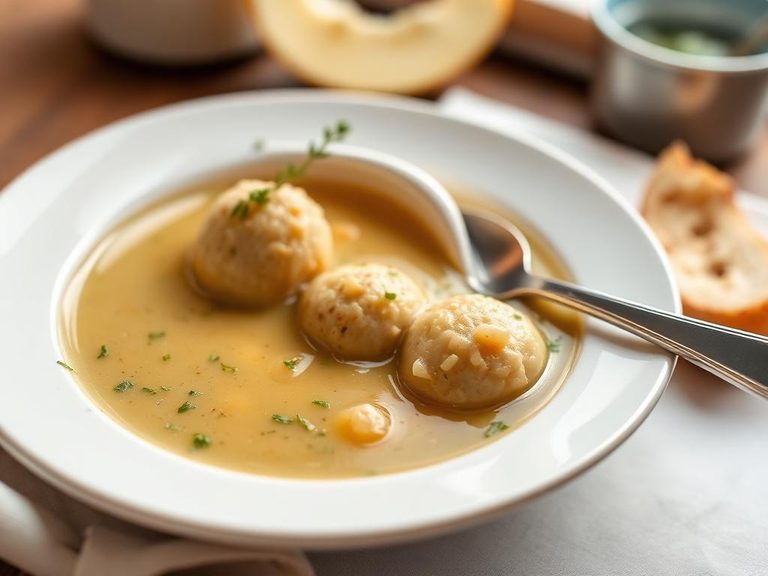
Absolutely. Matzo meal and whole sheets are used year-round in recipes like matzo ball soup, as a binder in meatballs, or crushed as a coating for fried foods, providing a distinct, crisp texture.
Why is matzo so dry and hard?
The dryness is a result of the baking process, which is intentionally fast and at high heat to prevent leavening. This removes moisture and creates the characteristic crisp, brittle texture that allows it to be stored for long periods.
Nutrient density (calculated · NRF9.3)
Nutrient Rich Foods index: beneficial nutrients (protein, fiber, vitamins, minerals) minus saturated fat, added sugar & sodium, per 100 kcal.
NRF9.3 index — Fulgoni, Keast & Drewnowski, 2009. Computed from USDA nutrients.
Weight-loss friendliness (composite index)
Energy density 3.95 kcal/g · 10% calories from protein · 3.0 g fiber · 0.3 g sugar per 100 g.
Composite of energy density (Rolls et al., 1999), protein & fiber satiety, minus sugar. A calculated heuristic — ranks satiety-per-calorie, not a clinical measure.
Dietary load (calculated from USDA values)
Potential renal acid load. Positive = acid-forming, negative = alkaline-forming.
Sodium-to-potassium ratio: 0.00 (lower is better — aim for ≤ 1)
Sodium:potassium per WHO potassium guidance. Computed from USDA nutrients.