

Crackers, matzo, egg
Whole food · Baked Products
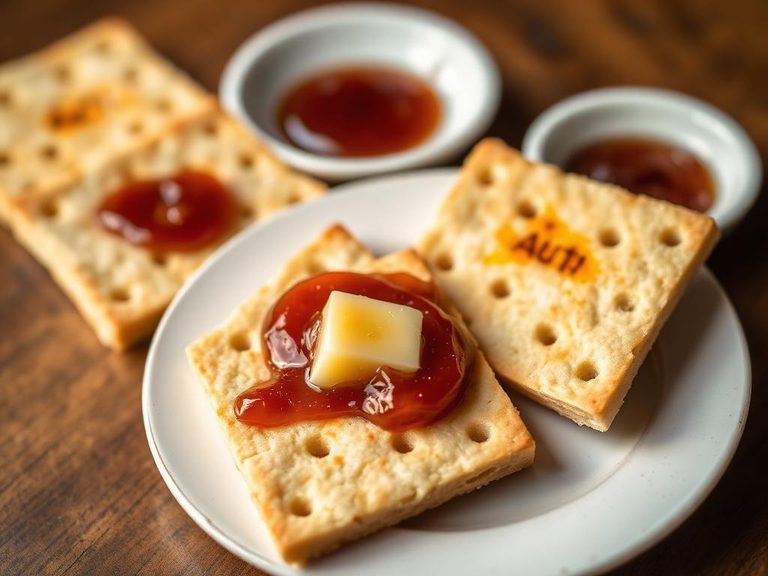
Egg matzo is a crisp, unleavened cracker made with wheat flour and egg, yielding a richer flavor and a more tender, flaky texture than standard matzo. Its golden hue and slightly sweet, toasty notes make it a versatile base for both savory and sweet toppings. Nutritionally, it is a high-carbohydrate, low-fat food that provides a solid source of plant-based protein and dietary fiber.
Calorie split: 13% protein · 82% carbs · 5% fat
↓ Full nutrition💚 Why it's loved
People love it for its satisfying crunch and subtle, toasty flavor that complements a wide range of spreads and toppings. Its cultural significance during Passover and its everyday appeal as a snack make it a beloved staple in many households.
⚠️ Watch-outs & how to enjoy it better
As a high-carbohydrate food, it can cause rapid blood-sugar spikes if eaten alone, especially for those with insulin sensitivity. To counteract this, pair it with protein-rich or fatty foods like hummus, cheese, or avocado, and practice portion control by sticking to a single serving.
Key benefits
- High in complex carbohydrates for sustained energy
- Good source of plant-based protein
- Provides dietary fiber for digestive health
- Low in fat and contains no sugar
- Versatile base for a variety of toppings
🍽️ Popular dishes

🌍 Where it's eaten
💡 Did you know?
The word 'matzo' comes from the Hebrew word for 'unleavened bread,' and during Passover, it is traditionally baked in under 18 minutes to prevent any fermentation.
Full nutrition (USDA data · scales with serving)
| Water | 6.4 g |
| Energy | 391 kcal |
| Energy | 1636 kj |
| Protein | 12.3 g |
| Total lipid (fat) | 2.1 g |
| Ash | 0.60 g |
| Carbohydrate, by difference | 78.6 g |
| Fiber, total dietary | 2.8 g |
| Calcium, Ca | 40.0 mg |
| Iron, Fe | 2.7 mg |
| Magnesium, Mg | 24.0 mg |
| Phosphorus, P | 148 mg |
| Potassium, K | 150 mg |
| Sodium, Na | 21.0 mg |
| Zinc, Zn | 0.73 mg |
| Copper, Cu | 0.15 mg |
| Manganese, Mn | 0.60 mg |
| Selenium, Se | 27.7 ug |
| Vitamin C, total ascorbic acid | 0.10 mg |
| Thiamin | 0.79 mg |
| Riboflavin | 0.62 mg |
| Niacin | 5.1 mg |
| Pantothenic acid | 0.43 mg |
| Vitamin B-6 | 0.05 mg |
| Folate, total | 24.0 ug |
| Folic acid | 0.00 ug |
| Folate, food | 24.0 ug |
| Folate, DFE | 24.0 ug |
| Vitamin B-12 | 0.19 ug |
| Vitamin A, RAE | 13.0 ug |
| Retinol | 13.0 ug |
| Vitamin A, IU | 42.0 iu |
Fat & fatty acid profile (per 100g)
| Fatty acids, total saturated | 0.55 g |
| SFA 8:0 | 0.00 g |
| SFA 10:0 | 0.00 g |
| SFA 12:0 | 0.00 g |
| SFA 14:0 | 0.01 g |
| SFA 16:0 | 0.42 g |
| SFA 18:0 | 0.12 g |
| Fatty acids, total monounsaturated | 0.61 g |
| MUFA 16:1 | 0.04 g |
| MUFA 18:1 | 0.56 g |
| MUFA 20:1 | 0.00 g |
| MUFA 22:1 | 0.00 g |
| Fatty acids, total polyunsaturated | 0.47 g |
| PUFA 18:2 | 0.43 g |
| PUFA 18:3 | 0.02 g |
| PUFA 20:4 | 0.02 g |
| PUFA 20:5 n-3 (EPA) | 0.00 g |
| PUFA 22:6 n-3 (DHA) | 0.01 g |
| Cholesterol | 83.0 mg |
Amino acid profile (per 100g)
| Tryptophan | 0.15 g |
| Threonine | 0.38 g |
| Isoleucine | 0.47 g |
| Leucine | 0.89 g |
| Lysine | 0.39 g |
| Methionine | 0.25 g |
| Cystine | 0.27 g |
| Phenylalanine | 0.62 g |
| Tyrosine | 0.40 g |
| Valine | 0.54 g |
| Arginine | 0.54 g |
| Histidine | 0.28 g |
| Alanine | 0.45 g |
| Aspartic acid | 0.66 g |
| Glutamic acid | 3.7 g |
| Glycine | 0.44 g |
| Proline | 1.3 g |
| Serine | 0.67 g |
FAQ
What is the difference between egg matzo and regular matzo?
Egg matzo contains eggs, which give it a richer flavor, a more tender texture, and a slightly higher protein content compared to regular matzo, which is made only from flour and water.
Is egg matzo suitable for people with gluten intolerance?
No, egg matzo is made from wheat flour and contains gluten. It is not suitable for individuals with celiac disease or gluten sensitivity.
How should egg matzo be stored to maintain freshness?
Store egg matzo in an airtight container at room temperature to keep it crisp. It can also be frozen for longer storage, but it may lose some of its texture upon thawing.
Nutrient density (calculated · NRF9.3)
Nutrient Rich Foods index: beneficial nutrients (protein, fiber, vitamins, minerals) minus saturated fat, added sugar & sodium, per 100 kcal.
NRF9.3 index — Fulgoni, Keast & Drewnowski, 2009. Computed from USDA nutrients.
Weight-loss friendliness (composite index)
Energy density 3.91 kcal/g · 13% calories from protein · 2.8 g fiber · 0.0 g sugar per 100 g.
Composite of energy density (Rolls et al., 1999), protein & fiber satiety, minus sugar. A calculated heuristic — ranks satiety-per-calorie, not a clinical measure.
Dietary load (calculated from USDA values)
Potential renal acid load. Positive = acid-forming, negative = alkaline-forming.
Sodium-to-potassium ratio: 0.14 (lower is better — aim for ≤ 1)
Sodium:potassium per WHO potassium guidance. Computed from USDA nutrients.