

Soup, broccoli cheese, canned, condensed, commercial
Whole food · Soups, Sauces, and Gravies
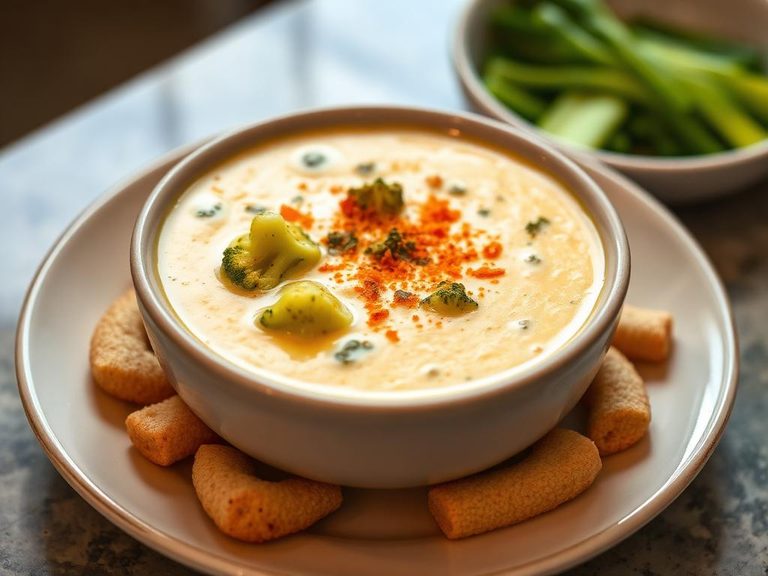
This is a smooth, velvety condensed soup made from pureed broccoli and processed cheese, designed to be diluted with water or milk before heating. Its flavor is a mild, savory blend of earthy broccoli and salty, creamy cheddar, with a thick, spoon-coating texture. Nutritionally, it's a relatively low-calorie option at 87 kcal per 100g, offering a modest protein boost and a good source of fiber.
Calorie split: 10% protein · 35% carbs · 55% fat
↓ Full nutrition💚 Why it's loved
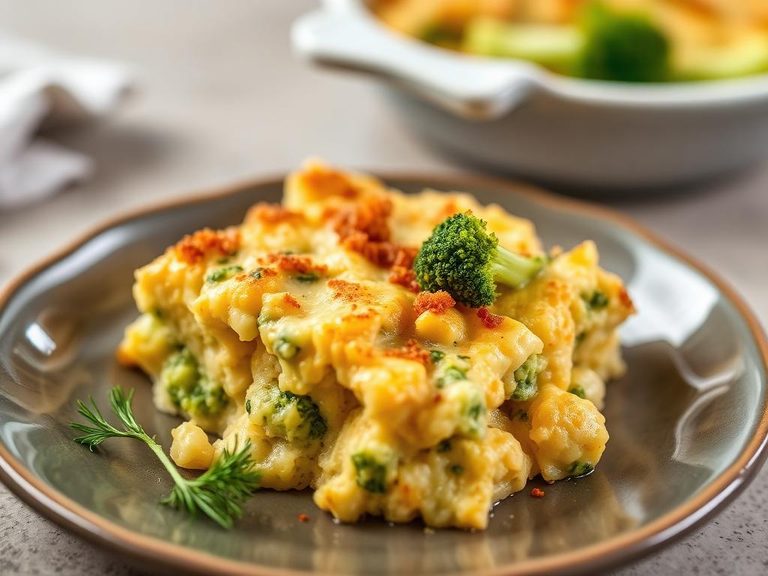
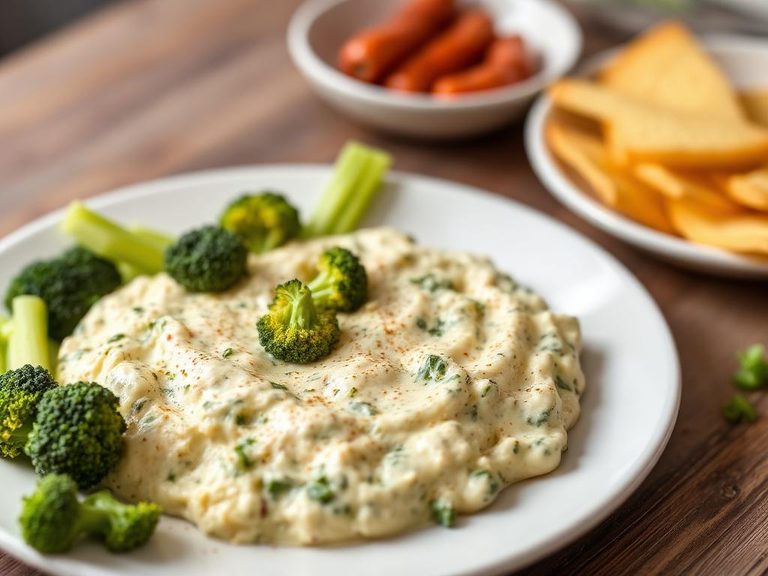
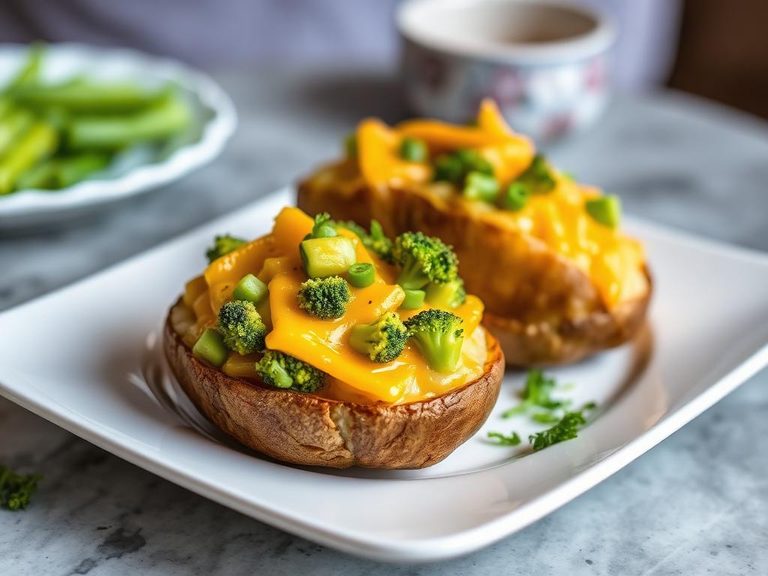
People love it for its comforting, nostalgic flavor and the sheer convenience of a ready-to-heat, creamy meal. Its versatility is a major draw, as it serves as a quick lunch, a base for casseroles, or a dipping sauce for pretzels and vegetables.
⚠️ Watch-outs & how to enjoy it better
The condensed, commercial version is often high in sodium, which can be a concern for those monitoring blood pressure. To counteract this, dilute it with low-sodium milk or water, and pair it with a low-sodium protein like grilled chicken or a side salad. The processed cheese can also be a source of saturated fat, so practicing portion control (e.g., using it as a sauce rather than a main dish) is wise.
Key benefits
- Provides a convenient source of vegetable-based fiber (1.8g per 100g).
- Offers a modest protein content (2.1g per 100g) from cheese and broccoli.
- Low in calories (87 kcal per 100g) for a creamy, satisfying soup.
- Quick and easy to prepare as a base or standalone meal.
- Contains calcium from the cheese component.
🍽️ Popular dishes
🌍 Where it's eaten
💡 Did you know?
The first canned broccoli cheese soup was popularized in the 1950s by the Campbell Soup Company, coinciding with the rise of convenience foods in post-war America.
Full nutrition (USDA data · scales with serving)
| Water | 82.7 g |
| Energy | 87.0 kcal |
| Energy | 364 kj |
| Protein | 2.1 g |
| Total lipid (fat) | 5.3 g |
| Ash | 2.3 g |
| Carbohydrate, by difference | 7.7 g |
| Fiber, total dietary | 1.8 g |
| Total Sugars | 2.1 g |
| Calcium, Ca | 41.0 mg |
| Iron, Fe | 0.30 mg |
| Magnesium, Mg | 13.0 mg |
| Phosphorus, P | 42.0 mg |
| Potassium, K | 207 mg |
| Sodium, Na | 661 mg |
| Zinc, Zn | 0.26 mg |
| Copper, Cu | 0.03 mg |
| Selenium, Se | 1.5 ug |
| Vitamin C, total ascorbic acid | 2.0 mg |
| Thiamin | 0.02 mg |
| Riboflavin | 0.04 mg |
| Niacin | 0.25 mg |
| Vitamin B-6 | 0.06 mg |
| Folate, total | 40.0 ug |
| Folic acid | 0.00 ug |
| Folate, food | 40.0 ug |
| Folate, DFE | 40.0 ug |
| Choline, total | 18.4 mg |
| Vitamin B-12 | 0.02 ug |
| Vitamin B-12, added | 0.00 ug |
| Vitamin A, RAE | 66.0 ug |
| Retinol | 30.0 ug |
| Carotene, beta | 435 ug |
| Carotene, alpha | 0.00 ug |
| Cryptoxanthin, beta | 0.00 ug |
| Vitamin A, IU | 825 iu |
| Lycopene | 0.00 ug |
| Lutein + zeaxanthin | 540 ug |
| Vitamin E (alpha-tocopherol) | 0.72 mg |
| Vitamin E, added | 0.00 mg |
| Vitamin D (D2 + D3), International Units | 0.00 iu |
| Vitamin D (D2 + D3) | 0.00 ug |
| Vitamin K (phylloquinone) | 51.8 ug |
| Alcohol, ethyl | 0.00 g |
| Caffeine | 0.00 mg |
| Theobromine | 0.00 mg |
Fat & fatty acid profile (per 100g)
| Fatty acids, total saturated | 1.6 g |
| SFA 4:0 | 0.02 g |
| SFA 6:0 | 0.01 g |
| SFA 8:0 | 0.00 g |
| SFA 10:0 | 0.01 g |
| SFA 12:0 | 0.01 g |
| SFA 14:0 | 0.06 g |
| SFA 16:0 | 0.97 g |
| SFA 18:0 | 0.51 g |
| Fatty acids, total monounsaturated | 2.0 g |
| MUFA 16:1 | 0.02 g |
| MUFA 18:1 | 2.0 g |
| MUFA 20:1 | 0.00 g |
| MUFA 22:1 | 0.00 g |
| Fatty acids, total polyunsaturated | 1.7 g |
| PUFA 18:2 | 1.5 g |
| PUFA 18:3 | 0.17 g |
| PUFA 18:4 | 0.00 g |
| PUFA 20:4 | 0.00 g |
| PUFA 20:5 n-3 (EPA) | 0.00 g |
| PUFA 22:5 n-3 (DPA) | 0.00 g |
| PUFA 22:6 n-3 (DHA) | 0.00 g |
| Cholesterol | 4.0 mg |
Amino acid profile (per 100g)
Estimated from Soup, bean with pork, canned, condensed — USDA does not publish this profile for Soup.
| Tryptophan | 0.06 g |
| Threonine | 0.24 g |
| Isoleucine | 0.29 g |
| Leucine | 0.48 g |
| Lysine | 0.40 g |
| Methionine | 0.07 g |
| Cystine | 0.07 g |
| Phenylalanine | 0.33 g |
| Tyrosine | 0.18 g |
| Valine | 0.32 g |
| Arginine | 0.31 g |
| Histidine | 0.15 g |
| Alanine | 0.29 g |
| Aspartic acid | 0.66 g |
| Glutamic acid | 1.1 g |
| Glycine | 0.28 g |
| Proline | 0.27 g |
| Serine | 0.29 g |
FAQ
How do I prepare canned condensed broccoli cheese soup?
Empty the contents of the can into a saucepan. Stir in one can of water or milk (for a creamier texture) and heat over medium heat, stirring occasionally, until hot. Do not boil.
Is this soup gluten-free?
Not typically. Commercial condensed broccoli cheese soups often contain wheat flour as a thickener. Always check the ingredient list for gluten-containing additives.
Can I use this as a sauce for pasta or vegetables?
Yes, it works well as a sauce. For pasta, you may want to thin it slightly with milk or pasta water. For vegetables, it can be used as a topping for steamed broccoli, cauliflower, or potatoes.
How does the nutritional profile change when diluted with milk vs. water?
Diluting with milk adds extra calories, protein, and calcium, making the soup richer and more nutritious. Diluting with water keeps the calorie count lower but results in a thinner, less creamy texture.
Nutrient density (calculated · NRF9.3)
Nutrient Rich Foods index: beneficial nutrients (protein, fiber, vitamins, minerals) minus saturated fat, added sugar & sodium, per 100 kcal.
NRF9.3 index — Fulgoni, Keast & Drewnowski, 2009. Computed from USDA nutrients.
Weight-loss friendliness (composite index)
Energy density 0.87 kcal/g · 10% calories from protein · 1.8 g fiber · 2.1 g sugar per 100 g.
Composite of energy density (Rolls et al., 1999), protein & fiber satiety, minus sugar. A calculated heuristic — ranks satiety-per-calorie, not a clinical measure.
Dietary load (calculated from USDA values)
Potential renal acid load. Positive = acid-forming, negative = alkaline-forming.
Sodium-to-potassium ratio: 3.19 (lower is better — aim for ≤ 1)
Sodium:potassium per WHO potassium guidance. Computed from USDA nutrients.