

Snacks, granola bars, hard, plain
Whole food · Snacks
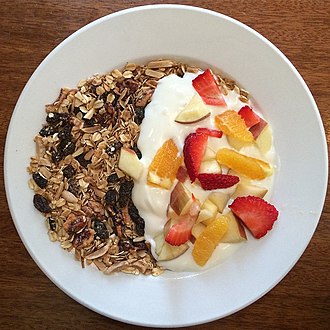
Photo: Wikipedia
A hard, crunchy granola bar is a dense, baked snack made primarily from oats, sweeteners, and fats, offering a satisfying, toothsome chew. Its flavor profile is typically sweet and malty, with a straightforward, non-fussy taste. Nutritionally, it's a calorie-dense source of quick energy, with carbohydrates making up the majority of its content.
Calorie split: 8% protein · 54% carbs · 37% fat
↓ Full nutrition💚 Why it's loved
People appreciate its reliable, no-mess convenience and the satisfying, hearty crunch that makes it a perfect on-the-go snack or quick breakfast filler. Its simple, sweet oat flavor is a nostalgic comfort for many.
⚠️ Watch-outs & how to enjoy it better
The high sugar content (nearly 29g per 100g) can lead to a rapid blood sugar spike followed by a crash, and the dense, dry texture can be a choking hazard if eaten too quickly. To counteract this, pair a half-bar with a source of protein or fat like Greek yogurt or a handful of nuts to slow sugar absorption, and always chew thoroughly.
Key benefits
- Provides a quick source of energy from carbohydrates
- Offers some dietary fiber from oats
- Convenient, portable, and shelf-stable snack
- Contains a moderate amount of plant-based protein
- Can serve as a simple, calorie-dense fuel for activities
🍽️ Popular dishes

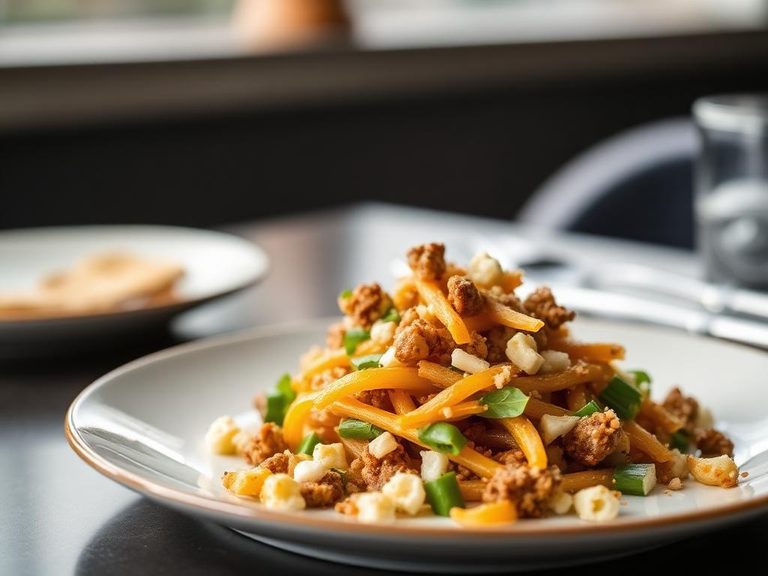
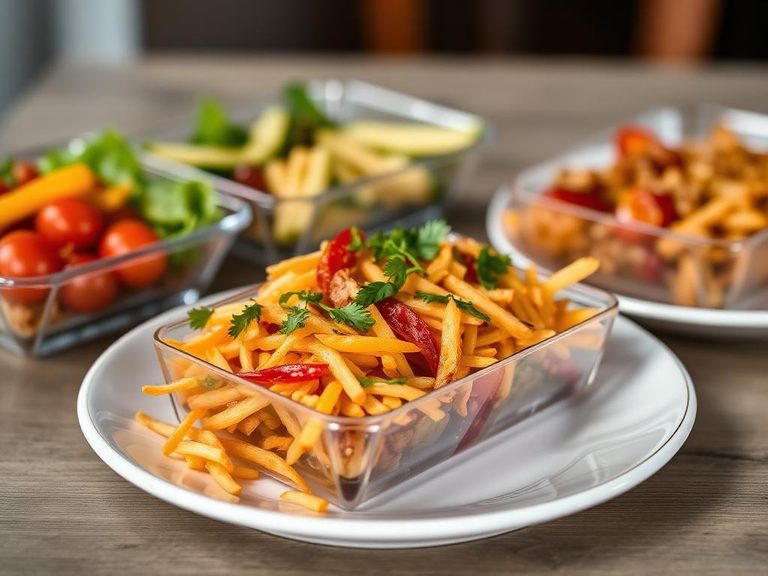
🌍 Where it's eaten
💡 Did you know?
The modern, mass-produced granola bar was essentially invented in 1975 by General Mills as a way to use up broken pieces of their Nature Valley granola cereal.
Full nutrition (USDA data · scales with serving)
| Water | 3.9 g |
| Energy | 471 kcal |
| Energy | 1972 kj |
| Protein | 10.1 g |
| Total lipid (fat) | 19.8 g |
| Ash | 1.9 g |
| Carbohydrate, by difference | 64.4 g |
| Fiber, total dietary | 5.3 g |
| Total Sugars | 28.6 g |
| Calcium, Ca | 61.0 mg |
| Iron, Fe | 3.0 mg |
| Magnesium, Mg | 97.0 mg |
| Phosphorus, P | 277 mg |
| Potassium, K | 336 mg |
| Sodium, Na | 294 mg |
| Zinc, Zn | 2.0 mg |
| Copper, Cu | 0.39 mg |
| Manganese, Mn | 1.8 mg |
| Selenium, Se | 16.2 ug |
| Vitamin C, total ascorbic acid | 0.90 mg |
| Thiamin | 0.26 mg |
| Riboflavin | 0.12 mg |
| Niacin | 1.6 mg |
| Pantothenic acid | 0.81 mg |
| Vitamin B-6 | 0.09 mg |
| Folate, total | 23.0 ug |
| Folic acid | 0.00 ug |
| Folate, food | 23.0 ug |
| Folate, DFE | 23.0 ug |
| Choline, total | 22.0 mg |
| Betaine | 6.9 mg |
| Vitamin B-12 | 0.00 ug |
| Vitamin B-12, added | 0.00 ug |
| Vitamin A, RAE | 2.0 ug |
| Retinol | 0.00 ug |
| Carotene, beta | 17.0 ug |
| Carotene, alpha | 6.0 ug |
| Cryptoxanthin, beta | 0.00 ug |
| Vitamin A, IU | 33.0 iu |
| Lycopene | 0.00 ug |
| Lutein + zeaxanthin | 189 ug |
| Vitamin E (alpha-tocopherol) | 2.1 mg |
| Vitamin E, added | 0.00 mg |
| Vitamin D (D2 + D3), International Units | 0.00 iu |
| Vitamin D (D2 + D3) | 0.00 ug |
| Vitamin K (phylloquinone) | 14.6 ug |
| Alcohol, ethyl | 0.00 g |
| Caffeine | 0.00 mg |
| Theobromine | 0.00 mg |
Fat & fatty acid profile (per 100g)
| Fatty acids, total saturated | 2.4 g |
| SFA 4:0 | 0.00 g |
| SFA 6:0 | 0.00 g |
| SFA 8:0 | 0.00 g |
| SFA 10:0 | 0.00 g |
| SFA 12:0 | 0.01 g |
| SFA 14:0 | 0.01 g |
| SFA 16:0 | 1.5 g |
| SFA 18:0 | 0.76 g |
| Fatty acids, total monounsaturated | 4.4 g |
| MUFA 16:1 | 0.01 g |
| MUFA 18:1 | 4.4 g |
| MUFA 20:1 | 0.13 g |
| MUFA 22:1 | 0.00 g |
| Fatty acids, total polyunsaturated | 12.1 g |
| PUFA 18:2 | 12.0 g |
| PUFA 18:3 | 0.06 g |
| PUFA 18:4 | 0.00 g |
| PUFA 20:4 | 0.00 g |
| PUFA 20:5 n-3 (EPA) | 0.00 g |
| PUFA 22:5 n-3 (DPA) | 0.00 g |
| PUFA 22:6 n-3 (DHA) | 0.00 g |
| Cholesterol | 0.00 mg |
Amino acid profile (per 100g)
| Tryptophan | 0.18 g |
| Threonine | 0.26 g |
| Isoleucine | 0.35 g |
| Leucine | 0.72 g |
| Lysine | 0.40 g |
| Methionine | 0.18 g |
| Cystine | 0.30 g |
| Phenylalanine | 0.48 g |
| Tyrosine | 0.35 g |
| Valine | 0.51 g |
| Arginine | 0.67 g |
| Histidine | 0.22 g |
| Alanine | 0.46 g |
| Aspartic acid | 0.83 g |
| Glutamic acid | 2.0 g |
| Glycine | 0.50 g |
| Proline | 0.52 g |
| Serine | 0.47 g |
FAQ
Why is this type of granola bar so hard and crunchy?
The hard texture comes from a lower moisture content during baking and a higher proportion of dry ingredients like oats and sometimes rice cereal, which are compressed and baked until very crisp and dry.
Is it a good source of fiber?
It contains some fiber (5.3g per 100g), primarily from the oats, but it's not exceptionally high-fiber compared to whole foods. The fiber content can vary by brand.
Can it be part of a healthy diet?
Yes, in moderation. It's best viewed as an occasional energy-dense snack or a convenient fuel source for physical activity, rather than a daily health food, due to its high sugar and calorie density.
Nutrient density (calculated · NRF9.3)
Nutrient Rich Foods index: beneficial nutrients (protein, fiber, vitamins, minerals) minus saturated fat, added sugar & sodium, per 100 kcal.
NRF9.3 index — Fulgoni, Keast & Drewnowski, 2009. Computed from USDA nutrients.
Weight-loss friendliness (composite index)
Energy density 4.71 kcal/g · 9% calories from protein · 5.3 g fiber · 28.6 g sugar per 100 g.
Composite of energy density (Rolls et al., 1999), protein & fiber satiety, minus sugar. A calculated heuristic — ranks satiety-per-calorie, not a clinical measure.
Dietary load (calculated from USDA values)
Potential renal acid load. Positive = acid-forming, negative = alkaline-forming.
Sodium-to-potassium ratio: 0.88 (lower is better — aim for ≤ 1)
Sodium:potassium per WHO potassium guidance. Computed from USDA nutrients.