

Seaweed, raw
Common food

Photo: Wikipedia
Raw seaweed is a thin, translucent marine algae with a crisp, slightly slippery texture and a briny, oceanic flavor that tastes of the sea itself. It is remarkably low in calories while being a powerhouse of minerals, particularly iodine, which is essential for thyroid function. Its delicate, umami-rich profile makes it a unique and refreshing addition to salads and soups.
Calorie split: 28% protein · 63% carbs · 9% fat
↓ Full nutrition💚 Why it's loved
People love it for its clean, savory umami flavor and satisfying crunch, which adds a refreshing oceanic note to dishes. It's also celebrated for its versatility, easily incorporated into salads, wraps, and soups, and its deep cultural significance in many coastal cuisines.
⚠️ Watch-outs & how to enjoy it better
Some find the slimy texture unappealing, and its strong oceanic taste can be overwhelming if not balanced. It can be high in sodium and may contain heavy metals like arsenic if sourced from polluted waters. To counteract, choose reputable brands, rinse thoroughly, and pair with fresh vegetables or a light dressing to balance the saltiness.
Key benefits
- Excellent source of iodine for thyroid health
- Rich in antioxidants like fucoxanthin and vitamin C
- Contains prebiotic fiber to support gut microbiome
- Provides plant-based iron and calcium
- Naturally low in calories and fat
🍽️ Popular dishes
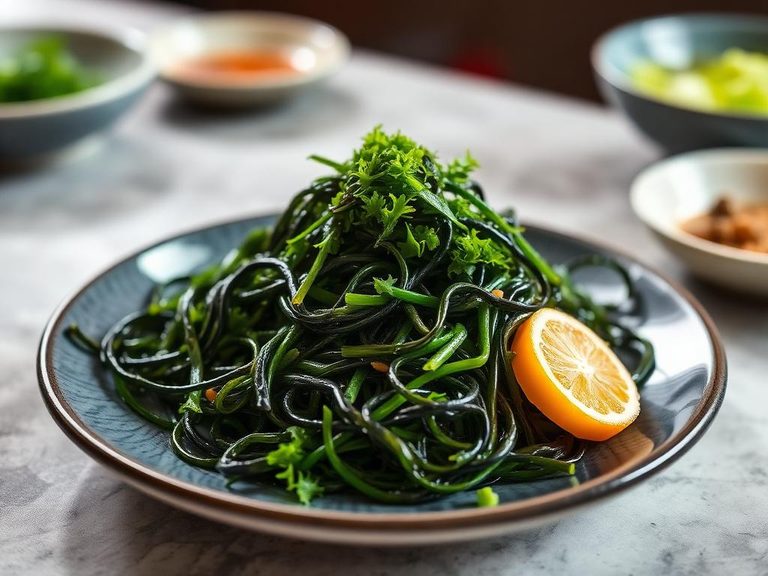

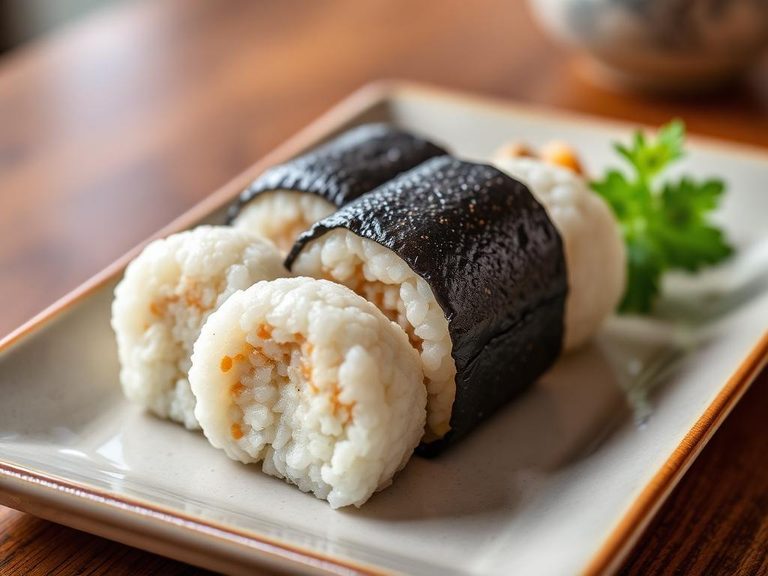


🌍 Where it's eaten
💡 Did you know?
Seaweed can absorb up to 20 times more carbon dioxide than land plants, making it a potential hero in combating climate change.
Full nutrition (USDA data · scales with serving)
| Water | 82.2 g |
| Energy | 41.0 kcal |
| Protein | 3.5 g |
| Total lipid (fat) | 0.49 g |
| Carbohydrate, by difference | 7.9 g |
| Fiber, total dietary | 0.70 g |
| Total Sugars | 0.58 g |
| Calcium, Ca | 129 mg |
| Iron, Fe | 2.3 mg |
| Magnesium, Mg | 77.0 mg |
| Phosphorus, P | 60.0 mg |
| Potassium, K | 165 mg |
| Sodium, Na | 384 mg |
| Zinc, Zn | 0.89 mg |
| Copper, Cu | 0.23 mg |
| Selenium, Se | 0.70 ug |
| Vitamin C, total ascorbic acid | 15.0 mg |
| Thiamin | 0.07 mg |
| Riboflavin | 0.28 mg |
| Niacin | 1.2 mg |
| Vitamin B-6 | 0.05 mg |
| Folate, total | 174 ug |
| Folic acid | 0.00 ug |
| Folate, food | 174 ug |
| Folate, DFE | 174 ug |
| Choline, total | 12.4 mg |
| Vitamin B-12 | 0.00 ug |
| Vitamin B-12, added | 0.00 ug |
| Vitamin A, RAE | 95.0 ug |
| Retinol | 0.00 ug |
| Carotene, beta | 1136 ug |
| Carotene, alpha | 0.00 ug |
| Cryptoxanthin, beta | 0.00 ug |
| Lycopene | 0.00 ug |
| Lutein + zeaxanthin | 0.00 ug |
| Vitamin E (alpha-tocopherol) | 0.96 mg |
| Vitamin E, added | 0.00 mg |
| Vitamin D (D2 + D3) | 0.00 ug |
| Vitamin K (phylloquinone) | 25.1 ug |
| Alcohol, ethyl | 0.00 g |
| Caffeine | 0.00 mg |
| Theobromine | 0.00 mg |
Fat & fatty acid profile (per 100g)
| Fatty acids, total saturated | 0.15 g |
| SFA 4:0 | 0.00 g |
| SFA 6:0 | 0.00 g |
| SFA 8:0 | 0.00 g |
| SFA 10:0 | 0.00 g |
| SFA 12:0 | 0.00 g |
| SFA 14:0 | 0.01 g |
| SFA 16:0 | 0.09 g |
| SFA 18:0 | 0.03 g |
| Fatty acids, total monounsaturated | 0.06 g |
| MUFA 16:1 | 0.01 g |
| MUFA 18:1 | 0.04 g |
| MUFA 20:1 | 0.01 g |
| MUFA 22:1 | 0.00 g |
| Fatty acids, total polyunsaturated | 0.13 g |
| PUFA 18:2 | 0.01 g |
| PUFA 18:3 | 0.00 g |
| PUFA 18:4 | 0.00 g |
| PUFA 20:4 | 0.01 g |
| PUFA 20:5 n-3 (EPA) | 0.09 g |
| PUFA 22:5 n-3 (DPA) | 0.00 g |
| PUFA 22:6 n-3 (DHA) | 0.00 g |
| Cholesterol | 0.00 mg |
Amino acid profile (per 100g)
Estimated from Seaweed, Canadian Cultivated EMI-TSUNOMATA, dry — USDA does not publish this profile for Seaweed.
| Tryptophan | 0.16 g |
| Threonine | 0.58 g |
| Isoleucine | 0.56 g |
| Leucine | 0.90 g |
| Lysine | 0.75 g |
| Methionine | 0.25 g |
| Cystine | 0.25 g |
| Phenylalanine | 0.81 g |
| Tyrosine | 0.34 g |
| Valine | 0.66 g |
| Arginine | 0.77 g |
| Histidine | 0.23 g |
| Alanine | 0.81 g |
| Aspartic acid | 1.3 g |
| Glutamic acid | 1.7 g |
| Glycine | 0.67 g |
| Proline | 0.66 g |
| Serine | 0.64 g |
FAQ
Is raw seaweed safe to eat?
Yes, raw seaweed is generally safe to eat, especially varieties like nori and wakame that are commonly consumed in salads and sushi. However, it's best to consume it in moderation due to its high iodine content and potential for heavy metal accumulation.
How should I store raw seaweed?
Store raw seaweed in a cool, dry place away from direct sunlight. If it's fresh, keep it refrigerated in an airtight container and use it within a few days. Dried seaweed can be stored in a pantry for months.
Can I eat seaweed if I have a thyroid condition?
If you have a thyroid condition, especially hyperthyroidism, consult your doctor before consuming seaweed regularly. Its high iodine content can affect thyroid hormone levels, so moderation and medical advice are key.
Nutrient density (calculated · NRF9.3)
Nutrient Rich Foods index: beneficial nutrients (protein, fiber, vitamins, minerals) minus saturated fat, added sugar & sodium, per 100 kcal.
NRF9.3 index — Fulgoni, Keast & Drewnowski, 2009. Computed from USDA nutrients.
Weight-loss friendliness (composite index)
Energy density 0.41 kcal/g · 34% calories from protein · 0.7 g fiber · 0.6 g sugar per 100 g.
Composite of energy density (Rolls et al., 1999), protein & fiber satiety, minus sugar. A calculated heuristic — ranks satiety-per-calorie, not a clinical measure.
Dietary load (calculated from USDA values)
Potential renal acid load. Positive = acid-forming, negative = alkaline-forming.
Sodium-to-potassium ratio: 2.33 (lower is better — aim for ≤ 1)
Sodium:potassium per WHO potassium guidance. Computed from USDA nutrients.