

Salad dressing, NFS, for salads
Common food
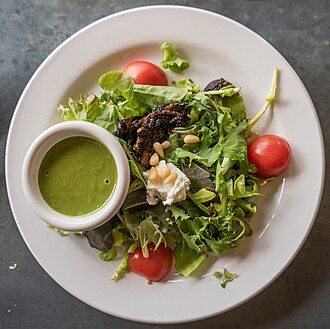
Photo: Wikipedia
This is a catch-all term for a wide variety of pre-made salad dressings, ranging from creamy Caesar and Ranch to tangy Italian and vinaigrettes. Its texture can be thick and creamy or light and oily, with flavors that are often a balanced mix of savory, sweet, and acidic. Nutritionally, it is a concentrated source of fat and calories, with minimal protein or fiber.
Calorie split: 1% protein · 5% carbs · 93% fat
↓ Full nutrition💚 Why it's loved
People love it for its ability to instantly transform a bowl of greens into a flavorful, satisfying meal. Its sheer variety means there's a dressing for every palate and cuisine, from creamy American classics to zesty Mediterranean blends.
⚠️ Watch-outs & how to enjoy it better
The primary downside is its high calorie and fat density, which can lead to overconsumption if not portioned carefully. Many varieties are also high in sodium and added sugars, which can be a concern for blood pressure and blood sugar management. To counteract this, measure your dressing (a typical serving is 2 tablespoons), opt for oil-and-vinegar based dressings when possible, and pair your salad with a lean protein source to increase fullness.
Key benefits
- Adds significant flavor to plain vegetables
- Provides dietary fat for nutrient absorption (e.g., vitamins A, D, E, K)
- Offers convenience for quick meal preparation
- Can make salads more palatable and satisfying
🍽️ Popular dishes
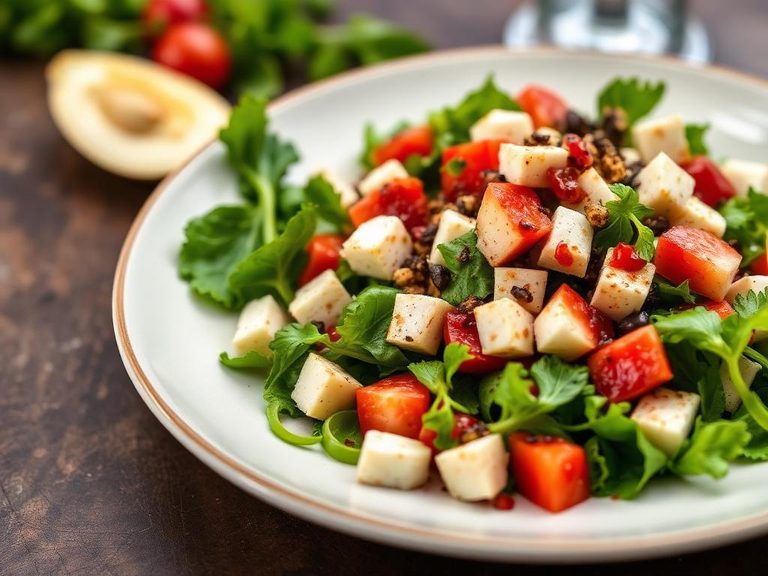
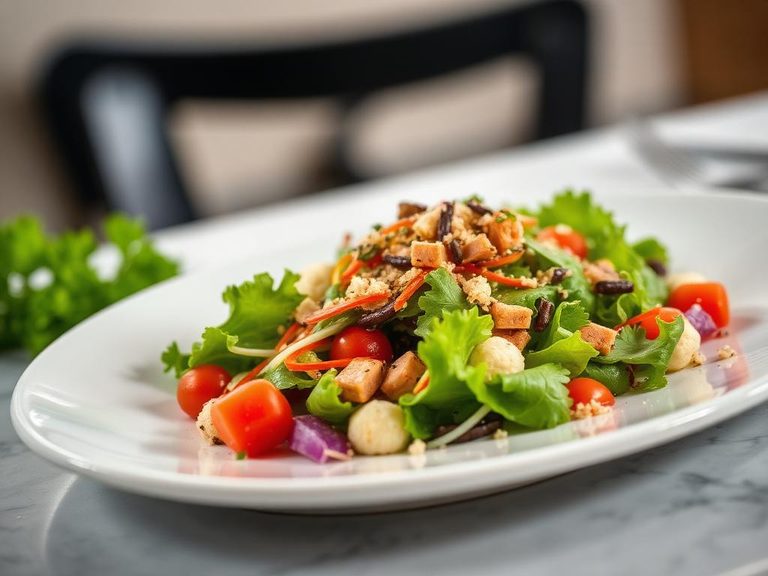
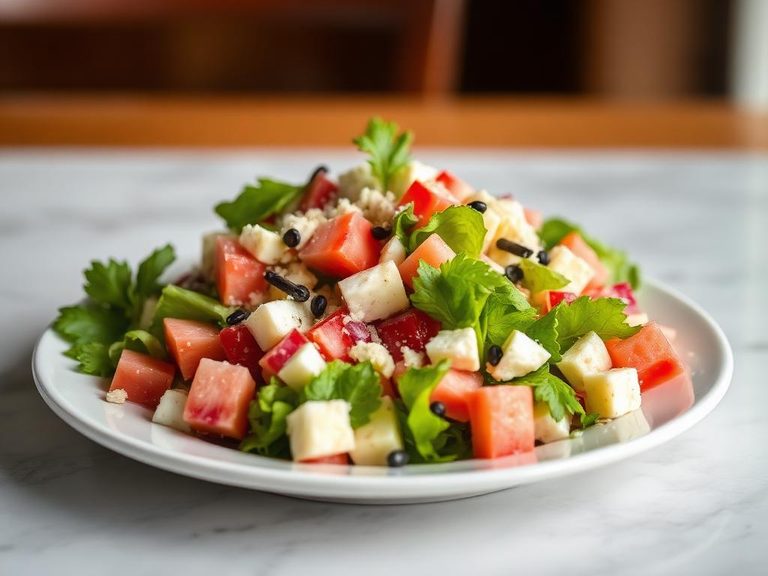
🌍 Where it's eaten
💡 Did you know?
The term 'salad dressing' is legally defined by the FDA; to be labeled as such, it must contain a minimum of 30% vegetable oil and an edible acid like vinegar or lemon juice.
Full nutrition (USDA data · scales with serving)
| Water | 45.7 g |
| Energy | 430 kcal |
| Protein | 1.3 g |
| Total lipid (fat) | 44.5 g |
| Carbohydrate, by difference | 5.9 g |
| Fiber, total dietary | 0.00 g |
| Total Sugars | 4.7 g |
| Calcium, Ca | 28.0 mg |
| Iron, Fe | 0.30 mg |
| Magnesium, Mg | 5.0 mg |
| Phosphorus, P | 186 mg |
| Potassium, K | 64.0 mg |
| Sodium, Na | 810 mg |
| Zinc, Zn | 0.17 mg |
| Copper, Cu | 0.02 mg |
| Selenium, Se | 3.5 ug |
| Vitamin C, total ascorbic acid | 0.00 mg |
| Thiamin | 0.01 mg |
| Riboflavin | 0.09 mg |
| Niacin | 0.05 mg |
| Vitamin B-6 | 0.03 mg |
| Folate, total | 4.0 ug |
| Folic acid | 0.00 ug |
| Folate, food | 4.0 ug |
| Folate, DFE | 4.0 ug |
| Choline, total | 32.8 mg |
| Vitamin B-12 | 0.17 ug |
| Vitamin B-12, added | 0.00 ug |
| Vitamin A, RAE | 15.0 ug |
| Retinol | 13.0 ug |
| Carotene, beta | 14.0 ug |
| Carotene, alpha | 0.00 ug |
| Cryptoxanthin, beta | 1.0 ug |
| Lycopene | 0.00 ug |
| Lutein + zeaxanthin | 21.0 ug |
| Vitamin E (alpha-tocopherol) | 2.2 mg |
| Vitamin E, added | 0.00 mg |
| Vitamin D (D2 + D3) | 0.10 ug |
| Vitamin K (phylloquinone) | 134 ug |
| Alcohol, ethyl | 0.00 g |
| Caffeine | 0.00 mg |
| Theobromine | 0.00 mg |
Fat & fatty acid profile (per 100g)
| Fatty acids, total saturated | 7.0 g |
| SFA 4:0 | 0.01 g |
| SFA 6:0 | 0.00 g |
| SFA 8:0 | 0.04 g |
| SFA 10:0 | 0.04 g |
| SFA 12:0 | 0.01 g |
| SFA 14:0 | 0.07 g |
| SFA 16:0 | 4.6 g |
| SFA 18:0 | 1.8 g |
| Fatty acids, total monounsaturated | 9.2 g |
| MUFA 16:1 | 0.06 g |
| MUFA 18:1 | 8.9 g |
| MUFA 20:1 | 0.12 g |
| MUFA 22:1 | 0.05 g |
| Fatty acids, total polyunsaturated | 25.8 g |
| PUFA 18:2 | 22.3 g |
| PUFA 18:3 | 3.4 g |
| PUFA 18:4 | 0.00 g |
| PUFA 20:4 | 0.03 g |
| PUFA 20:5 n-3 (EPA) | 0.00 g |
| PUFA 22:5 n-3 (DPA) | 0.00 g |
| PUFA 22:6 n-3 (DHA) | 0.00 g |
| Cholesterol | 26.0 mg |
Amino acid profile (per 100g)
Estimated from Salad dressing, sesame seed dressing, regular — USDA does not publish this profile for Salad dressing.
| Tryptophan | 0.05 g |
| Threonine | 0.05 g |
| Isoleucine | 0.05 g |
| Leucine | 0.08 g |
| Lysine | 0.14 g |
| Methionine | 0.03 g |
| Cystine | 0.00 g |
| Phenylalanine | 0.09 g |
| Tyrosine | 0.10 g |
| Valine | 0.07 g |
| Arginine | 0.40 g |
| Histidine | 0.03 g |
| Alanine | 0.00 g |
| Aspartic acid | 0.00 g |
| Glutamic acid | 0.46 g |
| Glycine | 0.00 g |
| Proline | 0.00 g |
| Serine | 0.00 g |
FAQ
Is salad dressing healthy?
It can be part of a healthy diet in moderation. Its primary role is to add flavor and fat to help absorb vitamins from vegetables. The key is portion control, as it is calorie-dense. Look for options with simpler ingredient lists, less added sugar, and healthier fats like olive oil.
What's the difference between 'salad dressing' and 'mayonnaise'?
Salad dressing is a broad category for sauces used on salads. Mayonnaise is a specific type of emulsion made from oil, egg yolk, and an acid (like vinegar or lemon juice). Some creamy salad dressings (like Ranch) use mayonnaise as a base ingredient.
Can I use salad dressing as a marinade or dip?
Absolutely. Vinaigrettes make excellent marinades for chicken, fish, or vegetables, as the acid helps tenderize. Creamy dressings like Ranch or Blue Cheese are classic dips for raw vegetables, wings, and pizza crusts.
Nutrient density (calculated · NRF9.3)
Nutrient Rich Foods index: beneficial nutrients (protein, fiber, vitamins, minerals) minus saturated fat, added sugar & sodium, per 100 kcal.
NRF9.3 index — Fulgoni, Keast & Drewnowski, 2009. Computed from USDA nutrients.
Weight-loss friendliness (composite index)
Energy density 4.30 kcal/g · 1% calories from protein · 0.0 g fiber · 4.7 g sugar per 100 g.
Composite of energy density (Rolls et al., 1999), protein & fiber satiety, minus sugar. A calculated heuristic — ranks satiety-per-calorie, not a clinical measure.
Dietary load (calculated from USDA values)
Potential renal acid load. Positive = acid-forming, negative = alkaline-forming.
Sodium-to-potassium ratio: 12.66 (lower is better — aim for ≤ 1)
Sodium:potassium per WHO potassium guidance. Computed from USDA nutrients.