

Ravioli, meat-filled, no sauce
Common food

Photo: Wikipedia
Meat-filled ravioli are delicate pasta parcels, typically square or circular, stuffed with a savory mixture of ground meat (often beef, pork, or a blend) and sometimes cheese or herbs. The texture is tender yet slightly chewy, with a rich, umami-packed filling that contrasts with the soft pasta exterior. Nutritionally, they offer a balanced profile of protein and carbs, making them a satisfying, energy-dense meal without added sauce.
Calorie split: 27% protein · 38% carbs · 36% fat
↓ Full nutrition💚 Why it's loved
People love meat-filled ravioli for their comforting, savory flavor and the satisfying contrast between the tender pasta and hearty filling. They are also cherished for their versatility, as they can be dressed with simple butter, rich tomato sauce, or creamy cheese, making them adaptable to many tastes and occasions.
⚠️ Watch-outs & how to enjoy it better
The main downsides include potential high sodium content in the pasta and filling, and the refined carbs can cause blood-sugar spikes if not paired with fiber or protein. To counteract this, serve with a side of vegetables or a salad, and opt for whole-wheat ravioli if available. Also, be mindful of portion sizes, as they can be calorie-dense, and check for common allergens like wheat and dairy.
Key benefits
- Good source of protein for muscle maintenance
- Provides complex carbs for sustained energy
- Convenient and quick to prepare
- Versatile base for various sauces and seasonings
- Traditional comfort food with cultural significance
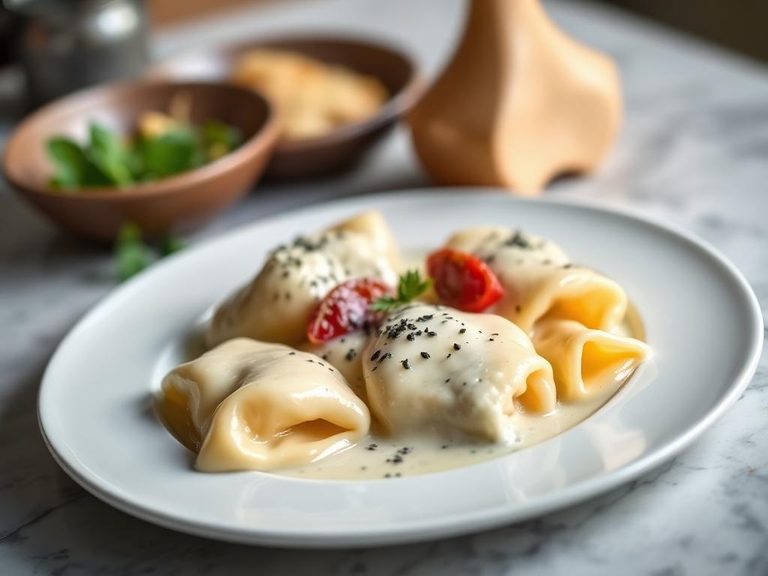
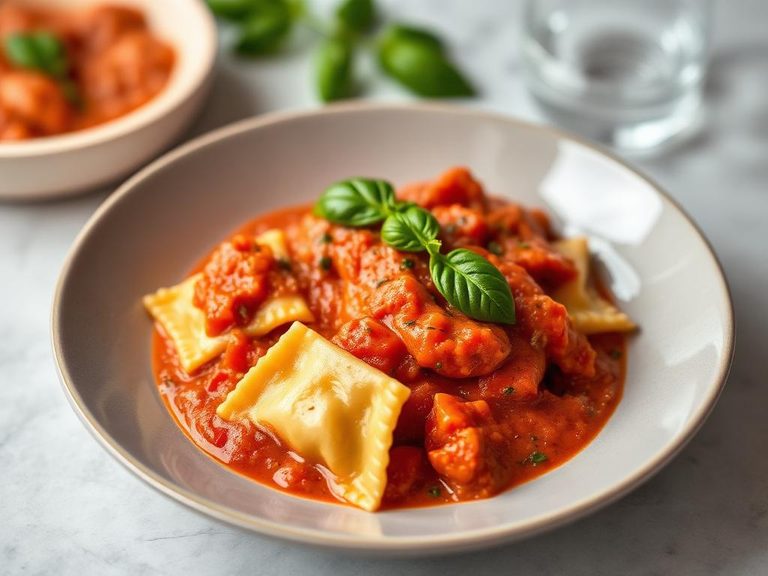
🍽️ Popular dishes
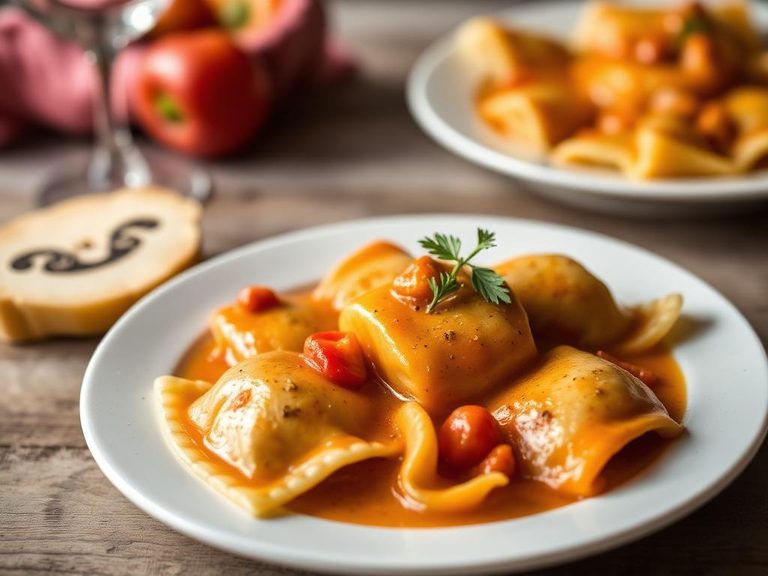
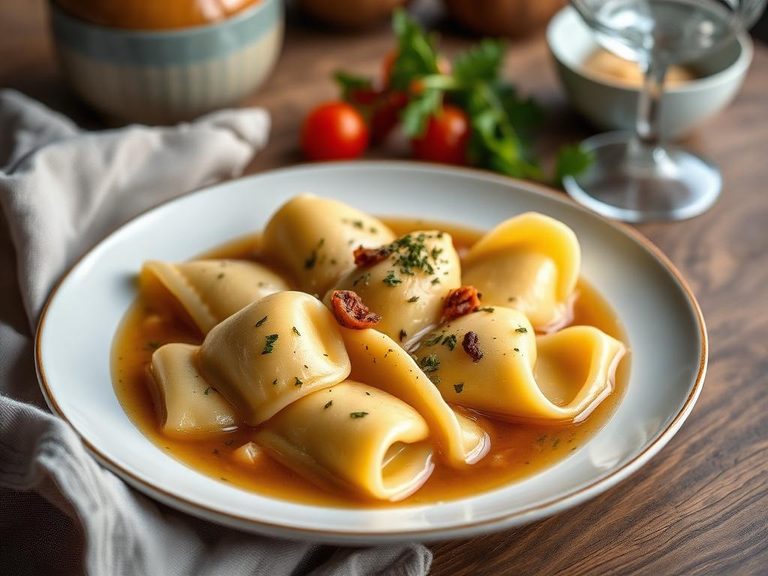
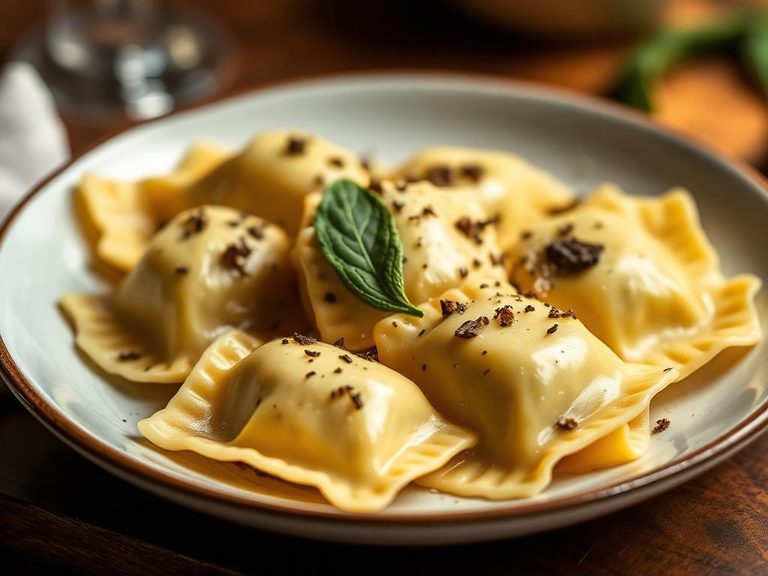
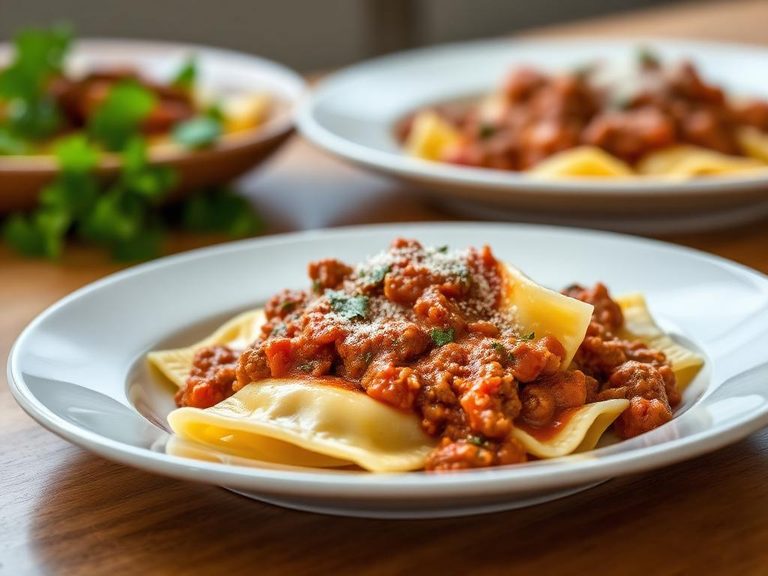
🌍 Where it's eaten
💡 Did you know?
The word 'ravioli' likely derives from the Italian 'riavvolgere' (to wrap), and the earliest known recipe appears in a 14th-century Italian manuscript, suggesting they have been a staple for over 600 years.
Full nutrition (USDA data · scales with serving)
| Water | 60.0 g |
| Energy | 190 kcal |
| Protein | 12.6 g |
| Total lipid (fat) | 7.4 g |
| Carbohydrate, by difference | 17.7 g |
| Fiber, total dietary | 0.60 g |
| Total Sugars | 0.20 g |
| Calcium, Ca | 32.0 mg |
| Iron, Fe | 2.3 mg |
| Magnesium, Mg | 15.0 mg |
| Phosphorus, P | 121 mg |
| Potassium, K | 148 mg |
| Sodium, Na | 770 mg |
| Zinc, Zn | 2.3 mg |
| Copper, Cu | 0.06 mg |
| Selenium, Se | 15.8 ug |
| Vitamin C, total ascorbic acid | 0.10 mg |
| Thiamin | 0.19 mg |
| Riboflavin | 0.21 mg |
| Niacin | 2.9 mg |
| Vitamin B-6 | 0.13 mg |
| Folate, total | 38.0 ug |
| Folic acid | 22.0 ug |
| Folate, food | 16.0 ug |
| Folate, DFE | 53.0 ug |
| Choline, total | 71.1 mg |
| Vitamin B-12 | 0.93 ug |
| Vitamin B-12, added | 0.00 ug |
| Vitamin A, RAE | 35.0 ug |
| Retinol | 35.0 ug |
| Carotene, beta | 0.00 ug |
| Carotene, alpha | 0.00 ug |
| Cryptoxanthin, beta | 2.0 ug |
| Lycopene | 0.00 ug |
| Lutein + zeaxanthin | 92.0 ug |
| Vitamin E (alpha-tocopherol) | 0.24 mg |
| Vitamin E, added | 0.00 mg |
| Vitamin D (D2 + D3) | 0.40 ug |
| Vitamin K (phylloquinone) | 0.60 ug |
| Alcohol, ethyl | 0.00 g |
| Caffeine | 0.00 mg |
| Theobromine | 0.00 mg |
Fat & fatty acid profile (per 100g)
| Fatty acids, total saturated | 2.7 g |
| SFA 4:0 | 0.01 g |
| SFA 6:0 | 0.01 g |
| SFA 8:0 | 0.00 g |
| SFA 10:0 | 0.01 g |
| SFA 12:0 | 0.01 g |
| SFA 14:0 | 0.18 g |
| SFA 16:0 | 1.6 g |
| SFA 18:0 | 0.77 g |
| Fatty acids, total monounsaturated | 3.0 g |
| MUFA 16:1 | 0.23 g |
| MUFA 18:1 | 2.6 g |
| MUFA 20:1 | 0.02 g |
| MUFA 22:1 | 0.00 g |
| Fatty acids, total polyunsaturated | 0.58 g |
| PUFA 18:2 | 0.48 g |
| PUFA 18:3 | 0.03 g |
| PUFA 18:4 | 0.00 g |
| PUFA 20:4 | 0.01 g |
| PUFA 20:5 n-3 (EPA) | 0.00 g |
| PUFA 22:5 n-3 (DPA) | 0.00 g |
| PUFA 22:6 n-3 (DHA) | 0.00 g |
| Cholesterol | 99.0 mg |
Amino acid profile (per 100g)
Estimated from OLIVE GARDEN, cheese ravioli with marinara sauce — USDA does not publish this profile for Ravioli.
| Tryptophan | 0.17 g |
| Threonine | 0.28 g |
| Isoleucine | 0.32 g |
| Leucine | 0.67 g |
| Lysine | 0.51 g |
| Methionine | 0.18 g |
| Cystine | 0.12 g |
| Phenylalanine | 0.36 g |
| Tyrosine | 0.26 g |
| Valine | 0.38 g |
| Arginine | 0.31 g |
| Histidine | 0.17 g |
| Alanine | 0.26 g |
| Aspartic acid | 0.54 g |
| Glutamic acid | 2.0 g |
| Glycine | 0.20 g |
| Proline | 1.0 g |
| Serine | 0.40 g |
| Hydroxyproline | 0.00 g |
FAQ
Are meat-filled ravioli a good source of protein?
Yes, they provide a decent amount of protein (around 12.6g per 100g), which supports muscle repair and satiety, though they are not as protein-dense as lean meats.
Can I make meat-filled ravioli healthier?
Absolutely. Use whole-wheat pasta, add vegetables to the filling, and pair with a light sauce or broth to reduce calorie density while boosting fiber and nutrients.
How should I store leftover cooked ravioli?
Store in an airtight container in the refrigerator for up to 3-4 days, or freeze for up to 2 months. Reheat gently in boiling water or a pan to maintain texture.
Nutrient density (calculated · NRF9.3)
Nutrient Rich Foods index: beneficial nutrients (protein, fiber, vitamins, minerals) minus saturated fat, added sugar & sodium, per 100 kcal.
NRF9.3 index — Fulgoni, Keast & Drewnowski, 2009. Computed from USDA nutrients.
Weight-loss friendliness (composite index)
Energy density 1.90 kcal/g · 27% calories from protein · 0.6 g fiber · 0.2 g sugar per 100 g.
Composite of energy density (Rolls et al., 1999), protein & fiber satiety, minus sugar. A calculated heuristic — ranks satiety-per-calorie, not a clinical measure.
Dietary load (calculated from USDA values)
Potential renal acid load. Positive = acid-forming, negative = alkaline-forming.
Sodium-to-potassium ratio: 5.20 (lower is better — aim for ≤ 1)
Sodium:potassium per WHO potassium guidance. Computed from USDA nutrients.