

Potato, mashed, from fast food
Common food
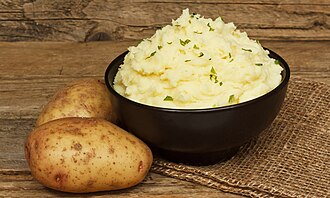
Photo: Wikipedia
Fast-food mashed potatoes are a velvety, buttery side dish made from russet potatoes, often with added milk, salt, and sometimes a touch of garlic or onion powder. The texture is typically smooth and creamy, though some versions are slightly grainy or watery, with a mild, savory flavor that pairs well with gravy. At 89 kcal per 100g, they're a moderate-energy option, with carbs providing most of the calories and a small amount of fat from added dairy or butter.
Calorie split: 7% protein · 65% carbs · 28% fat
↓ Full nutrition💚 Why it's loved
People love fast-food mashed potatoes for their creamy, comforting texture and the way they absorb gravy or butter, making them a satisfying, nostalgic side. Their versatility as a base for toppings or mix-ins like cheese or herbs adds to their appeal across many cultures.
⚠️ Watch-outs & how to enjoy it better
Fast-food mashed potatoes can be high in sodium (often 300-500mg per serving), which may concern those with hypertension or fluid retention. To counteract, pair with a low-sodium protein like grilled chicken or add herbs like parsley for flavor without salt, and watch portion sizes to avoid blood-sugar spikes from the high carb content.
Key benefits
- Quick source of energy from carbohydrates
- Provides potassium and vitamin C from potatoes
- Low in fat compared to many fast-food sides
- Can be a comforting, familiar food for many
- Offers some dietary fiber (1.3g per 100g)
🍽️ Popular dishes

🌍 Where it's eaten
💡 Did you know?
Fast-food mashed potatoes often contain a small amount of modified food starch or emulsifiers to maintain a smooth texture and prevent separation, which is why they can sometimes taste slightly different from homemade versions.
Full nutrition (USDA data · scales with serving)
| Water | 79.6 g |
| Energy | 89.0 kcal |
| Protein | 1.6 g |
| Total lipid (fat) | 2.8 g |
| Carbohydrate, by difference | 14.7 g |
| Fiber, total dietary | 1.3 g |
| Total Sugars | 0.50 g |
| Calcium, Ca | 18.0 mg |
| Iron, Fe | 0.31 mg |
| Magnesium, Mg | 15.0 mg |
| Phosphorus, P | 59.0 mg |
| Potassium, K | 286 mg |
| Sodium, Na | 306 mg |
| Zinc, Zn | 0.22 mg |
| Copper, Cu | 0.04 mg |
| Selenium, Se | 0.80 ug |
| Vitamin C, total ascorbic acid | 0.00 mg |
| Thiamin | 0.01 mg |
| Riboflavin | 0.01 mg |
| Niacin | 1.1 mg |
| Vitamin B-6 | 0.12 mg |
| Folate, total | 9.0 ug |
| Folic acid | 0.00 ug |
| Folate, food | 9.0 ug |
| Folate, DFE | 9.0 ug |
| Choline, total | 13.4 mg |
| Vitamin B-12 | 0.07 ug |
| Vitamin B-12, added | 0.00 ug |
| Vitamin A, RAE | 43.0 ug |
| Retinol | 41.0 ug |
| Carotene, beta | 30.0 ug |
| Carotene, alpha | 0.00 ug |
| Cryptoxanthin, beta | 0.00 ug |
| Lycopene | 0.00 ug |
| Lutein + zeaxanthin | 7.0 ug |
| Vitamin E (alpha-tocopherol) | 0.42 mg |
| Vitamin E, added | 0.00 mg |
| Vitamin D (D2 + D3) | 0.00 ug |
| Vitamin K (phylloquinone) | 5.9 ug |
| Alcohol, ethyl | 0.00 g |
| Caffeine | 0.00 mg |
| Theobromine | 0.00 mg |
Fat & fatty acid profile (per 100g)
| Fatty acids, total saturated | 0.58 g |
| SFA 4:0 | 0.00 g |
| SFA 6:0 | 0.00 g |
| SFA 8:0 | 0.00 g |
| SFA 10:0 | 0.00 g |
| SFA 12:0 | 0.00 g |
| SFA 14:0 | 0.01 g |
| SFA 16:0 | 0.32 g |
| SFA 18:0 | 0.22 g |
| Fatty acids, total monounsaturated | 0.72 g |
| MUFA 16:1 | 0.00 g |
| MUFA 18:1 | 0.70 g |
| MUFA 20:1 | 0.02 g |
| MUFA 22:1 | 0.00 g |
| Fatty acids, total polyunsaturated | 1.3 g |
| PUFA 18:2 | 1.2 g |
| PUFA 18:3 | 0.17 g |
| PUFA 18:4 | 0.00 g |
| PUFA 20:4 | 0.00 g |
| PUFA 20:5 n-3 (EPA) | 0.00 g |
| PUFA 22:5 n-3 (DPA) | 0.00 g |
| PUFA 22:6 n-3 (DHA) | 0.00 g |
| Cholesterol | 0.00 mg |
Amino acid profile (per 100g)
Estimated from Snacks, potato chips, made from dried potatoes, reduced fat — USDA does not publish this profile for Potato.
| Tryptophan | 0.04 g |
| Threonine | 0.24 g |
| Isoleucine | 0.25 g |
| Leucine | 0.37 g |
| Lysine | 0.35 g |
| Methionine | 0.07 g |
| Cystine | 0.07 g |
| Phenylalanine | 0.26 g |
| Tyrosine | 0.22 g |
| Valine | 0.33 g |
| Arginine | 0.27 g |
| Histidine | 0.13 g |
| Alanine | 0.20 g |
| Aspartic acid | 1.1 g |
| Glutamic acid | 0.94 g |
| Glycine | 0.19 g |
| Proline | 0.20 g |
| Serine | 0.23 g |
FAQ
Are fast-food mashed potatoes healthy?
They can be part of a balanced diet in moderation, but they often contain added salt, butter, and sometimes preservatives. Their nutritional value depends on the specific preparation and portion size.
How do fast-food mashed potatoes differ from homemade?
Fast-food versions may use more salt, added fats, and stabilizers for consistency, while homemade mashed potatoes typically have fewer additives and allow control over ingredients like butter and salt.
Can I make a healthier version at home?
Yes, use fresh potatoes, minimal salt, and substitute butter with olive oil or Greek yogurt for creaminess. Adding herbs or garlic can enhance flavor without extra calories.
Nutrient density (calculated · NRF9.3)
Nutrient Rich Foods index: beneficial nutrients (protein, fiber, vitamins, minerals) minus saturated fat, added sugar & sodium, per 100 kcal.
NRF9.3 index — Fulgoni, Keast & Drewnowski, 2009. Computed from USDA nutrients.
Weight-loss friendliness (composite index)
Energy density 0.89 kcal/g · 7% calories from protein · 1.3 g fiber · 0.5 g sugar per 100 g.
Composite of energy density (Rolls et al., 1999), protein & fiber satiety, minus sugar. A calculated heuristic — ranks satiety-per-calorie, not a clinical measure.
Dietary load (calculated from USDA values)
Potential renal acid load. Positive = acid-forming, negative = alkaline-forming.
Sodium-to-potassium ratio: 1.07 (lower is better — aim for ≤ 1)
Sodium:potassium per WHO potassium guidance. Computed from USDA nutrients.