

Pie, blueberry, commercially prepared
Whole food · Baked Products

Photo: Wikipedia
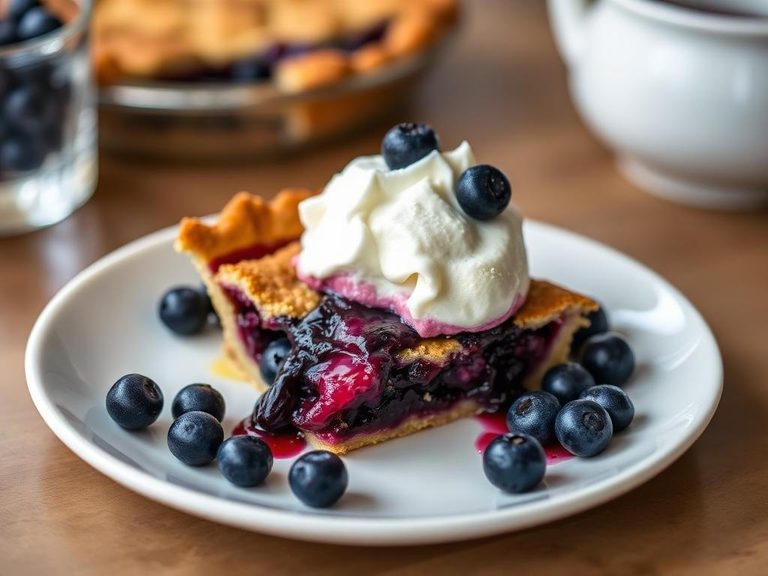
This is a classic dessert pie featuring a sweet, jammy blueberry filling encased in a flaky, buttery pastry crust. The filling is typically thickened with starch, offering a burst of sweet-tart berry flavor with a soft, cohesive texture. Nutritionally, it's a calorie-dense treat primarily from carbohydrates and fats, with minimal protein or fiber.
Calorie split: 3% protein · 59% carbs · 38% fat
↓ Full nutrition💚 Why it's loved
People adore it for the harmonious balance of sweet, juicy berries and rich, flaky crust, which delivers a satisfying textural contrast. It's a nostalgic comfort food often associated with home baking, summer picnics, and holiday gatherings.
⚠️ Watch-outs & how to enjoy it better
Its high sugar and refined carbohydrate content can cause rapid blood sugar spikes, making it a concern for those managing diabetes. The pastry crust is typically high in saturated fat and calories. To mitigate, pair a small slice with a source of protein (like Greek yogurt) or healthy fat (like a handful of nuts) to slow sugar absorption, and practice strict portion control.
Key benefits
- Provides quick energy from carbohydrates
- Contains antioxidants from blueberries
- A source of dietary fat for satiety
- Offers a comforting, familiar flavor profile
🍽️ Popular dishes
🌍 Where it's eaten
💡 Did you know?
Commercial blueberry pies often use a blend of wild and cultivated blueberries, with wild berries being smaller and more intensely flavored, creating a more complex taste profile.
Full nutrition (USDA data · scales with serving)
| Water | 52.5 g |
| Energy | 232 kcal |
| Energy | 971 kj |
| Protein | 1.8 g |
| Total lipid (fat) | 10.0 g |
| Ash | 0.80 g |
| Carbohydrate, by difference | 34.9 g |
| Fiber, total dietary | 1.0 g |
| Total Sugars | 9.9 g |
| Calcium, Ca | 8.0 mg |
| Iron, Fe | 0.30 mg |
| Magnesium, Mg | 5.0 mg |
| Phosphorus, P | 23.0 mg |
| Potassium, K | 50.0 mg |
| Sodium, Na | 287 mg |
| Zinc, Zn | 0.16 mg |
| Copper, Cu | 0.05 mg |
| Manganese, Mn | 0.18 mg |
| Selenium, Se | 1.4 ug |
| Vitamin C, total ascorbic acid | 2.7 mg |
| Thiamin | 0.01 mg |
| Riboflavin | 0.03 mg |
| Niacin | 0.30 mg |
| Pantothenic acid | 0.14 mg |
| Vitamin B-6 | 0.04 mg |
| Folate, total | 27.0 ug |
| Folic acid | 23.0 ug |
| Folate, food | 4.0 ug |
| Folate, DFE | 43.0 ug |
| Choline, total | 7.2 mg |
| Vitamin B-12 | 0.01 ug |
| Vitamin B-12, added | 0.00 ug |
| Vitamin A, RAE | 44.0 ug |
| Retinol | 41.0 ug |
| Carotene, beta | 39.0 ug |
| Carotene, alpha | 0.00 ug |
| Cryptoxanthin, beta | 0.00 ug |
| Vitamin A, IU | 140 iu |
| Lycopene | 0.00 ug |
| Lutein + zeaxanthin | 15.0 ug |
| Vitamin E (alpha-tocopherol) | 1.0 mg |
| Vitamin E, added | 0.00 mg |
| Vitamin D (D2 + D3), International Units | 0.00 iu |
| Vitamin D (D2 + D3) | 0.00 ug |
| Vitamin K (phylloquinone) | 10.5 ug |
| Alcohol, ethyl | 0.00 g |
| Caffeine | 0.00 mg |
| Theobromine | 0.00 mg |
Fat & fatty acid profile (per 100g)
| Fatty acids, total saturated | 1.7 g |
| SFA 4:0 | 0.00 g |
| SFA 6:0 | 0.00 g |
| SFA 8:0 | 0.00 g |
| SFA 10:0 | 0.00 g |
| SFA 12:0 | 0.00 g |
| SFA 14:0 | 0.02 g |
| SFA 16:0 | 1.1 g |
| SFA 18:0 | 0.58 g |
| Fatty acids, total monounsaturated | 4.2 g |
| MUFA 16:1 | 0.02 g |
| MUFA 18:1 | 4.2 g |
| MUFA 20:1 | 0.00 g |
| MUFA 22:1 | 0.00 g |
| Fatty acids, total polyunsaturated | 3.5 g |
| PUFA 18:2 | 3.3 g |
| PUFA 18:3 | 0.24 g |
| PUFA 18:4 | 0.00 g |
| PUFA 20:4 | 0.00 g |
| PUFA 20:5 n-3 (EPA) | 0.00 g |
| PUFA 22:5 n-3 (DPA) | 0.00 g |
| PUFA 22:6 n-3 (DHA) | 0.00 g |
| Cholesterol | 0.00 mg |
Amino acid profile (per 100g)
| Tryptophan | 0.03 g |
| Threonine | 0.05 g |
| Isoleucine | 0.07 g |
| Leucine | 0.13 g |
| Lysine | 0.06 g |
| Methionine | 0.03 g |
| Cystine | 0.04 g |
| Phenylalanine | 0.09 g |
| Tyrosine | 0.05 g |
| Valine | 0.08 g |
| Arginine | 0.07 g |
| Histidine | 0.04 g |
| Alanine | 0.06 g |
| Aspartic acid | 0.08 g |
| Glutamic acid | 0.58 g |
| Glycine | 0.06 g |
| Proline | 0.20 g |
| Serine | 0.09 g |
FAQ
Is commercially prepared blueberry pie healthier than homemade?
Not necessarily. Commercial versions often contain more added sugars, preservatives, and sometimes hydrogenated oils for shelf stability. Homemade allows control over sugar, fat, and ingredient quality.
Can I find a low-sugar version of this pie?
Some brands offer 'light' or 'no sugar added' varieties using artificial sweeteners or fruit juice concentrates. Check labels carefully, as they may have different textures and still contain refined carbs.
What's the best way to store leftover pie?
Cover and refrigerate for up to 3-4 days. For longer storage, freeze slices wrapped tightly in plastic and foil for up to 4 months. Reheat in a 350°F oven to re-crisp the crust.
Nutrient density (calculated · NRF9.3)
Nutrient Rich Foods index: beneficial nutrients (protein, fiber, vitamins, minerals) minus saturated fat, added sugar & sodium, per 100 kcal.
NRF9.3 index — Fulgoni, Keast & Drewnowski, 2009. Computed from USDA nutrients.
Weight-loss friendliness (composite index)
Energy density 2.32 kcal/g · 3% calories from protein · 1.0 g fiber · 9.9 g sugar per 100 g.
Composite of energy density (Rolls et al., 1999), protein & fiber satiety, minus sugar. A calculated heuristic — ranks satiety-per-calorie, not a clinical measure.
Dietary load (calculated from USDA values)
Potential renal acid load. Positive = acid-forming, negative = alkaline-forming.
Sodium-to-potassium ratio: 5.74 (lower is better — aim for ≤ 1)
Sodium:potassium per WHO potassium guidance. Computed from USDA nutrients.