

Mushrooms, stuffed
Common food

Photo: Wikipedia
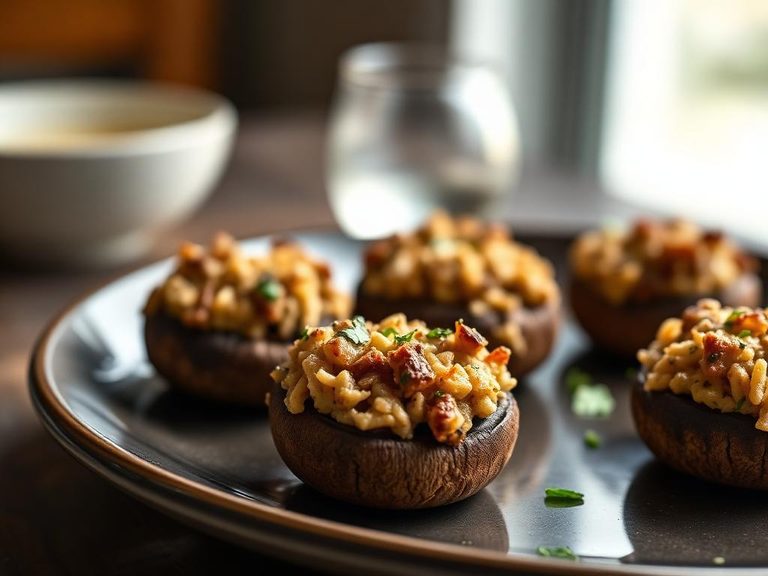
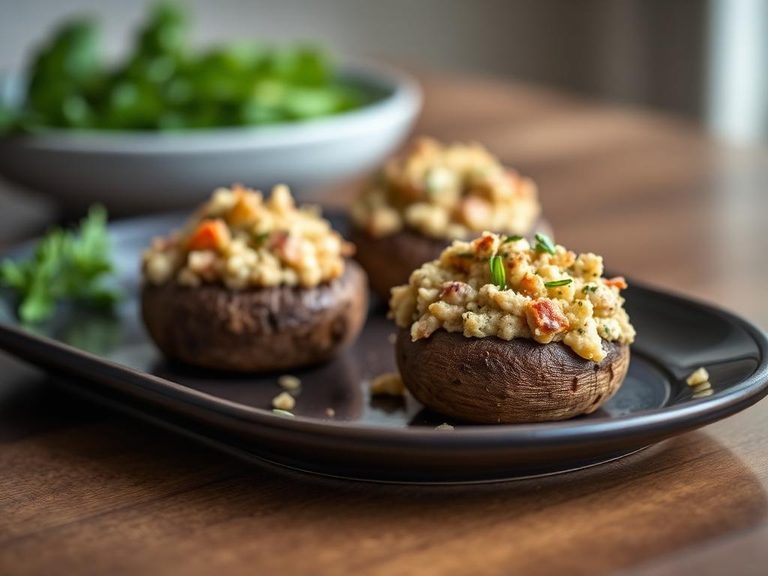
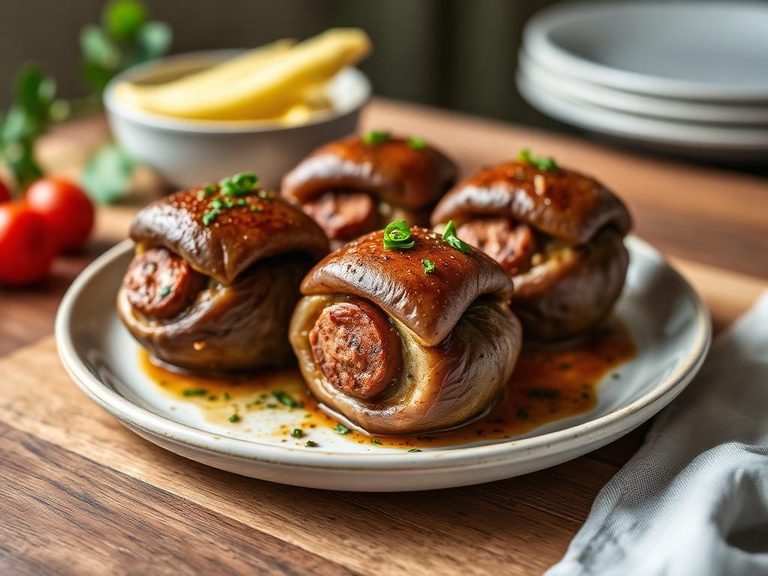
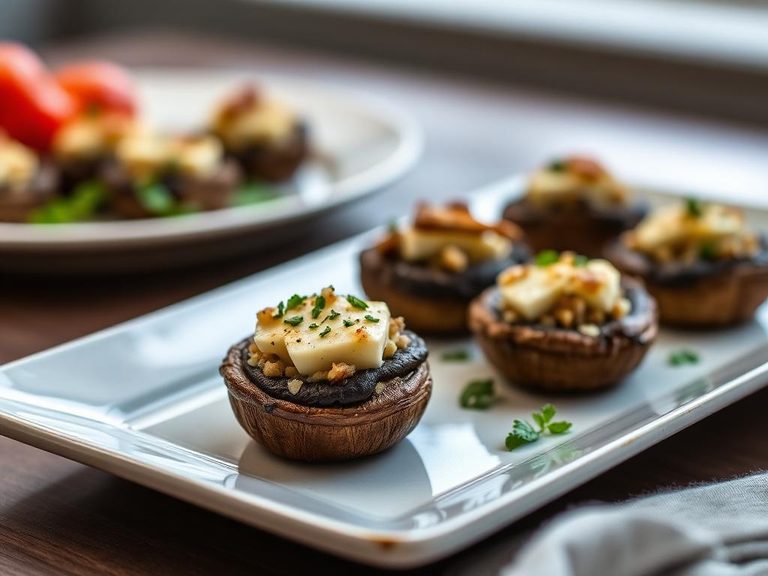
Stuffed mushrooms are whole mushroom caps, typically button or cremini, filled with a savory mixture of breadcrumbs, herbs, cheese, and often sausage or crab. They offer a delightful contrast between the tender, umami-rich cap and a crispy, flavorful filling. Nutritionally, they provide a good protein boost from the filling while the mushroom itself contributes B vitamins and minerals.
Calorie split: 15% protein · 38% carbs · 47% fat
↓ Full nutrition💚 Why it's loved
People love them for their perfect bite-sized format and the satisfying combination of earthy mushroom and rich, seasoned filling. They are a versatile crowd-pleaser that can be customized from classic garlic-herb to luxurious crab-stuffed versions.
⚠️ Watch-outs & how to enjoy it better
The primary concern is often the high sodium and saturated fat content from cheese, butter, and processed meat fillings, which can be problematic for heart health. Those watching blood sugar should be mindful of breadcrumb-heavy fillings; opt for versions with almond flour or extra vegetables and pair with a leafy green salad to slow absorption.
Key benefits
- Good source of protein from the filling
- Provides B vitamins like riboflavin and niacin from the mushroom
- Contains minerals like selenium and potassium
- Can be a lower-carb appetizer option depending on filling
- Offers dietary fiber from the mushroom and breadcrumb components
🍽️ Popular dishes
🌍 Where it's eaten
💡 Did you know?
The largest producer of cultivated mushrooms in the world is China, which accounts for over 75% of global output.
Full nutrition (USDA data · scales with serving)
| Water | 43.6 g |
| Energy | 288 kcal |
| Protein | 10.7 g |
| Total lipid (fat) | 15.0 g |
| Carbohydrate, by difference | 27.7 g |
| Fiber, total dietary | 3.0 g |
| Total Sugars | 4.0 g |
| Calcium, Ca | 147 mg |
| Iron, Fe | 1.8 mg |
| Magnesium, Mg | 27.0 mg |
| Phosphorus, P | 203 mg |
| Potassium, K | 434 mg |
| Sodium, Na | 638 mg |
| Zinc, Zn | 1.5 mg |
| Copper, Cu | 0.40 mg |
| Selenium, Se | 28.7 ug |
| Vitamin C, total ascorbic acid | 4.4 mg |
| Thiamin | 0.29 mg |
| Riboflavin | 0.53 mg |
| Niacin | 5.4 mg |
| Vitamin B-6 | 0.13 mg |
| Folate, total | 50.0 ug |
| Folic acid | 16.0 ug |
| Folate, food | 34.0 ug |
| Folate, DFE | 61.0 ug |
| Choline, total | 26.1 mg |
| Vitamin B-12 | 0.29 ug |
| Vitamin B-12, added | 0.00 ug |
| Vitamin A, RAE | 112 ug |
| Retinol | 105 ug |
| Carotene, beta | 86.0 ug |
| Carotene, alpha | 0.00 ug |
| Cryptoxanthin, beta | 0.00 ug |
| Lycopene | 0.00 ug |
| Lutein + zeaxanthin | 4.0 ug |
| Vitamin E (alpha-tocopherol) | 1.1 mg |
| Vitamin E, added | 0.00 mg |
| Vitamin D (D2 + D3) | 0.50 ug |
| Vitamin K (phylloquinone) | 13.9 ug |
| Alcohol, ethyl | 0.00 g |
| Caffeine | 0.00 mg |
| Theobromine | 0.00 mg |
Fat & fatty acid profile (per 100g)
| Fatty acids, total saturated | 4.1 g |
| SFA 4:0 | 0.05 g |
| SFA 6:0 | 0.04 g |
| SFA 8:0 | 0.03 g |
| SFA 10:0 | 0.06 g |
| SFA 12:0 | 0.07 g |
| SFA 14:0 | 0.25 g |
| SFA 16:0 | 2.2 g |
| SFA 18:0 | 1.3 g |
| Fatty acids, total monounsaturated | 5.8 g |
| MUFA 16:1 | 0.08 g |
| MUFA 18:1 | 5.7 g |
| MUFA 20:1 | 0.04 g |
| MUFA 22:1 | 0.00 g |
| Fatty acids, total polyunsaturated | 3.8 g |
| PUFA 18:2 | 3.5 g |
| PUFA 18:3 | 0.29 g |
| PUFA 18:4 | 0.00 g |
| PUFA 20:4 | 0.01 g |
| PUFA 20:5 n-3 (EPA) | 0.00 g |
| PUFA 22:5 n-3 (DPA) | 0.00 g |
| PUFA 22:6 n-3 (DHA) | 0.00 g |
| Cholesterol | 14.0 mg |
Amino acid profile (per 100g)
Estimated from Mushrooms, portabella, exposed to ultraviolet light, raw — USDA does not publish this profile for Mushrooms.
| Tryptophan | 0.06 g |
| Threonine | 0.11 g |
| Isoleucine | 0.10 g |
| Leucine | 0.15 g |
| Lysine | 0.25 g |
| Methionine | 0.05 g |
| Cystine | 0.01 g |
| Phenylalanine | 0.10 g |
| Tyrosine | 0.05 g |
| Valine | 0.12 g |
| Arginine | 0.12 g |
| Histidine | 0.07 g |
| Alanine | 0.19 g |
| Aspartic acid | 0.23 g |
| Glutamic acid | 0.43 g |
| Glycine | 0.11 g |
| Proline | 0.18 g |
| Serine | 0.13 g |
FAQ
Can I make stuffed mushrooms ahead of time?
Yes, you can assemble them, cover, and refrigerate for up to 24 hours before baking. Add a few minutes to the baking time if cooking from cold.
What's the best mushroom for stuffing?
Large white button or cremini (baby bella) mushrooms are ideal due to their sturdy cup shape. Portobello caps make excellent individual servings.
How do I prevent the filling from being soggy?
After cleaning, lightly bake the empty caps for 5 minutes to release excess moisture before adding the filling.
Nutrient density (calculated · NRF9.3)
Nutrient Rich Foods index: beneficial nutrients (protein, fiber, vitamins, minerals) minus saturated fat, added sugar & sodium, per 100 kcal.
NRF9.3 index — Fulgoni, Keast & Drewnowski, 2009. Computed from USDA nutrients.
Weight-loss friendliness (composite index)
Energy density 2.88 kcal/g · 15% calories from protein · 3.0 g fiber · 4.0 g sugar per 100 g.
Composite of energy density (Rolls et al., 1999), protein & fiber satiety, minus sugar. A calculated heuristic — ranks satiety-per-calorie, not a clinical measure.
Dietary load (calculated from USDA values)
Potential renal acid load. Positive = acid-forming, negative = alkaline-forming.
Sodium-to-potassium ratio: 1.47 (lower is better — aim for ≤ 1)
Sodium:potassium per WHO potassium guidance. Computed from USDA nutrients.