

Leeks
Common food

Photo: Wikipedia
Leeks are the mild, sweet, and elegant member of the allium family, offering a delicate onion flavor without the sharp bite. Their tender white and light green stalks soften into a silky texture when cooked, making them a foundational aromatic in countless dishes. Nutritionally, they are a low-calorie source of vitamin K and manganese, with a notable prebiotic fiber content that supports gut health.
Calorie split: 7% protein · 64% carbs · 30% fat
↓ Full nutrition💚 Why it's loved
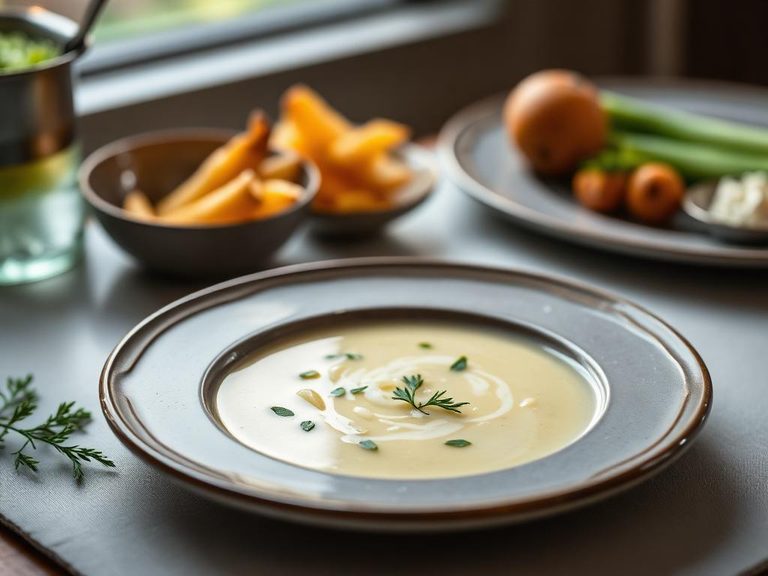
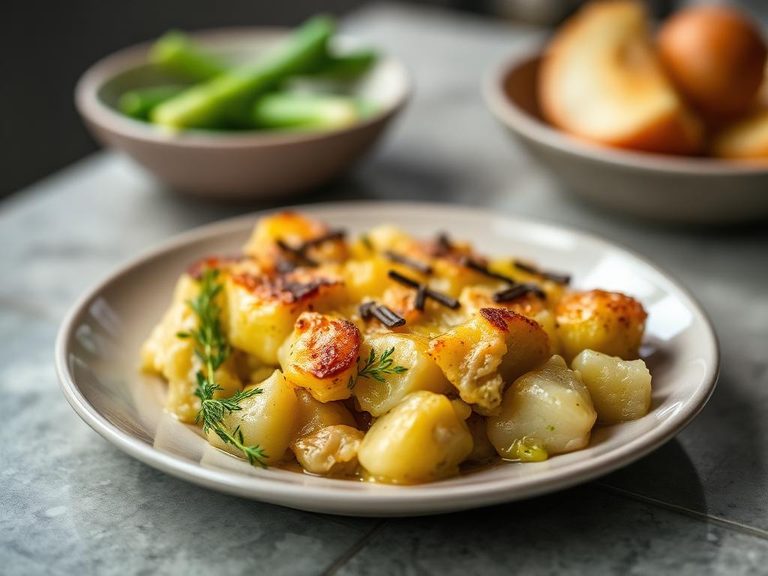
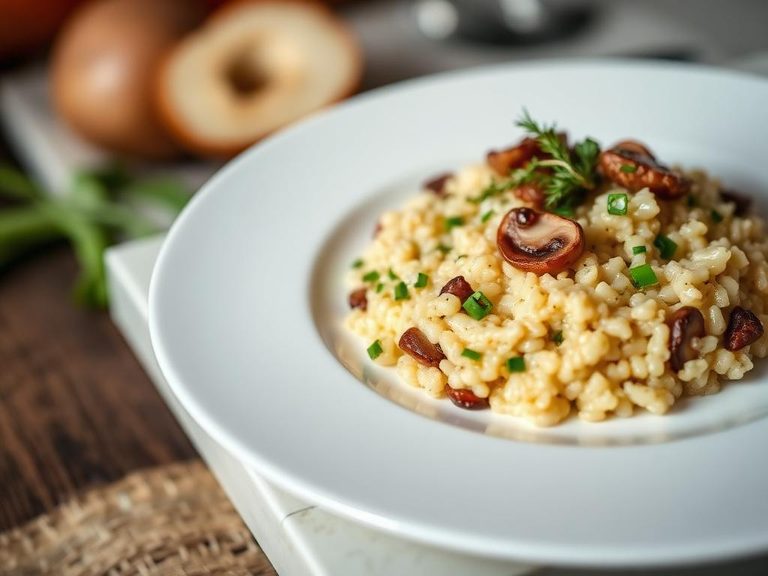
People love leeks for their unique ability to provide a deep, savory, and slightly sweet allium base to dishes without overwhelming other ingredients. Their versatility shines in everything from creamy soups to elegant tarts, and they are a cornerstone of classic French and Welsh cuisine.
⚠️ Watch-outs & how to enjoy it better
Their layered structure can trap grit and sand, requiring thorough cleaning. Those following a low-FODMAP diet may need to limit portions, as leeks contain fructans that can cause digestive discomfort in sensitive individuals. To counteract this, cook them thoroughly and use only the green tops, which are lower in fructans, or opt for the green parts in infused oils.
Key benefits
- Excellent source of vitamin K for bone health.
- Contains prebiotic fiber to feed beneficial gut bacteria.
- Rich in antioxidant flavonoids like kaempferol.
- Low-calorie, high-volume vegetable for satiety.
- Provides manganese for metabolism and bone formation.
🍽️ Popular dishes



🌍 Where it's eaten
💡 Did you know?
The ancient Egyptians, Greeks, and Romans valued leeks not just as food but as medicine; the Roman Emperor Nero was said to have eaten leeks daily to improve the clarity of his singing voice.
Full nutrition (USDA data · scales with serving)
| Water | 79.2 g |
| Energy | 88.0 kcal |
| Protein | 1.6 g |
| Total lipid (fat) | 3.0 g |
| Carbohydrate, by difference | 14.7 g |
| Fiber, total dietary | 1.9 g |
| Total Sugars | 4.1 g |
| Calcium, Ca | 62.0 mg |
| Iron, Fe | 2.2 mg |
| Magnesium, Mg | 29.0 mg |
| Phosphorus, P | 37.0 mg |
| Potassium, K | 188 mg |
| Sodium, Na | 151 mg |
| Zinc, Zn | 0.13 mg |
| Copper, Cu | 0.13 mg |
| Selenium, Se | 1.0 ug |
| Vitamin C, total ascorbic acid | 10.6 mg |
| Thiamin | 0.06 mg |
| Riboflavin | 0.03 mg |
| Niacin | 0.40 mg |
| Vitamin B-6 | 0.24 mg |
| Folate, total | 57.0 ug |
| Folic acid | 0.00 ug |
| Folate, food | 57.0 ug |
| Folate, DFE | 57.0 ug |
| Choline, total | 10.1 mg |
| Vitamin B-12 | 0.00 ug |
| Vitamin B-12, added | 0.00 ug |
| Vitamin A, RAE | 94.0 ug |
| Retinol | 12.0 ug |
| Carotene, beta | 994 ug |
| Carotene, alpha | 0.00 ug |
| Cryptoxanthin, beta | 0.00 ug |
| Lycopene | 0.00 ug |
| Lutein + zeaxanthin | 1879 ug |
| Vitamin E (alpha-tocopherol) | 1.4 mg |
| Vitamin E, added | 0.00 mg |
| Vitamin D (D2 + D3) | 0.00 ug |
| Vitamin K (phylloquinone) | 51.2 ug |
| Alcohol, ethyl | 0.00 g |
| Caffeine | 0.00 mg |
| Theobromine | 0.00 mg |
Fat & fatty acid profile (per 100g)
| Fatty acids, total saturated | 0.76 g |
| SFA 4:0 | 0.02 g |
| SFA 6:0 | 0.01 g |
| SFA 8:0 | 0.01 g |
| SFA 10:0 | 0.02 g |
| SFA 12:0 | 0.02 g |
| SFA 14:0 | 0.07 g |
| SFA 16:0 | 0.43 g |
| SFA 18:0 | 0.15 g |
| Fatty acids, total monounsaturated | 0.98 g |
| MUFA 16:1 | 0.01 g |
| MUFA 18:1 | 0.94 g |
| MUFA 20:1 | 0.01 g |
| MUFA 22:1 | 0.00 g |
| Fatty acids, total polyunsaturated | 0.96 g |
| PUFA 18:2 | 0.77 g |
| PUFA 18:3 | 0.19 g |
| PUFA 18:4 | 0.00 g |
| PUFA 20:4 | 0.00 g |
| PUFA 20:5 n-3 (EPA) | 0.00 g |
| PUFA 22:5 n-3 (DPA) | 0.00 g |
| PUFA 22:6 n-3 (DHA) | 0.00 g |
| Cholesterol | 2.0 mg |
Amino acid profile (per 100g)
Estimated from Leeks, (bulb and lower leaf-portion), cooked, boiled, drained, without salt — USDA does not publish this profile for Leeks.
| Tryptophan | 0.01 g |
| Threonine | 0.03 g |
| Isoleucine | 0.03 g |
| Leucine | 0.05 g |
| Lysine | 0.04 g |
| Methionine | 0.01 g |
| Cystine | 0.01 g |
| Phenylalanine | 0.03 g |
| Tyrosine | 0.02 g |
| Valine | 0.03 g |
| Arginine | 0.04 g |
| Histidine | 0.01 g |
| Alanine | 0.04 g |
| Aspartic acid | 0.08 g |
| Glutamic acid | 0.12 g |
| Glycine | 0.04 g |
| Proline | 0.04 g |
| Serine | 0.05 g |
FAQ
What's the difference between a leek and a green onion?
Leeks are much larger with a thick, cylindrical white stalk and broad, flat green leaves. Their flavor is milder and sweeter than the sharper, more pungent taste of green onions (scallions).
How do you properly clean a leek?
After trimming the root end and dark green tops, slice the leek lengthwise, then chop into half-moons. Submerge the pieces in a bowl of cold water, agitate to loosen dirt, and let the grit settle to the bottom before scooping the clean leeks out.
Can you eat the dark green parts?
Yes, the dark green leaves are edible but are tougher and have a stronger flavor. They are best used for making stocks, broths, or bouquet garni rather than in dishes where a tender texture is desired.
Nutrient density (calculated · NRF9.3)
Nutrient Rich Foods index: beneficial nutrients (protein, fiber, vitamins, minerals) minus saturated fat, added sugar & sodium, per 100 kcal.
NRF9.3 index — Fulgoni, Keast & Drewnowski, 2009. Computed from USDA nutrients.
Weight-loss friendliness (composite index)
Energy density 0.88 kcal/g · 7% calories from protein · 1.9 g fiber · 4.1 g sugar per 100 g.
Composite of energy density (Rolls et al., 1999), protein & fiber satiety, minus sugar. A calculated heuristic — ranks satiety-per-calorie, not a clinical measure.
Dietary load (calculated from USDA values)
Potential renal acid load. Positive = acid-forming, negative = alkaline-forming.
Sodium-to-potassium ratio: 0.80 (lower is better — aim for ≤ 1)
Sodium:potassium per WHO potassium guidance. Computed from USDA nutrients.