

Lasagna with meat, from restaurant
Common food
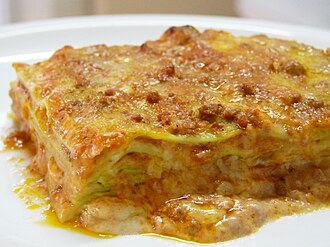
Photo: Wikipedia
This is a classic, hearty slice of restaurant-style meat lasagna, featuring layers of tender pasta, rich tomato-meat sauce, and melted cheese. The texture is a satisfying blend of soft, yielding noodles, savory ground meat, and creamy, slightly stringy cheese. With a balanced macronutrient profile per 100g, it provides a substantial source of protein and fat alongside its carbohydrate content.
Calorie split: 23% protein · 25% carbs · 52% fat
↓ Full nutrition💚 Why it's loved
People love it for its comforting, savory depth—the umami-rich meat sauce, creamy cheese, and tender pasta create a harmonious, indulgent experience. It's a cultural staple that evokes family gatherings and restaurant indulgence, often seen as a celebratory or comfort food.
⚠️ Watch-outs & how to enjoy it better
It can be high in sodium and saturated fat, which may be a concern for those monitoring heart health or blood pressure. To counteract this, pair a moderate portion with a large side salad or steamed vegetables to add fiber and volume, and choose a restaurant version with less cheese or leaner meat if possible.
Key benefits
- Provides a good source of protein from meat and dairy
- Contains calcium and phosphorus from cheese for bone health
- Offers iron and B vitamins from the meat component
- Delivers a balanced mix of protein, carbs, and fats for satiety
- A complete, satisfying meal in a single serving
🍽️ Popular dishes
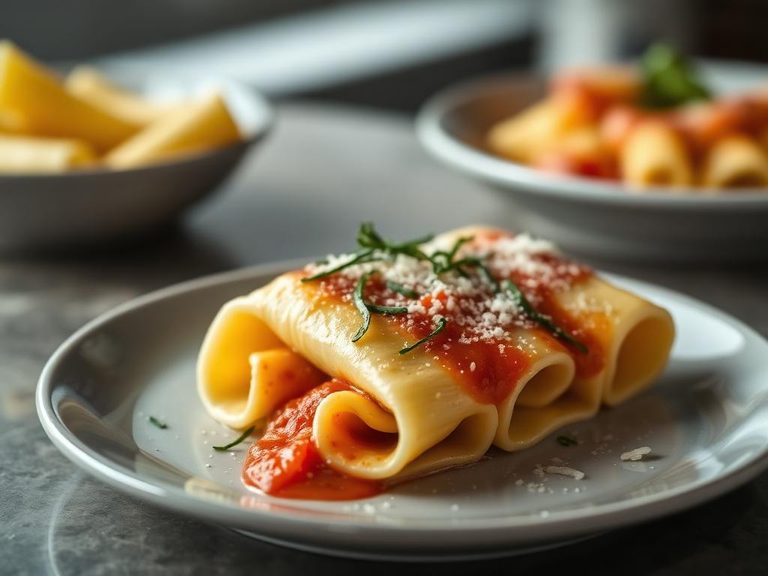
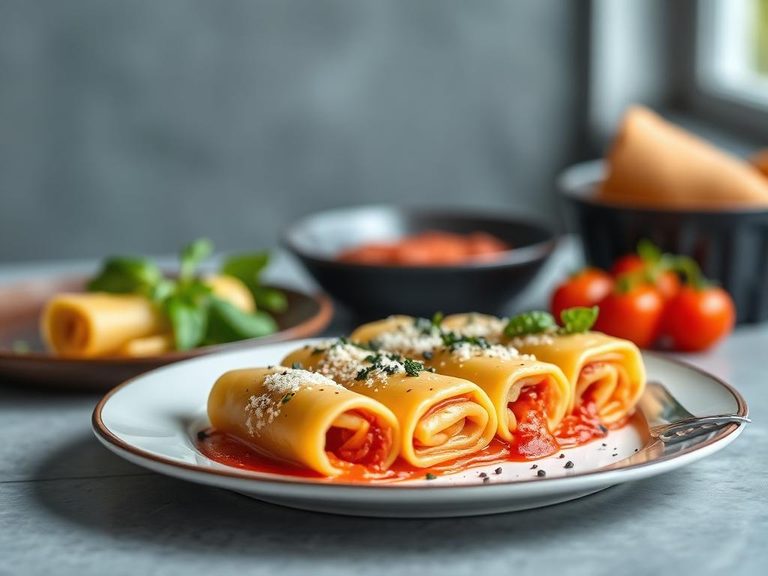
🌍 Where it's eaten
💡 Did you know?
The word 'lasagna' likely derives from the Greek 'lasanon,' meaning a large cooking pot or cauldron, not the pasta itself.
Full nutrition (USDA data · scales with serving)
| Water | 64.9 g |
| Energy | 185 kcal |
| Protein | 10.8 g |
| Total lipid (fat) | 10.7 g |
| Carbohydrate, by difference | 11.4 g |
| Fiber, total dietary | 1.5 g |
| Total Sugars | 3.1 g |
| Calcium, Ca | 197 mg |
| Iron, Fe | 0.79 mg |
| Magnesium, Mg | 22.0 mg |
| Phosphorus, P | 178 mg |
| Potassium, K | 255 mg |
| Sodium, Na | 466 mg |
| Zinc, Zn | 1.3 mg |
| Copper, Cu | 0.07 mg |
| Selenium, Se | 18.0 ug |
| Vitamin C, total ascorbic acid | 0.70 mg |
| Thiamin | 0.14 mg |
| Riboflavin | 0.24 mg |
| Niacin | 1.8 mg |
| Vitamin B-6 | 0.12 mg |
| Folate, total | 26.0 ug |
| Folic acid | 17.0 ug |
| Folate, food | 8.0 ug |
| Folate, DFE | 38.0 ug |
| Choline, total | 33.5 mg |
| Vitamin B-12 | 0.66 ug |
| Vitamin B-12, added | 0.00 ug |
| Vitamin A, RAE | 81.0 ug |
| Retinol | 64.0 ug |
| Carotene, beta | 197 ug |
| Carotene, alpha | 9.0 ug |
| Cryptoxanthin, beta | 0.00 ug |
| Lycopene | 2517 ug |
| Lutein + zeaxanthin | 97.0 ug |
| Vitamin E (alpha-tocopherol) | 0.91 mg |
| Vitamin E, added | 0.00 mg |
| Vitamin D (D2 + D3) | 0.00 ug |
| Vitamin K (phylloquinone) | 6.8 ug |
| Alcohol, ethyl | 0.00 g |
| Caffeine | 0.00 mg |
| Theobromine | 0.00 mg |
Fat & fatty acid profile (per 100g)
| Fatty acids, total saturated | 4.9 g |
| SFA 4:0 | 0.12 g |
| SFA 6:0 | 0.10 g |
| SFA 8:0 | 0.07 g |
| SFA 10:0 | 0.17 g |
| SFA 12:0 | 0.19 g |
| SFA 14:0 | 0.66 g |
| SFA 16:0 | 2.4 g |
| SFA 18:0 | 1.0 g |
| Fatty acids, total monounsaturated | 3.3 g |
| MUFA 16:1 | 0.18 g |
| MUFA 18:1 | 3.0 g |
| MUFA 20:1 | 0.03 g |
| MUFA 22:1 | 0.00 g |
| Fatty acids, total polyunsaturated | 0.79 g |
| PUFA 18:2 | 0.67 g |
| PUFA 18:3 | 0.06 g |
| PUFA 18:4 | 0.00 g |
| PUFA 20:4 | 0.02 g |
| PUFA 20:5 n-3 (EPA) | 0.00 g |
| PUFA 22:5 n-3 (DPA) | 0.01 g |
| PUFA 22:6 n-3 (DHA) | 0.00 g |
| Cholesterol | 36.0 mg |
Amino acid profile (per 100g)
Estimated from Restaurant, Italian, lasagna with meat — USDA does not publish this profile for Lasagna with meat.
| Tryptophan | 0.13 g |
| Threonine | 0.38 g |
| Isoleucine | 0.42 g |
| Leucine | 0.86 g |
| Lysine | 0.82 g |
| Methionine | 0.25 g |
| Cystine | 0.11 g |
| Phenylalanine | 0.49 g |
| Tyrosine | 0.36 g |
| Valine | 0.46 g |
| Arginine | 0.47 g |
| Histidine | 0.28 g |
| Alanine | 0.41 g |
| Aspartic acid | 0.77 g |
| Glutamic acid | 2.1 g |
| Glycine | 0.35 g |
| Proline | 1.1 g |
| Serine | 0.50 g |
| Hydroxyproline | 0.07 g |
FAQ
Is restaurant lasagna healthier than homemade?
Not necessarily. Restaurant versions often use more cheese, cream, and salt for richer flavor, which can increase calories and sodium. Homemade allows control over ingredients like lean meat, reduced-fat cheese, and added vegetables.
Can I eat lasagna on a low-carb diet?
Traditional lasagna is high in carbs from pasta, but you can make a low-carb version using zucchini or eggplant slices instead of noodles, or try a 'lasagna bowl' with extra vegetables and less pasta.
What's the best way to store leftover lasagna?
Store in an airtight container in the refrigerator for up to 3-4 days. For longer storage, freeze portions in freezer-safe containers for up to 3 months. Reheat thoroughly to an internal temperature of 165°F (74°C).
Nutrient density (calculated · NRF9.3)
Nutrient Rich Foods index: beneficial nutrients (protein, fiber, vitamins, minerals) minus saturated fat, added sugar & sodium, per 100 kcal.
NRF9.3 index — Fulgoni, Keast & Drewnowski, 2009. Computed from USDA nutrients.
Weight-loss friendliness (composite index)
Energy density 1.85 kcal/g · 23% calories from protein · 1.5 g fiber · 3.1 g sugar per 100 g.
Composite of energy density (Rolls et al., 1999), protein & fiber satiety, minus sugar. A calculated heuristic — ranks satiety-per-calorie, not a clinical measure.
Dietary load (calculated from USDA values)
Potential renal acid load. Positive = acid-forming, negative = alkaline-forming.
Sodium-to-potassium ratio: 1.83 (lower is better — aim for ≤ 1)
Sodium:potassium per WHO potassium guidance. Computed from USDA nutrients.