

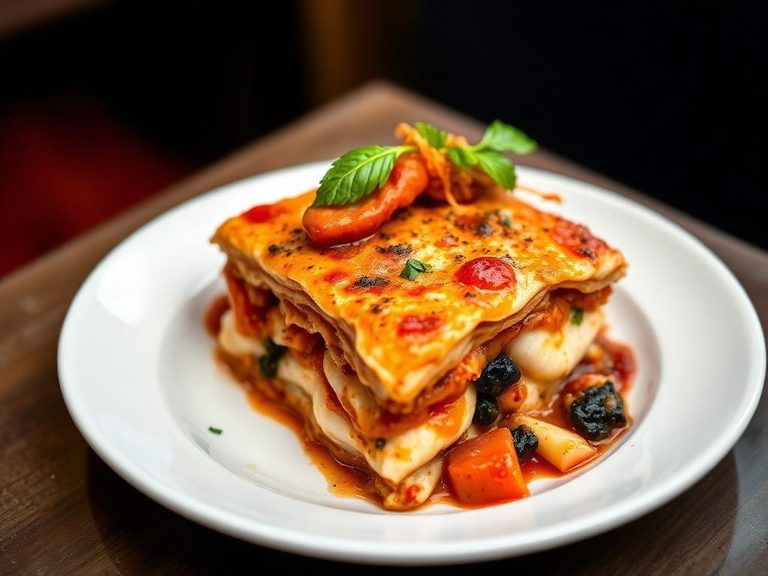
Lasagna with meat
Common food
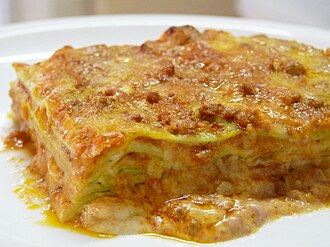
Photo: Wikipedia
Lasagna with meat is a layered pasta casserole featuring sheets of pasta, a savory meat-based ragù, creamy béchamel or ricotta, and melted cheese, baked until bubbly and golden. Each bite offers a rich, hearty texture with a balance of tender pasta, savory meat, and creamy, cheesy layers. Nutritionally, it provides a solid source of protein and carbohydrates, making it a satisfying, energy-dense meal.
Calorie split: 21% protein · 46% carbs · 32% fat
↓ Full nutrition💚 Why it's loved
People love lasagna for its comforting, layered flavors that meld together during baking, creating a deeply savory and satisfying dish. It's a versatile centerpiece for family gatherings and celebrations, embodying the warmth of Italian home cooking.
⚠️ Watch-outs & how to enjoy it better
The dish can be high in sodium and saturated fat, which may concern those monitoring heart health or blood pressure. To counteract this, use lean ground meat, reduce added salt, and pair with a large, vinegar-dressed side salad to balance the meal. Those watching blood sugar should be mindful of portion size, as the refined pasta and cheese can cause spikes; adding extra vegetables like spinach or zucchini to the layers can help.
Key benefits
- Good source of protein for muscle maintenance
- Provides energy from complex carbohydrates
- Contains calcium from cheese for bone health
- Iron from meat supports oxygen transport
- Fiber from pasta and sauce aids digestion
🍽️ Popular dishes

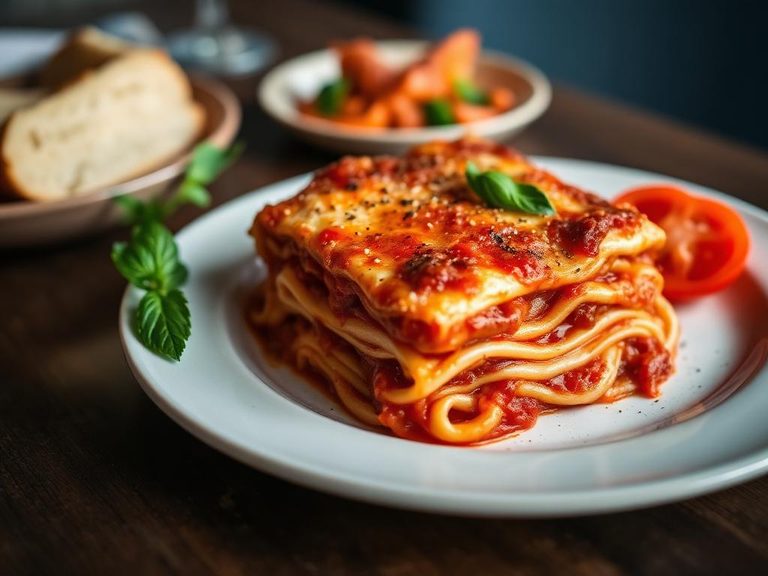
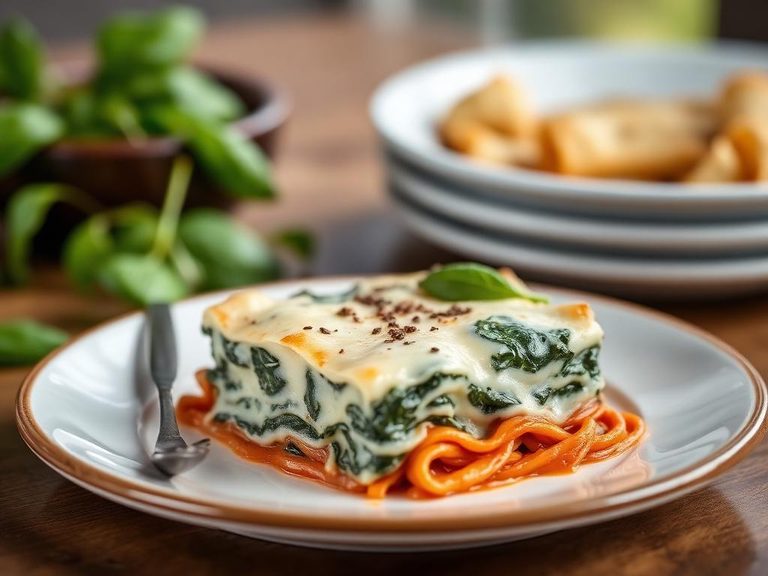
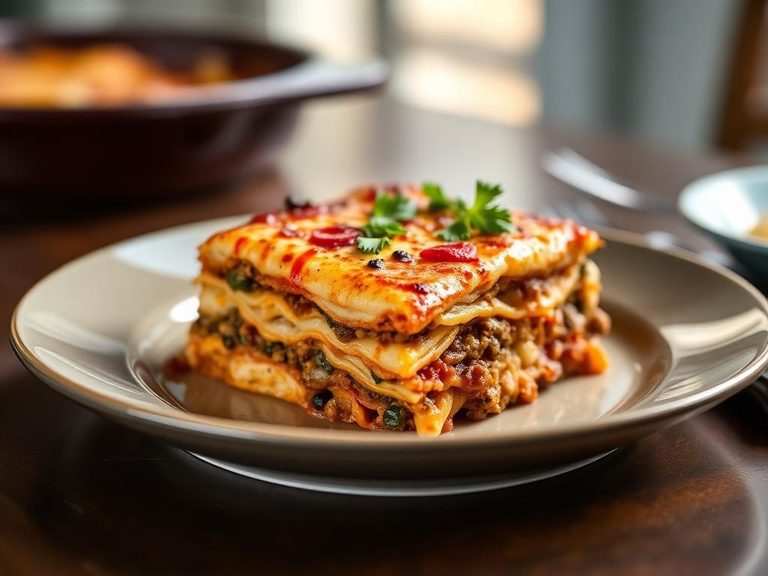
🌍 Where it's eaten
💡 Did you know?
The word 'lasagna' likely comes from the Greek 'lasanon,' meaning a large cooking pot or chamber pot, which was later adopted by the Romans to refer to the cookware used to make the layered dish.
Full nutrition (USDA data · scales with serving)
| Water | 69.8 g |
| Energy | 139 kcal |
| Protein | 7.5 g |
| Total lipid (fat) | 5.0 g |
| Carbohydrate, by difference | 16.2 g |
| Fiber, total dietary | 1.6 g |
| Total Sugars | 3.3 g |
| Calcium, Ca | 82.0 mg |
| Iron, Fe | 0.73 mg |
| Magnesium, Mg | 20.0 mg |
| Phosphorus, P | 115 mg |
| Potassium, K | 207 mg |
| Sodium, Na | 390 mg |
| Zinc, Zn | 0.89 mg |
| Copper, Cu | 0.10 mg |
| Selenium, Se | 16.6 ug |
| Vitamin C, total ascorbic acid | 4.4 mg |
| Thiamin | 0.06 mg |
| Riboflavin | 0.06 mg |
| Niacin | 1.6 mg |
| Vitamin B-6 | 0.14 mg |
| Folate, total | 15.0 ug |
| Folic acid | 12.0 ug |
| Folate, food | 3.0 ug |
| Folate, DFE | 23.0 ug |
| Choline, total | 17.2 mg |
| Vitamin B-12 | 0.83 ug |
| Vitamin B-12, added | 0.00 ug |
| Vitamin A, RAE | 42.0 ug |
| Retinol | 20.0 ug |
| Carotene, beta | 249 ug |
| Carotene, alpha | 8.0 ug |
| Cryptoxanthin, beta | 2.0 ug |
| Lycopene | 3764 ug |
| Lutein + zeaxanthin | 197 ug |
| Vitamin E (alpha-tocopherol) | 0.98 mg |
| Vitamin E, added | 0.00 mg |
| Vitamin D (D2 + D3) | 0.00 ug |
| Vitamin K (phylloquinone) | 6.6 ug |
| Alcohol, ethyl | 0.00 g |
| Caffeine | 0.00 mg |
| Theobromine | 0.00 mg |
Fat & fatty acid profile (per 100g)
| Fatty acids, total saturated | 2.3 g |
| SFA 4:0 | 0.04 g |
| SFA 6:0 | 0.03 g |
| SFA 8:0 | 0.02 g |
| SFA 10:0 | 0.05 g |
| SFA 12:0 | 0.06 g |
| SFA 14:0 | 0.26 g |
| SFA 16:0 | 1.2 g |
| SFA 18:0 | 0.59 g |
| Fatty acids, total monounsaturated | 1.8 g |
| MUFA 16:1 | 0.14 g |
| MUFA 18:1 | 1.6 g |
| MUFA 20:1 | 0.01 g |
| MUFA 22:1 | 0.00 g |
| Fatty acids, total polyunsaturated | 0.40 g |
| PUFA 18:2 | 0.35 g |
| PUFA 18:3 | 0.03 g |
| PUFA 18:4 | 0.00 g |
| PUFA 20:4 | 0.01 g |
| PUFA 20:5 n-3 (EPA) | 0.00 g |
| PUFA 22:5 n-3 (DPA) | 0.00 g |
| PUFA 22:6 n-3 (DHA) | 0.00 g |
| Cholesterol | 16.0 mg |
Amino acid profile (per 100g)
Estimated from Restaurant, Italian, lasagna with meat — USDA does not publish this profile for Lasagna with meat.
| Tryptophan | 0.13 g |
| Threonine | 0.38 g |
| Isoleucine | 0.42 g |
| Leucine | 0.86 g |
| Lysine | 0.82 g |
| Methionine | 0.25 g |
| Cystine | 0.11 g |
| Phenylalanine | 0.49 g |
| Tyrosine | 0.36 g |
| Valine | 0.46 g |
| Arginine | 0.47 g |
| Histidine | 0.28 g |
| Alanine | 0.41 g |
| Aspartic acid | 0.77 g |
| Glutamic acid | 2.1 g |
| Glycine | 0.35 g |
| Proline | 1.1 g |
| Serine | 0.50 g |
| Hydroxyproline | 0.07 g |
FAQ
What's the difference between lasagna and lasagne?
'Lasagne' is the Italian plural for the pasta sheets, while 'lasagna' is the common English term for the assembled dish. In Italy, 'lasagne' refers to the pasta itself, and the dish is often called 'lasagne al forno' (baked lasagna).
Can I make lasagna ahead of time?
Yes, lasagna is ideal for making ahead. Assemble it, cover tightly, and refrigerate for up to 24 hours before baking. This allows the flavors to meld. You can also freeze unbaked or baked lasagna for up to 3 months.
Why is my lasagna watery?
Watery lasagna often comes from not draining the ricotta cheese, using overly wet vegetables (like uncooked spinach), or not letting the dish rest after baking. Letting it sit for 10-15 minutes before slicing allows the layers to set and absorb excess moisture.
Nutrient density (calculated · NRF9.3)
Nutrient Rich Foods index: beneficial nutrients (protein, fiber, vitamins, minerals) minus saturated fat, added sugar & sodium, per 100 kcal.
NRF9.3 index — Fulgoni, Keast & Drewnowski, 2009. Computed from USDA nutrients.
Weight-loss friendliness (composite index)
Energy density 1.39 kcal/g · 21% calories from protein · 1.6 g fiber · 3.3 g sugar per 100 g.
Composite of energy density (Rolls et al., 1999), protein & fiber satiety, minus sugar. A calculated heuristic — ranks satiety-per-calorie, not a clinical measure.
Dietary load (calculated from USDA values)
Potential renal acid load. Positive = acid-forming, negative = alkaline-forming.
Sodium-to-potassium ratio: 1.88 (lower is better — aim for ≤ 1)
Sodium:potassium per WHO potassium guidance. Computed from USDA nutrients.