

Kung Pao beef
Common food
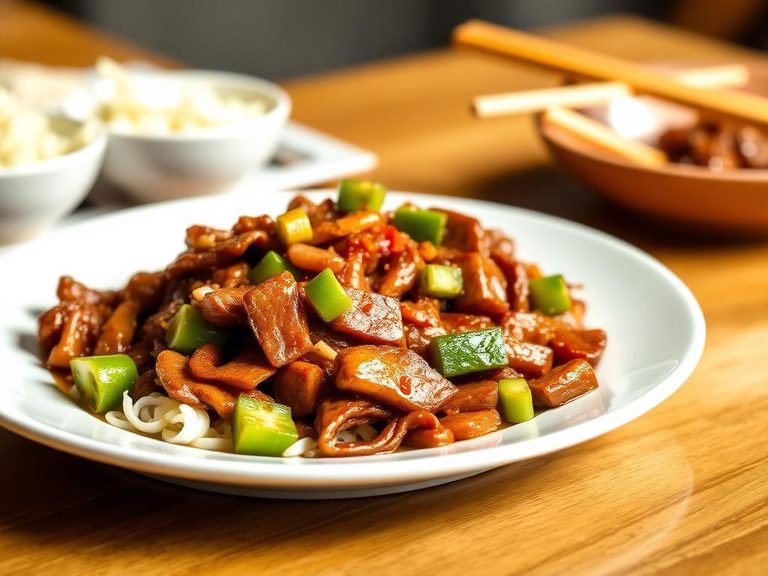
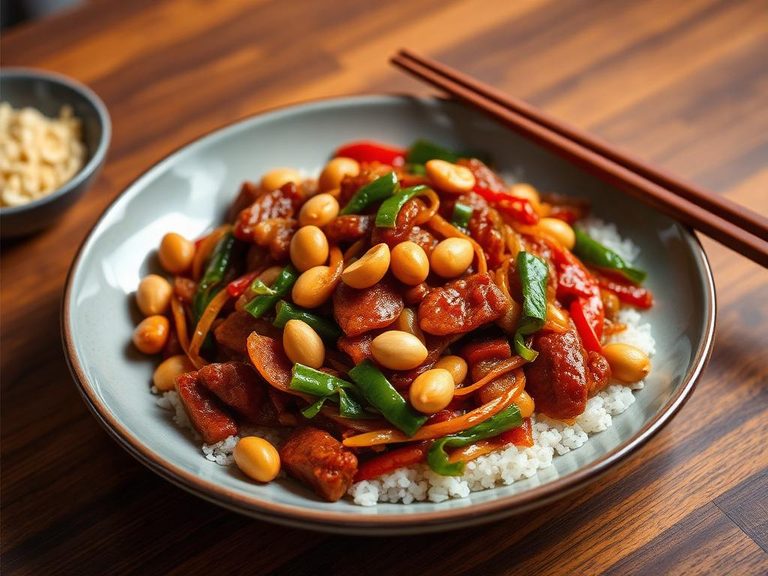
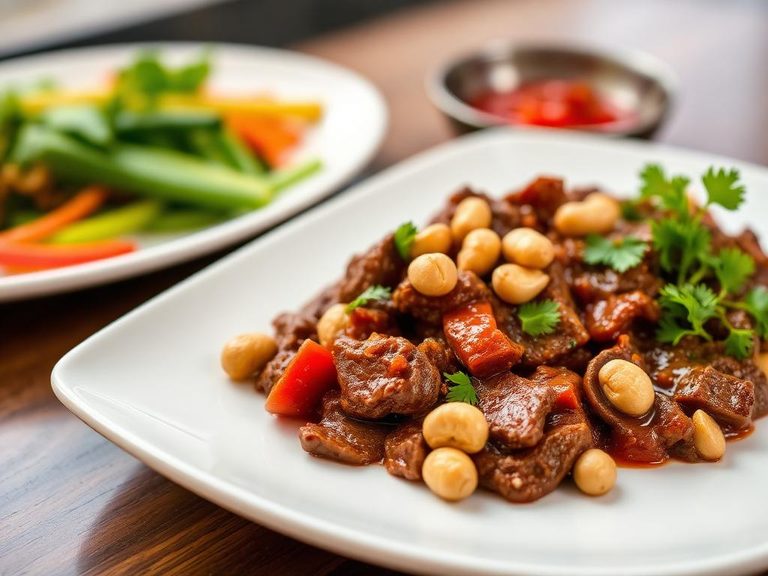
Kung Pao beef is a fiery Sichuan stir-fry where tender strips of beef are tossed with peanuts, dried chilies, and Sichuan peppercorns in a savory-sweet, glossy sauce. The texture is a delightful contrast: juicy beef, crunchy peanuts, and the signature numbing 'ma la' tingle from the peppercorns. Nutritionally, it's a protein-packed dish with a moderate calorie count, though its fat content comes largely from the cooking oil and peanuts.
Calorie split: 33% protein · 8% carbs · 59% fat
↓ Full nutrition💚 Why it's loved
People adore the complex 'málà' (numbing-spicy) flavor profile that is both addictive and deeply satisfying. It's a beloved staple of Sichuan cuisine, celebrated for its bold, layered taste and the exciting textural contrast between the meat and peanuts.
⚠️ Watch-outs & how to enjoy it better
The dish can be high in sodium from soy sauce and MSG, and its oil content may be a concern for some. Those watching blood sugar should be mindful of the added sugar in the sauce. To mitigate, you can request less sauce, pair it with plain steamed rice or fiber-rich vegetables to slow sugar absorption, and ensure the beef is not overcooked to preserve tenderness.
Key benefits
- High-quality protein source for muscle maintenance
- Contains capsaicin from chilies, which may boost metabolism
- Sichuan peppercorns may aid digestion and have anti-inflammatory properties
- Provides healthy monounsaturated fats from peanuts
- Iron and B vitamins from the beef
🍽️ Popular dishes
🌍 Where it's eaten
💡 Did you know?
The dish is named after Ding Baozhen, a late Qing Dynasty official whose title was 'Gōng Bǎo' (Palace Guardian), and the name was later adapted to 'Kung Pao' in English.
Full nutrition (USDA data · scales with serving)
| Water | 61.9 g |
| Energy | 216 kcal |
| Protein | 17.9 g |
| Total lipid (fat) | 14.4 g |
| Carbohydrate, by difference | 4.5 g |
| Fiber, total dietary | 1.0 g |
| Total Sugars | 1.4 g |
| Calcium, Ca | 16.0 mg |
| Iron, Fe | 1.6 mg |
| Magnesium, Mg | 29.0 mg |
| Phosphorus, P | 136 mg |
| Potassium, K | 225 mg |
| Sodium, Na | 175 mg |
| Zinc, Zn | 2.9 mg |
| Copper, Cu | 0.09 mg |
| Selenium, Se | 17.1 ug |
| Vitamin C, total ascorbic acid | 11.7 mg |
| Thiamin | 0.06 mg |
| Riboflavin | 0.12 mg |
| Niacin | 4.1 mg |
| Vitamin B-6 | 0.28 mg |
| Folate, total | 20.0 ug |
| Folic acid | 0.00 ug |
| Folate, food | 20.0 ug |
| Folate, DFE | 20.0 ug |
| Choline, total | 65.9 mg |
| Vitamin B-12 | 0.87 ug |
| Vitamin B-12, added | 0.00 ug |
| Vitamin A, RAE | 15.0 ug |
| Retinol | 0.00 ug |
| Carotene, beta | 159 ug |
| Carotene, alpha | 2.0 ug |
| Cryptoxanthin, beta | 41.0 ug |
| Lycopene | 0.00 ug |
| Lutein + zeaxanthin | 49.0 ug |
| Vitamin E (alpha-tocopherol) | 1.7 mg |
| Vitamin E, added | 0.00 mg |
| Vitamin D (D2 + D3) | 0.10 ug |
| Vitamin K (phylloquinone) | 14.4 ug |
| Alcohol, ethyl | 0.00 g |
| Caffeine | 0.00 mg |
| Theobromine | 0.00 mg |
Fat & fatty acid profile (per 100g)
| Fatty acids, total saturated | 3.2 g |
| SFA 4:0 | 0.00 g |
| SFA 6:0 | 0.00 g |
| SFA 8:0 | 0.00 g |
| SFA 10:0 | 0.01 g |
| SFA 12:0 | 0.01 g |
| SFA 14:0 | 0.14 g |
| SFA 16:0 | 2.0 g |
| SFA 18:0 | 0.78 g |
| Fatty acids, total monounsaturated | 6.5 g |
| MUFA 16:1 | 0.21 g |
| MUFA 18:1 | 6.2 g |
| MUFA 20:1 | 0.09 g |
| MUFA 22:1 | 0.01 g |
| Fatty acids, total polyunsaturated | 3.3 g |
| PUFA 18:2 | 3.0 g |
| PUFA 18:3 | 0.26 g |
| PUFA 18:4 | 0.00 g |
| PUFA 20:4 | 0.01 g |
| PUFA 20:5 n-3 (EPA) | 0.00 g |
| PUFA 22:5 n-3 (DPA) | 0.01 g |
| PUFA 22:6 n-3 (DHA) | 0.00 g |
| Cholesterol | 46.0 mg |
Amino acid profile (per 100g)
Estimated from Restaurant, Chinese, kung pao chicken — USDA does not publish this profile for Kung Pao beef.
| Tryptophan | 0.12 g |
| Threonine | 0.41 g |
| Isoleucine | 0.43 g |
| Leucine | 0.78 g |
| Lysine | 0.45 g |
| Methionine | 0.24 g |
| Cystine | 0.10 g |
| Phenylalanine | 0.40 g |
| Tyrosine | 0.35 g |
| Valine | 0.47 g |
| Arginine | 0.64 g |
| Histidine | 0.27 g |
| Alanine | 0.57 g |
| Aspartic acid | 0.97 g |
| Glutamic acid | 1.8 g |
| Glycine | 0.40 g |
| Proline | 0.34 g |
| Serine | 0.40 g |
FAQ
Is Kung Pao beef very spicy?
Authentic versions are moderately to very spicy, with heat from dried chilies and a unique numbing sensation from Sichuan peppercorns. Restaurants often adjust the spice level to order.
What makes it different from Kung Pao chicken?
The primary difference is the protein: beef versus chicken. The sauce, peanuts, and chili-peppercorn base are very similar, though beef may require slightly different slicing and marinating for tenderness.
Can I make a healthier version at home?
Yes. Use lean beef, reduce the oil and sugar in the sauce, increase the proportion of vegetables like bell peppers or zucchini, and serve it over brown rice or cauliflower rice.
Nutrient density (calculated · NRF9.3)
Nutrient Rich Foods index: beneficial nutrients (protein, fiber, vitamins, minerals) minus saturated fat, added sugar & sodium, per 100 kcal.
NRF9.3 index — Fulgoni, Keast & Drewnowski, 2009. Computed from USDA nutrients.
Weight-loss friendliness (composite index)
Energy density 2.16 kcal/g · 33% calories from protein · 1.0 g fiber · 1.4 g sugar per 100 g.
Composite of energy density (Rolls et al., 1999), protein & fiber satiety, minus sugar. A calculated heuristic — ranks satiety-per-calorie, not a clinical measure.
Dietary load (calculated from USDA values)
Potential renal acid load. Positive = acid-forming, negative = alkaline-forming.
Sodium-to-potassium ratio: 0.78 (lower is better — aim for ≤ 1)
Sodium:potassium per WHO potassium guidance. Computed from USDA nutrients.