

Hamburger, NFS
Common food
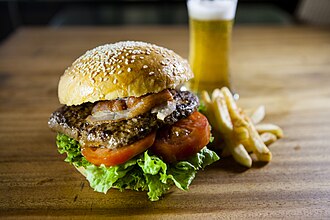
Photo: Wikipedia
A hamburger, NFS (not further specified), is a quintessential sandwich featuring a ground meat patty—typically beef—served within a sliced bun. Its appeal lies in the satisfying contrast of a juicy, savory patty against a soft, yielding bread, often enhanced by toppings. Nutritionally, it delivers a substantial protein punch (17.51g per 100g) alongside a significant calorie and fat content from the meat and bun.
Calorie split: 25% protein · 29% carbs · 46% fat
↓ Full nutrition💚 Why it's loved
People love it for its deeply satisfying umami flavor from the seared meat and its comforting, familiar texture. Its ultimate versatility allows it to be dressed up or down, fitting seamlessly from backyard barbecues to gourmet restaurants.
⚠️ Watch-outs & how to enjoy it better
Its downsides include being high in saturated fat and sodium, which can be a concern for heart health, and the refined carbohydrate bun can cause blood-sugar spikes. To counteract, choose a whole-grain bun, load up on lettuce, tomato, and onion for fiber, and consider a leaner patty like turkey or a plant-based option.
Key benefits
- Excellent source of complete protein for muscle maintenance.
- Provides essential nutrients like iron, zinc, and B vitamins from the meat patty.
- Highly customizable to incorporate vegetables and other nutrient-dense toppings.
- Convenient and calorie-dense, making it a quick source of energy.
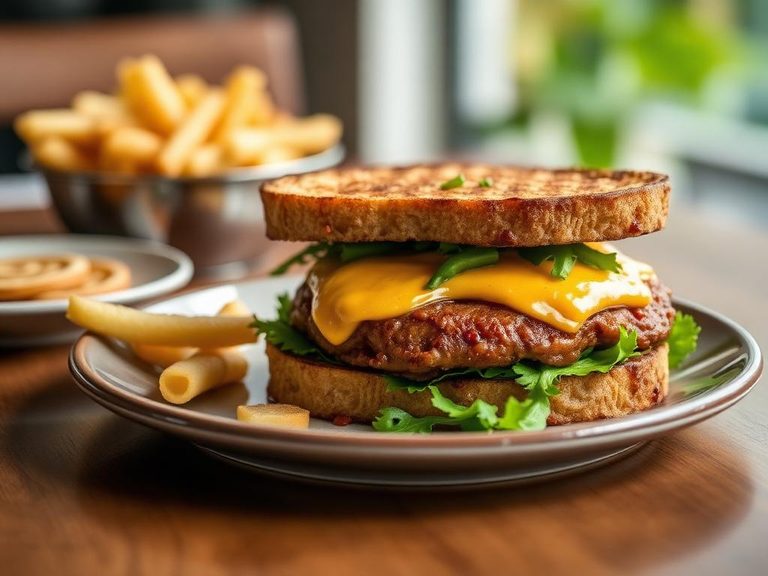
🍽️ Popular dishes





🌍 Where it's eaten
💡 Did you know?
The term 'hamburger' likely derives from Hamburg, Germany, where a similar style of minced beef steak was popular, but the sandwich form we know was perfected in the United States in the late 19th or early 20th century.
Full nutrition (USDA data · scales with serving)
| Water | 45.7 g |
| Energy | 288 kcal |
| Protein | 17.5 g |
| Total lipid (fat) | 14.4 g |
| Carbohydrate, by difference | 20.7 g |
| Fiber, total dietary | 0.70 g |
| Total Sugars | 3.0 g |
| Calcium, Ca | 66.0 mg |
| Iron, Fe | 2.8 mg |
| Magnesium, Mg | 21.0 mg |
| Phosphorus, P | 143 mg |
| Potassium, K | 229 mg |
| Sodium, Na | 355 mg |
| Zinc, Zn | 3.1 mg |
| Copper, Cu | 0.09 mg |
| Selenium, Se | 23.8 ug |
| Vitamin C, total ascorbic acid | 0.50 mg |
| Thiamin | 0.24 mg |
| Riboflavin | 0.23 mg |
| Niacin | 4.8 mg |
| Vitamin B-6 | 0.28 mg |
| Folate, total | 51.0 ug |
| Folic acid | 22.0 ug |
| Folate, food | 29.0 ug |
| Folate, DFE | 66.0 ug |
| Choline, total | 49.6 mg |
| Vitamin B-12 | 1.6 ug |
| Vitamin B-12, added | 0.00 ug |
| Vitamin A, RAE | 0.00 ug |
| Retinol | 0.00 ug |
| Carotene, beta | 0.00 ug |
| Carotene, alpha | 0.00 ug |
| Cryptoxanthin, beta | 0.00 ug |
| Lycopene | 0.00 ug |
| Lutein + zeaxanthin | 2.0 ug |
| Vitamin E (alpha-tocopherol) | 0.11 mg |
| Vitamin E, added | 0.00 mg |
| Vitamin D (D2 + D3) | 0.10 ug |
| Vitamin K (phylloquinone) | 3.3 ug |
| Alcohol, ethyl | 0.00 g |
| Caffeine | 0.00 mg |
| Theobromine | 0.00 mg |
Fat & fatty acid profile (per 100g)
| Fatty acids, total saturated | 5.5 g |
| SFA 4:0 | 0.00 g |
| SFA 6:0 | 0.00 g |
| SFA 8:0 | 0.00 g |
| SFA 10:0 | 0.00 g |
| SFA 12:0 | 0.00 g |
| SFA 14:0 | 0.41 g |
| SFA 16:0 | 3.1 g |
| SFA 18:0 | 1.7 g |
| Fatty acids, total monounsaturated | 5.8 g |
| MUFA 16:1 | 0.41 g |
| MUFA 18:1 | 5.2 g |
| MUFA 20:1 | 0.03 g |
| MUFA 22:1 | 0.00 g |
| Fatty acids, total polyunsaturated | 1.1 g |
| PUFA 18:2 | 1.0 g |
| PUFA 18:3 | 0.10 g |
| PUFA 18:4 | 0.00 g |
| PUFA 20:4 | 0.00 g |
| PUFA 20:5 n-3 (EPA) | 0.00 g |
| PUFA 22:5 n-3 (DPA) | 0.01 g |
| PUFA 22:6 n-3 (DHA) | 0.00 g |
| Cholesterol | 49.0 mg |
Amino acid profile (per 100g)
Estimated from Pickle relish, hamburger — USDA does not publish this profile for Hamburger.
| Tryptophan | 0.01 g |
| Threonine | 0.02 g |
| Isoleucine | 0.02 g |
| Leucine | 0.03 g |
| Lysine | 0.03 g |
| Methionine | 0.01 g |
| Cystine | 0.01 g |
| Phenylalanine | 0.02 g |
| Tyrosine | 0.01 g |
| Valine | 0.02 g |
| Arginine | 0.04 g |
| Histidine | 0.01 g |
| Alanine | 0.02 g |
| Aspartic acid | 0.04 g |
| Glutamic acid | 0.15 g |
| Glycine | 0.02 g |
| Proline | 0.02 g |
| Serine | 0.02 g |
FAQ
What does NFS mean on a nutrition label?
NFS stands for 'Not Further Specified.' It indicates the data is for a generic version of the food (like a plain hamburger) without specific details about brand, preparation method, or exact ingredients.
Is a hamburger a good source of protein?
Yes, a hamburger is an excellent source of complete protein, providing all essential amino acids. A typical patty contributes significantly to your daily protein needs.
How can I make a hamburger healthier?
You can use a leaner ground meat (like 90/10 beef or turkey), choose a whole-wheat bun, and pile on nutrient-rich toppings like lettuce, tomato, onion, and avocado instead of high-fat cheeses and sauces.
Nutrient density (calculated · NRF9.3)
Nutrient Rich Foods index: beneficial nutrients (protein, fiber, vitamins, minerals) minus saturated fat, added sugar & sodium, per 100 kcal.
NRF9.3 index — Fulgoni, Keast & Drewnowski, 2009. Computed from USDA nutrients.
Weight-loss friendliness (composite index)
Energy density 2.88 kcal/g · 24% calories from protein · 0.7 g fiber · 3.0 g sugar per 100 g.
Composite of energy density (Rolls et al., 1999), protein & fiber satiety, minus sugar. A calculated heuristic — ranks satiety-per-calorie, not a clinical measure.
Dietary load (calculated from USDA values)
Potential renal acid load. Positive = acid-forming, negative = alkaline-forming.
Sodium-to-potassium ratio: 1.55 (lower is better — aim for ≤ 1)
Sodium:potassium per WHO potassium guidance. Computed from USDA nutrients.