

Hamburger, from fast food, 1 medium patty
Common food
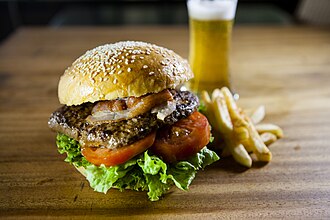
Photo: Wikipedia
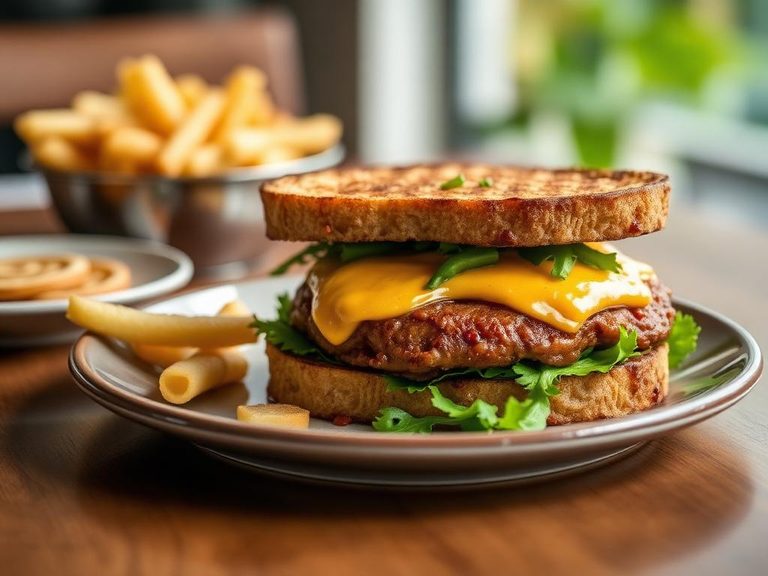
A classic fast-food staple, the medium-patty hamburger is a savory, juicy sandwich built around a seasoned ground beef patty, often with a soft bun, lettuce, and tomato. Its taste is a satisfying blend of umami, salt, and a hint of sweetness from the bun and condiments. Nutritionally, it's a dense source of protein and calories, with a notable fat content from the beef and cooking process.
Calorie split: 25% protein · 29% carbs · 46% fat
↓ Full nutrition💚 Why it's loved
People love the hamburger for its deeply satisfying, savory flavor profile and the comforting, familiar texture of a soft bun with a juicy patty. It's a cultural icon of casual dining, offering a customizable and shareable meal experience.
⚠️ Watch-outs & how to enjoy it better
A standard fast-food hamburger can be high in sodium, saturated fat, and refined carbohydrates, which may contribute to blood-sugar spikes and isn't ideal for those monitoring heart health or blood pressure. To counteract, choose a single-patty version, skip high-sugar sauces like ketchup, and pair it with a side salad or vegetable sticks instead of fries.
Key benefits
- High-quality complete protein for muscle maintenance
- Provides essential minerals like iron and zinc from beef
- Quick and convenient source of energy and satiety
- Can be a vehicle for vegetables like lettuce, tomato, and onion
🍽️ Popular dishes
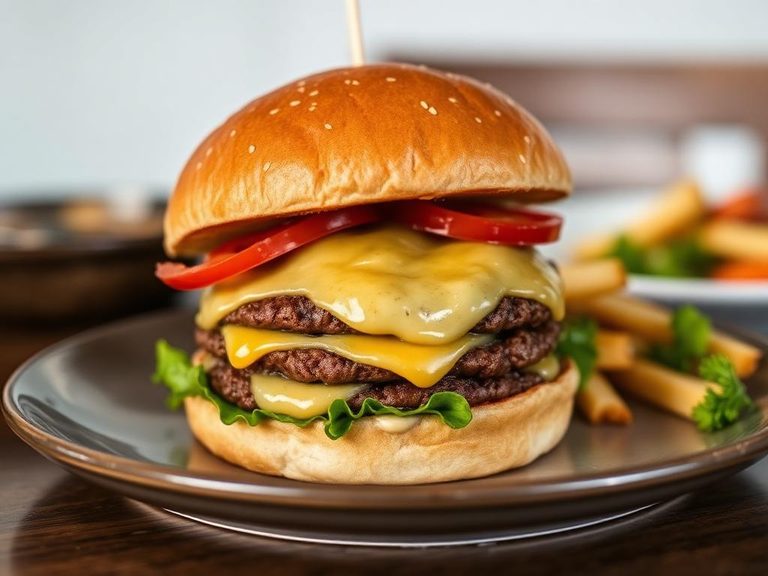
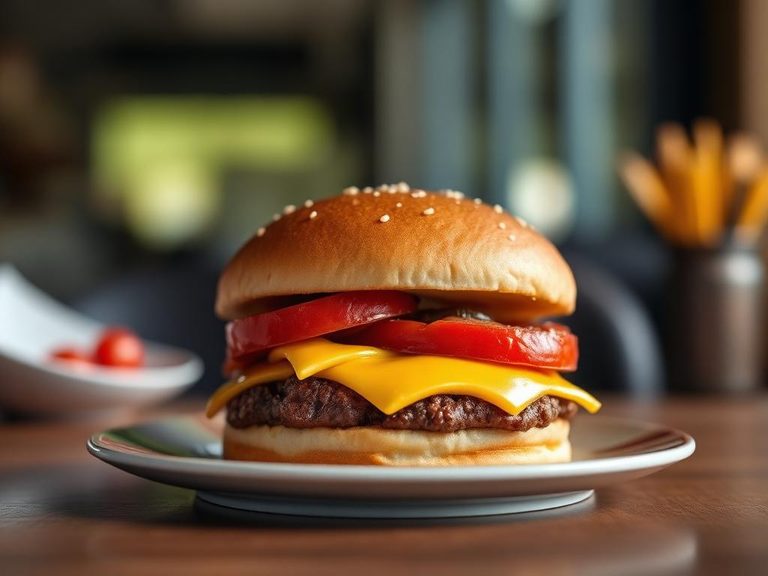
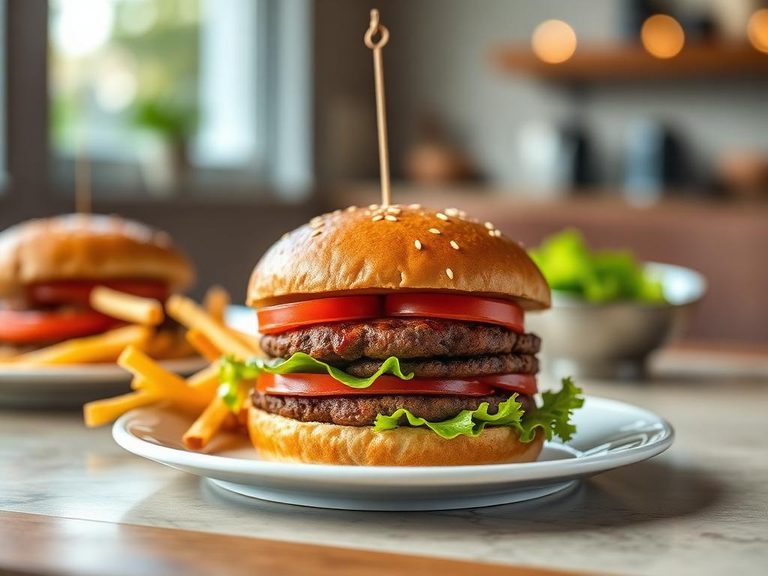


🌍 Where it's eaten
💡 Did you know?
The term 'hamburger' likely derives from Hamburg, Germany, where a similar style of minced beef steak was popular, though the modern sandwich was perfected in the United States.
Full nutrition (USDA data · scales with serving)
| Water | 45.7 g |
| Energy | 288 kcal |
| Protein | 17.5 g |
| Total lipid (fat) | 14.4 g |
| Carbohydrate, by difference | 20.7 g |
| Fiber, total dietary | 0.70 g |
| Total Sugars | 3.0 g |
| Calcium, Ca | 66.0 mg |
| Iron, Fe | 2.8 mg |
| Magnesium, Mg | 21.0 mg |
| Phosphorus, P | 143 mg |
| Potassium, K | 229 mg |
| Sodium, Na | 355 mg |
| Zinc, Zn | 3.1 mg |
| Copper, Cu | 0.09 mg |
| Selenium, Se | 23.8 ug |
| Vitamin C, total ascorbic acid | 0.50 mg |
| Thiamin | 0.24 mg |
| Riboflavin | 0.23 mg |
| Niacin | 4.8 mg |
| Vitamin B-6 | 0.28 mg |
| Folate, total | 51.0 ug |
| Folic acid | 22.0 ug |
| Folate, food | 29.0 ug |
| Folate, DFE | 66.0 ug |
| Choline, total | 49.6 mg |
| Vitamin B-12 | 1.6 ug |
| Vitamin B-12, added | 0.00 ug |
| Vitamin A, RAE | 0.00 ug |
| Retinol | 0.00 ug |
| Carotene, beta | 0.00 ug |
| Carotene, alpha | 0.00 ug |
| Cryptoxanthin, beta | 0.00 ug |
| Lycopene | 0.00 ug |
| Lutein + zeaxanthin | 2.0 ug |
| Vitamin E (alpha-tocopherol) | 0.11 mg |
| Vitamin E, added | 0.00 mg |
| Vitamin D (D2 + D3) | 0.10 ug |
| Vitamin K (phylloquinone) | 3.3 ug |
| Alcohol, ethyl | 0.00 g |
| Caffeine | 0.00 mg |
| Theobromine | 0.00 mg |
Fat & fatty acid profile (per 100g)
| Fatty acids, total saturated | 5.5 g |
| SFA 4:0 | 0.00 g |
| SFA 6:0 | 0.00 g |
| SFA 8:0 | 0.00 g |
| SFA 10:0 | 0.00 g |
| SFA 12:0 | 0.00 g |
| SFA 14:0 | 0.41 g |
| SFA 16:0 | 3.1 g |
| SFA 18:0 | 1.7 g |
| Fatty acids, total monounsaturated | 5.8 g |
| MUFA 16:1 | 0.41 g |
| MUFA 18:1 | 5.2 g |
| MUFA 20:1 | 0.03 g |
| MUFA 22:1 | 0.00 g |
| Fatty acids, total polyunsaturated | 1.1 g |
| PUFA 18:2 | 1.0 g |
| PUFA 18:3 | 0.10 g |
| PUFA 18:4 | 0.00 g |
| PUFA 20:4 | 0.00 g |
| PUFA 20:5 n-3 (EPA) | 0.00 g |
| PUFA 22:5 n-3 (DPA) | 0.01 g |
| PUFA 22:6 n-3 (DHA) | 0.00 g |
| Cholesterol | 49.0 mg |
Amino acid profile (per 100g)
Estimated from Pickle relish, hamburger — USDA does not publish this profile for Hamburger.
| Tryptophan | 0.01 g |
| Threonine | 0.02 g |
| Isoleucine | 0.02 g |
| Leucine | 0.03 g |
| Lysine | 0.03 g |
| Methionine | 0.01 g |
| Cystine | 0.01 g |
| Phenylalanine | 0.02 g |
| Tyrosine | 0.01 g |
| Valine | 0.02 g |
| Arginine | 0.04 g |
| Histidine | 0.01 g |
| Alanine | 0.02 g |
| Aspartic acid | 0.04 g |
| Glutamic acid | 0.15 g |
| Glycine | 0.02 g |
| Proline | 0.02 g |
| Serine | 0.02 g |
FAQ
Is a hamburger a good source of protein?
Yes, a medium-patty hamburger provides a substantial amount of complete protein, typically around 15-20 grams, which is essential for building and repairing tissues.
How can I make a fast-food hamburger healthier at home?
Use lean ground beef (90/10 or leaner), grill instead of fry, use a whole-wheat bun, and load up on fresh vegetable toppings like spinach, onions, and peppers.
Why do hamburgers sometimes cause heartburn?
The high fat content can relax the esophageal sphincter, allowing stomach acid to reflux. Spicy or acidic toppings like mustard and pickles can also trigger symptoms in some individuals.
Nutrient density (calculated · NRF9.3)
Nutrient Rich Foods index: beneficial nutrients (protein, fiber, vitamins, minerals) minus saturated fat, added sugar & sodium, per 100 kcal.
NRF9.3 index — Fulgoni, Keast & Drewnowski, 2009. Computed from USDA nutrients.
Weight-loss friendliness (composite index)
Energy density 2.88 kcal/g · 24% calories from protein · 0.7 g fiber · 3.0 g sugar per 100 g.
Composite of energy density (Rolls et al., 1999), protein & fiber satiety, minus sugar. A calculated heuristic — ranks satiety-per-calorie, not a clinical measure.
Dietary load (calculated from USDA values)
Potential renal acid load. Positive = acid-forming, negative = alkaline-forming.
Sodium-to-potassium ratio: 1.55 (lower is better — aim for ≤ 1)
Sodium:potassium per WHO potassium guidance. Computed from USDA nutrients.