

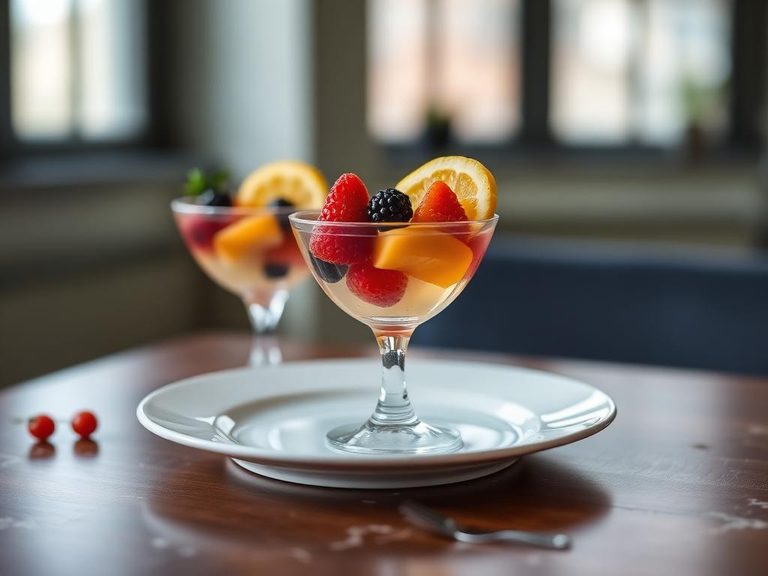
Gelatin dessert, sugar free, with fruit
Common food

Photo: Wikipedia
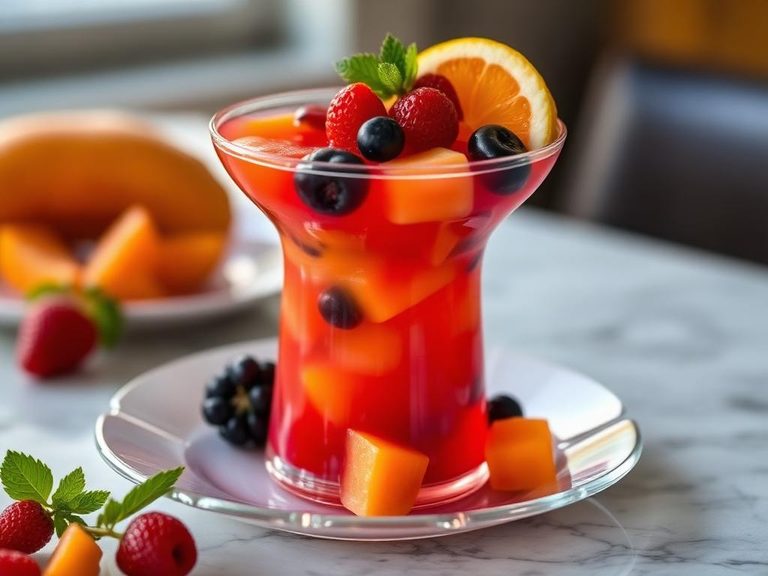
A wobbly, translucent dessert made from gelatin, sweetened without sugar, and studded with colorful fruit pieces. It offers a refreshing, light texture with a mild sweetness and a burst of fruity flavor in each bite. Nutritionally, it's an extremely low-calorie treat, providing almost no fat and minimal sugar, making it a guilt-free option for a sweet snack.
Calorie split: 14% protein · 86% carbs · 0% fat
↓ Full nutrition💚 Why it's loved
People love it for its playful, jiggly texture and the way it delivers a clean, fruity flavor without heaviness. It's a versatile, nostalgic dessert that can be easily customized with different fruits or served in fun molds for parties.
⚠️ Watch-outs & how to enjoy it better
It offers minimal nutritional value beyond calories and can feel unsatisfying due to its light texture. Those watching their intake of certain additives should check labels, as some sugar-free versions may contain sugar alcohols that can cause digestive discomfort in some individuals. To counteract this, start with a small portion to assess personal tolerance.
Key benefits
- Very low in calories (22 kcal per 100g)
- Virtually fat-free
- Provides a small amount of protein from gelatin
- Can be a hydrating, refreshing snack
- Offers a sweet treat without added sugars
🍽️ Popular dishes
🌍 Where it's eaten
💡 Did you know?
The primary gelling agent, gelatin, is derived from collagen found in animal bones and connective tissues, making this dessert a traditional way to use parts of the animal that might otherwise be discarded.
Full nutrition (USDA data · scales with serving)
| Water | 94.1 g |
| Energy | 22.0 kcal |
| Protein | 0.77 g |
| Total lipid (fat) | 0.01 g |
| Carbohydrate, by difference | 4.9 g |
| Fiber, total dietary | 0.20 g |
| Total Sugars | 1.1 g |
| Calcium, Ca | 3.0 mg |
| Iron, Fe | 0.05 mg |
| Magnesium, Mg | 2.0 mg |
| Phosphorus, P | 59.0 mg |
| Potassium, K | 15.0 mg |
| Sodium, Na | 41.0 mg |
| Zinc, Zn | 0.01 mg |
| Copper, Cu | 0.02 mg |
| Selenium, Se | 0.10 ug |
| Vitamin C, total ascorbic acid | 0.30 mg |
| Thiamin | 0.00 mg |
| Riboflavin | 0.00 mg |
| Niacin | 0.05 mg |
| Vitamin B-6 | 0.01 mg |
| Folate, total | 0.00 ug |
| Folic acid | 0.00 ug |
| Folate, food | 0.00 ug |
| Folate, DFE | 0.00 ug |
| Choline, total | 0.60 mg |
| Vitamin B-12 | 0.00 ug |
| Vitamin B-12, added | 0.00 ug |
| Vitamin A, RAE | 2.0 ug |
| Retinol | 0.00 ug |
| Carotene, beta | 19.0 ug |
| Carotene, alpha | 0.00 ug |
| Cryptoxanthin, beta | 7.0 ug |
| Lycopene | 0.00 ug |
| Lutein + zeaxanthin | 11.0 ug |
| Vitamin E (alpha-tocopherol) | 0.06 mg |
| Vitamin E, added | 0.00 mg |
| Vitamin D (D2 + D3) | 0.00 ug |
| Vitamin K (phylloquinone) | 0.40 ug |
| Alcohol, ethyl | 0.00 g |
| Caffeine | 0.00 mg |
| Theobromine | 0.00 mg |
Fat & fatty acid profile (per 100g)
| Fatty acids, total saturated | 0.00 g |
| SFA 4:0 | 0.00 g |
| SFA 6:0 | 0.00 g |
| SFA 8:0 | 0.00 g |
| SFA 10:0 | 0.00 g |
| SFA 12:0 | 0.00 g |
| SFA 14:0 | 0.00 g |
| SFA 16:0 | 0.00 g |
| SFA 18:0 | 0.00 g |
| Fatty acids, total monounsaturated | 0.00 g |
| MUFA 16:1 | 0.00 g |
| MUFA 18:1 | 0.00 g |
| MUFA 20:1 | 0.00 g |
| MUFA 22:1 | 0.00 g |
| Fatty acids, total polyunsaturated | 0.00 g |
| PUFA 18:2 | 0.00 g |
| PUFA 18:3 | 0.00 g |
| PUFA 18:4 | 0.00 g |
| PUFA 20:4 | 0.00 g |
| PUFA 20:5 n-3 (EPA) | 0.00 g |
| PUFA 22:5 n-3 (DPA) | 0.00 g |
| PUFA 22:6 n-3 (DHA) | 0.00 g |
| Cholesterol | 0.00 mg |
Amino acid profile (per 100g)
Estimated from Gelatin desserts, dry mix — USDA does not publish this profile for Gelatin dessert.
| Tryptophan | 0.00 g |
| Threonine | 0.15 g |
| Isoleucine | 0.12 g |
| Leucine | 0.25 g |
| Lysine | 0.35 g |
| Methionine | 0.06 g |
| Cystine | 0.00 g |
| Phenylalanine | 0.18 g |
| Tyrosine | 0.03 g |
| Valine | 0.21 g |
| Arginine | 0.68 g |
| Histidine | 0.07 g |
| Alanine | 0.82 g |
| Aspartic acid | 0.54 g |
| Glutamic acid | 0.89 g |
| Glycine | 1.9 g |
| Proline | 1.3 g |
| Serine | 0.27 g |
FAQ
Is sugar-free gelatin dessert good for weight loss?
It can be a useful tool because it's very low in calories and can satisfy a sweet craving without adding significant energy to your diet. However, it's not very filling, so it's best used as an occasional treat within a balanced eating plan.
Why does my sugar-free gelatin sometimes taste bitter?
Some sugar-free sweeteners, like certain artificial sweeteners or sugar alcohols, can leave a bitter or metallic aftertaste, especially as the product warms up. Choosing a different brand or flavor might help.
Can I make this dessert at home?
Absolutely. You can make it by dissolving unflavored gelatin and a sugar-free sweetener in hot water, then chilling it with your choice of fresh or canned fruit. This gives you full control over the ingredients.
Nutrient density (calculated · NRF9.3)
Nutrient Rich Foods index: beneficial nutrients (protein, fiber, vitamins, minerals) minus saturated fat, added sugar & sodium, per 100 kcal.
NRF9.3 index — Fulgoni, Keast & Drewnowski, 2009. Computed from USDA nutrients.
Weight-loss friendliness (composite index)
Energy density 0.22 kcal/g · 14% calories from protein · 0.2 g fiber · 1.1 g sugar per 100 g.
Composite of energy density (Rolls et al., 1999), protein & fiber satiety, minus sugar. A calculated heuristic — ranks satiety-per-calorie, not a clinical measure.
Dietary load (calculated from USDA values)
Potential renal acid load. Positive = acid-forming, negative = alkaline-forming.
Sodium-to-potassium ratio: 2.73 (lower is better — aim for ≤ 1)
Sodium:potassium per WHO potassium guidance. Computed from USDA nutrients.