

Gelatin dessert with fruit
Common food

Photo: Wikipedia
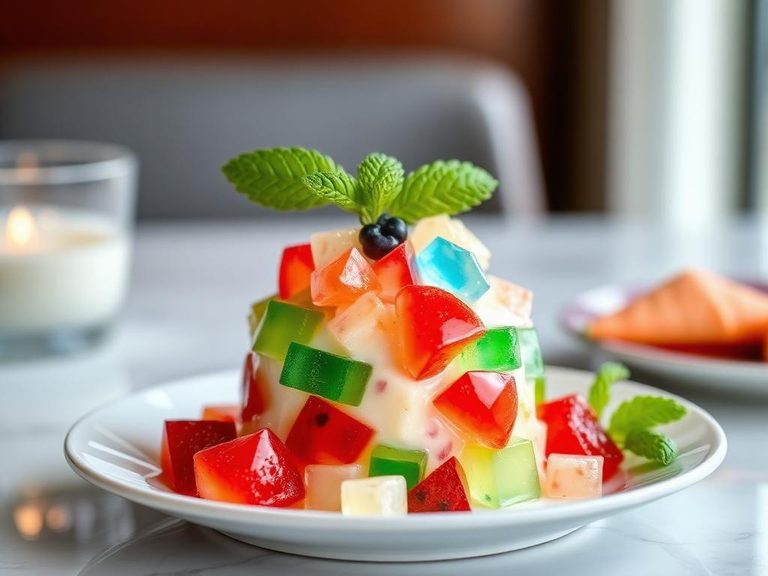
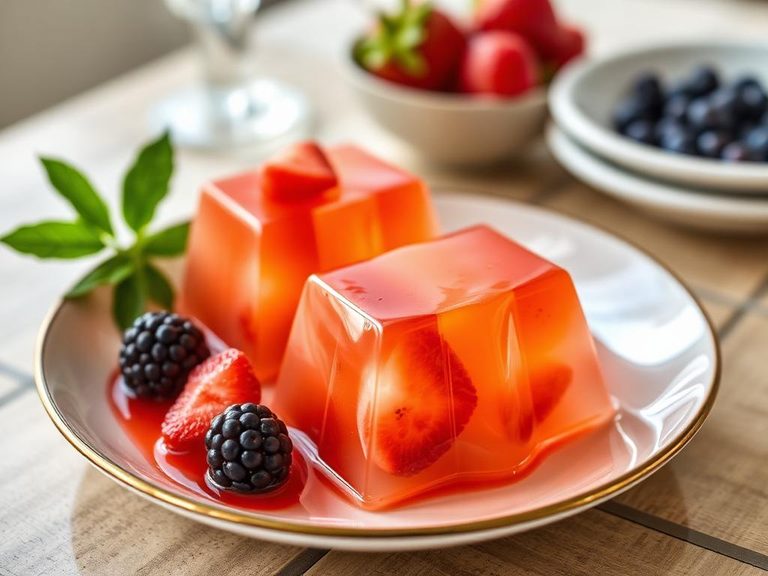
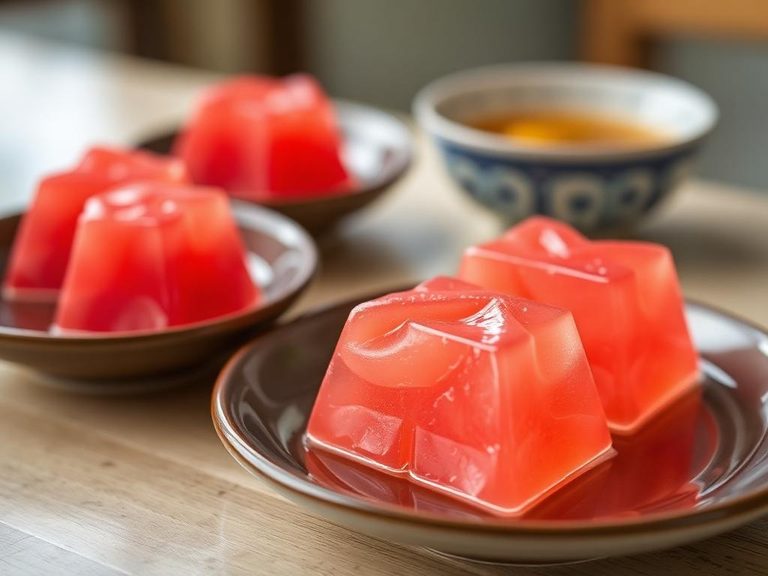
A wobbly, translucent dessert made from sweetened gelatin and suspended fruit pieces, offering a refreshing, jiggly texture with bursts of fruity flavor. Nutritionally, it's a very low-calorie, virtually fat-free treat, primarily providing quick energy from its high sugar content.
Calorie split: 8% protein · 92% carbs · 0% fat
↓ Full nutrition💚 Why it's loved
People love it for its playful, jiggly texture and the refreshing contrast between the sweet, cool gelatin and the juicy fruit pieces. It's a versatile, nostalgic treat often served at parties and as a simple, comforting dessert.
⚠️ Watch-outs & how to enjoy it better
Its high sugar content can cause rapid blood-sugar spikes, making it less suitable for those managing diabetes. To counteract this, pair a small portion with a source of protein or healthy fat (like nuts or yogurt) to slow sugar absorption, or look for versions sweetened with sugar alternatives.
Key benefits
- Very low in calories and fat
- Provides quick energy from carbohydrates
- Contains small amounts of protein from gelatin
- Refreshing and hydrating due to high water content
- Offers a light, fat-free dessert option
🍽️ Popular dishes

🌍 Where it's eaten
💡 Did you know?
The wobbly texture of gelatin comes from collagen, a protein derived from animal bones and connective tissues, which forms a gel when dissolved in hot liquid and cooled.
Full nutrition (USDA data · scales with serving)
| Water | 85.3 g |
| Energy | 56.0 kcal |
| Protein | 1.1 g |
| Total lipid (fat) | 0.01 g |
| Carbohydrate, by difference | 13.3 g |
| Fiber, total dietary | 0.20 g |
| Total Sugars | 12.6 g |
| Calcium, Ca | 3.0 mg |
| Iron, Fe | 0.05 mg |
| Magnesium, Mg | 2.0 mg |
| Phosphorus, P | 20.0 mg |
| Potassium, K | 15.0 mg |
| Sodium, Na | 64.0 mg |
| Zinc, Zn | 0.02 mg |
| Copper, Cu | 0.03 mg |
| Selenium, Se | 1.0 ug |
| Vitamin C, total ascorbic acid | 0.30 mg |
| Thiamin | 0.00 mg |
| Riboflavin | 0.01 mg |
| Niacin | 0.06 mg |
| Vitamin B-6 | 0.01 mg |
| Folate, total | 1.0 ug |
| Folic acid | 0.00 ug |
| Folate, food | 1.0 ug |
| Folate, DFE | 1.0 ug |
| Choline, total | 1.0 mg |
| Vitamin B-12 | 0.00 ug |
| Vitamin B-12, added | 0.00 ug |
| Vitamin A, RAE | 2.0 ug |
| Retinol | 0.00 ug |
| Carotene, beta | 19.0 ug |
| Carotene, alpha | 0.00 ug |
| Cryptoxanthin, beta | 7.0 ug |
| Lycopene | 0.00 ug |
| Lutein + zeaxanthin | 11.0 ug |
| Vitamin E (alpha-tocopherol) | 0.06 mg |
| Vitamin E, added | 0.00 mg |
| Vitamin D (D2 + D3) | 0.00 ug |
| Vitamin K (phylloquinone) | 0.40 ug |
| Alcohol, ethyl | 0.00 g |
| Caffeine | 0.00 mg |
| Theobromine | 0.00 mg |
Fat & fatty acid profile (per 100g)
| Fatty acids, total saturated | 0.00 g |
| SFA 4:0 | 0.00 g |
| SFA 6:0 | 0.00 g |
| SFA 8:0 | 0.00 g |
| SFA 10:0 | 0.00 g |
| SFA 12:0 | 0.00 g |
| SFA 14:0 | 0.00 g |
| SFA 16:0 | 0.00 g |
| SFA 18:0 | 0.00 g |
| Fatty acids, total monounsaturated | 0.00 g |
| MUFA 16:1 | 0.00 g |
| MUFA 18:1 | 0.00 g |
| MUFA 20:1 | 0.00 g |
| MUFA 22:1 | 0.00 g |
| Fatty acids, total polyunsaturated | 0.00 g |
| PUFA 18:2 | 0.00 g |
| PUFA 18:3 | 0.00 g |
| PUFA 18:4 | 0.00 g |
| PUFA 20:4 | 0.00 g |
| PUFA 20:5 n-3 (EPA) | 0.00 g |
| PUFA 22:5 n-3 (DPA) | 0.00 g |
| PUFA 22:6 n-3 (DHA) | 0.00 g |
| Cholesterol | 0.00 mg |
Amino acid profile (per 100g)
Estimated from Gelatin desserts, dry mix — USDA does not publish this profile for Gelatin dessert with fruit.
| Tryptophan | 0.00 g |
| Threonine | 0.15 g |
| Isoleucine | 0.12 g |
| Leucine | 0.25 g |
| Lysine | 0.35 g |
| Methionine | 0.06 g |
| Cystine | 0.00 g |
| Phenylalanine | 0.18 g |
| Tyrosine | 0.03 g |
| Valine | 0.21 g |
| Arginine | 0.68 g |
| Histidine | 0.07 g |
| Alanine | 0.82 g |
| Aspartic acid | 0.54 g |
| Glutamic acid | 0.89 g |
| Glycine | 1.9 g |
| Proline | 1.3 g |
| Serine | 0.27 g |
FAQ
Is gelatin dessert a good source of protein?
While gelatin itself is a protein, the amount in a typical serving is very small (about 1-2 grams). It's not considered a significant protein source compared to foods like meat, eggs, or legumes.
Can I make a healthier version at home?
Yes. You can use unflavored gelatin with less sugar or a sugar substitute, and incorporate fresh or frozen fruit instead of canned fruit in syrup. This significantly reduces the sugar and calorie content.
Is this dessert suitable for vegetarians?
Traditional gelatin is animal-derived and not vegetarian. For a vegetarian version, use plant-based gelling agents like agar-agar or carrageenan, which are derived from seaweed.
Nutrient density (calculated · NRF9.3)
Nutrient Rich Foods index: beneficial nutrients (protein, fiber, vitamins, minerals) minus saturated fat, added sugar & sodium, per 100 kcal.
NRF9.3 index — Fulgoni, Keast & Drewnowski, 2009. Computed from USDA nutrients.
Weight-loss friendliness (composite index)
Energy density 0.56 kcal/g · 8% calories from protein · 0.2 g fiber · 12.6 g sugar per 100 g.
Composite of energy density (Rolls et al., 1999), protein & fiber satiety, minus sugar. A calculated heuristic — ranks satiety-per-calorie, not a clinical measure.
Dietary load (calculated from USDA values)
Potential renal acid load. Positive = acid-forming, negative = alkaline-forming.
Sodium-to-potassium ratio: 4.27 (lower is better — aim for ≤ 1)
Sodium:potassium per WHO potassium guidance. Computed from USDA nutrients.