

Cheese, cottage cheese, with gelatin dessert and fruit
Common food

Photo: Wikipedia
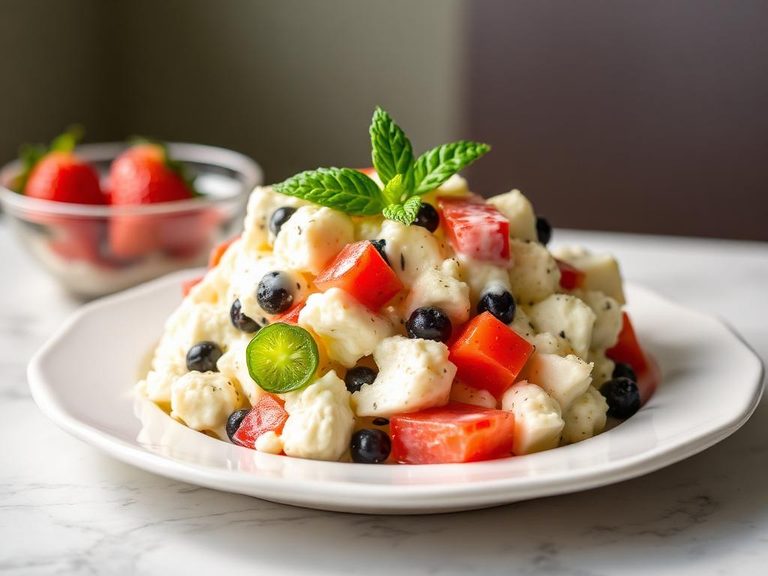
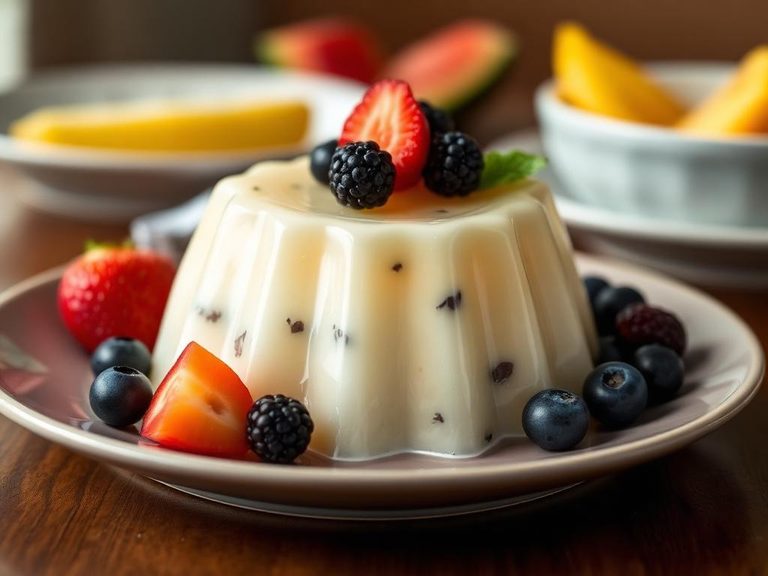
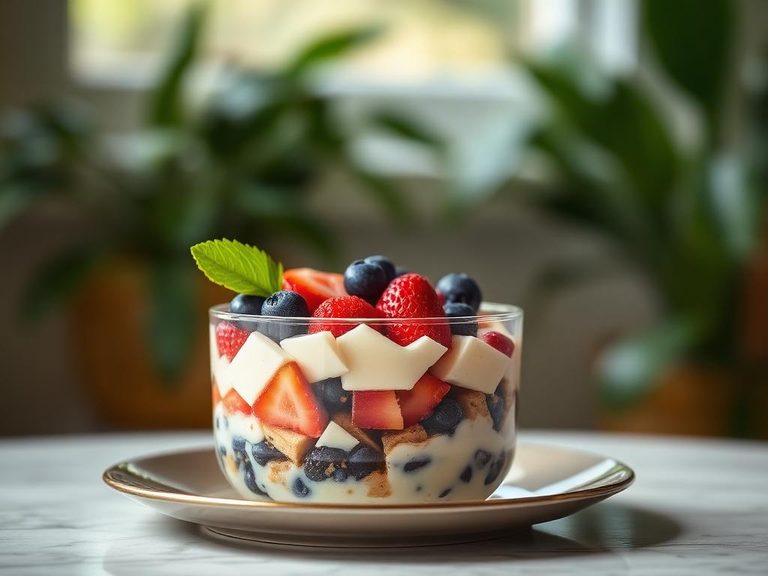
This is a light, refreshing dessert that combines the creamy, mild tang of cottage cheese with the sweet, fruity flavor and jiggly texture of gelatin. It's a protein-packed treat with a surprisingly low calorie count, making it a popular choice for a healthy snack or light dessert.
Calorie split: 28% protein · 52% carbs · 20% fat
↓ Full nutrition💚 Why it's loved
People love it for its unique, satisfying texture contrast between the creamy curds and the smooth, wobbly gelatin. It's a nostalgic, versatile dish that can be customized with any fruit and is often seen as a 'guilt-free' sweet treat.
⚠️ Watch-outs & how to enjoy it better
The added sugar can cause a blood-spike if eaten alone, and the combination may not appeal to those who dislike the texture of cottage cheese. To counteract this, pair it with a handful of nuts or seeds for added fat and fiber, or choose a version made with sugar-free gelatin and fresh fruit.
Key benefits
- High in satiating protein for its calorie count
- Low in fat and calories
- Good source of calcium from the cottage cheese
- Provides a quick energy boost from fruit and sugar
- Can be a portion-controlled dessert option
🍽️ Popular dishes
🌍 Where it's eaten
💡 Did you know?
This dish was a staple of the 1970s and 80s 'diet plate' and is a classic example of a 'salad' in the vintage American sense, where gelatin and mayonnaise could transform almost anything into a 'salad.'
Full nutrition (USDA data · scales with serving)
| Water | 82.3 g |
| Energy | 75.0 kcal |
| Protein | 5.3 g |
| Total lipid (fat) | 1.7 g |
| Carbohydrate, by difference | 9.9 g |
| Fiber, total dietary | 0.40 g |
| Total Sugars | 8.5 g |
| Calcium, Ca | 39.0 mg |
| Iron, Fe | 0.10 mg |
| Magnesium, Mg | 7.0 mg |
| Phosphorus, P | 74.0 mg |
| Potassium, K | 85.0 mg |
| Sodium, Na | 170 mg |
| Zinc, Zn | 0.22 mg |
| Copper, Cu | 0.03 mg |
| Selenium, Se | 4.5 ug |
| Vitamin C, total ascorbic acid | 0.80 mg |
| Thiamin | 0.03 mg |
| Riboflavin | 0.07 mg |
| Niacin | 0.19 mg |
| Vitamin B-6 | 0.04 mg |
| Folate, total | 6.0 ug |
| Folic acid | 0.00 ug |
| Folate, food | 6.0 ug |
| Folate, DFE | 6.0 ug |
| Choline, total | 9.0 mg |
| Vitamin B-12 | 0.27 ug |
| Vitamin B-12, added | 0.00 ug |
| Vitamin A, RAE | 19.0 ug |
| Retinol | 15.0 ug |
| Carotene, beta | 46.0 ug |
| Carotene, alpha | 0.00 ug |
| Cryptoxanthin, beta | 17.0 ug |
| Lycopene | 0.00 ug |
| Lutein + zeaxanthin | 27.0 ug |
| Vitamin E (alpha-tocopherol) | 0.18 mg |
| Vitamin E, added | 0.00 mg |
| Vitamin D (D2 + D3) | 0.00 ug |
| Vitamin K (phylloquinone) | 0.90 ug |
| Alcohol, ethyl | 0.00 g |
| Caffeine | 0.00 mg |
| Theobromine | 0.00 mg |
Fat & fatty acid profile (per 100g)
| Fatty acids, total saturated | 1.1 g |
| SFA 4:0 | 0.04 g |
| SFA 6:0 | 0.01 g |
| SFA 8:0 | 0.01 g |
| SFA 10:0 | 0.03 g |
| SFA 12:0 | 0.06 g |
| SFA 14:0 | 0.17 g |
| SFA 16:0 | 0.50 g |
| SFA 18:0 | 0.16 g |
| Fatty acids, total monounsaturated | 0.38 g |
| MUFA 16:1 | 0.02 g |
| MUFA 18:1 | 0.29 g |
| MUFA 20:1 | 0.00 g |
| MUFA 22:1 | 0.00 g |
| Fatty acids, total polyunsaturated | 0.06 g |
| PUFA 18:2 | 0.05 g |
| PUFA 18:3 | 0.01 g |
| PUFA 18:4 | 0.00 g |
| PUFA 20:4 | 0.00 g |
| PUFA 20:5 n-3 (EPA) | 0.00 g |
| PUFA 22:5 n-3 (DPA) | 0.00 g |
| PUFA 22:6 n-3 (DHA) | 0.00 g |
| Cholesterol | 7.0 mg |
Amino acid profile (per 100g)
Estimated from Crackers, cheese, sandwich-type with cheese filling — USDA does not publish this profile for Cheese.
| Tryptophan | 0.11 g |
| Threonine | 0.33 g |
| Isoleucine | 0.36 g |
| Leucine | 0.64 g |
| Lysine | 0.39 g |
| Methionine | 0.15 g |
| Cystine | 0.15 g |
| Phenylalanine | 0.35 g |
| Tyrosine | 0.25 g |
| Valine | 0.38 g |
| Arginine | 0.29 g |
| Histidine | 0.17 g |
| Alanine | 0.30 g |
| Aspartic acid | 0.52 g |
| Glutamic acid | 2.2 g |
| Glycine | 0.24 g |
| Proline | 0.77 g |
| Serine | 0.40 g |
FAQ
Is this a healthy dessert?
It can be a relatively healthy option due to its high protein and low-fat content, but the nutritional value depends heavily on the specific ingredients used, especially the amount of added sugar in the gelatin and any sweeteners.
Can I make it with sugar-free gelatin?
Absolutely. Using sugar-free gelatin and adding fresh fruit instead of canned fruit in syrup is a common way to reduce the sugar and calorie content significantly.
Why does it sometimes separate or get watery?
This can happen if the gelatin isn't set properly, if too much liquid (like juice from fruit) is added, or if it's stored for too long. Ensuring the gelatin is fully dissolved and allowing it to set completely before adding the cottage cheese helps.
Nutrient density (calculated · NRF9.3)
Nutrient Rich Foods index: beneficial nutrients (protein, fiber, vitamins, minerals) minus saturated fat, added sugar & sodium, per 100 kcal.
NRF9.3 index — Fulgoni, Keast & Drewnowski, 2009. Computed from USDA nutrients.
Weight-loss friendliness (composite index)
Energy density 0.75 kcal/g · 28% calories from protein · 0.4 g fiber · 8.5 g sugar per 100 g.
Composite of energy density (Rolls et al., 1999), protein & fiber satiety, minus sugar. A calculated heuristic — ranks satiety-per-calorie, not a clinical measure.
Dietary load (calculated from USDA values)
Potential renal acid load. Positive = acid-forming, negative = alkaline-forming.
Sodium-to-potassium ratio: 2.00 (lower is better — aim for ≤ 1)
Sodium:potassium per WHO potassium guidance. Computed from USDA nutrients.