

Fast foods, biscuit, with ham
Whole food · Fast Foods

Photo: Wikipedia
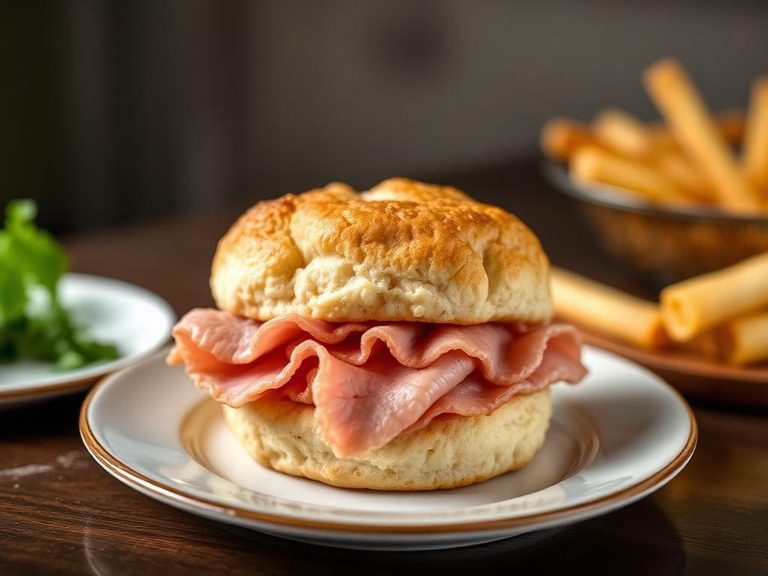
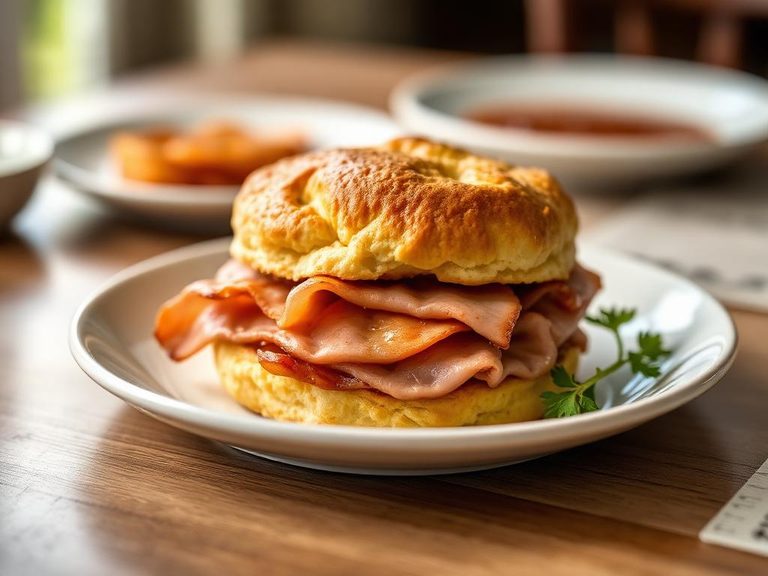
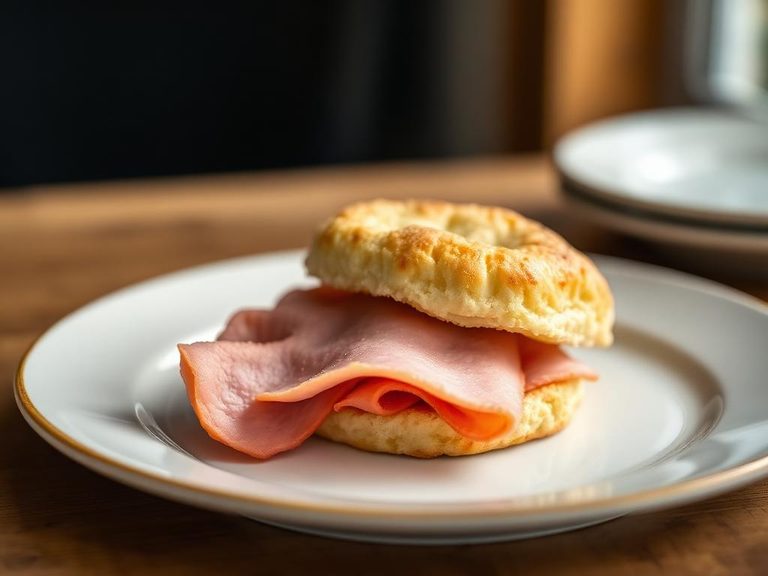
A flaky, buttery biscuit split and filled with a slice of savory ham, creating a handheld sandwich with a tender crumb and salty, meaty contrast. The biscuit's high fat content (16.3g per 100g) provides a rich, satisfying mouthfeel, while the ham contributes a significant portion of the 11.85g of protein. It's a classic, quick-bite comfort food.
Calorie split: 14% protein · 44% carbs · 42% fat
↓ Full nutrition💚 Why it's loved
People love it for the perfect contrast between the warm, crumbly, savory biscuit and the cool, salty slice of ham. It's a versatile staple in Southern U.S. cuisine, enjoyed for breakfast, lunch, or a quick snack.
⚠️ Watch-outs & how to enjoy it better
The combination can be high in sodium and refined carbs, which may cause blood sugar spikes or be a concern for those monitoring salt intake. To counteract, pair it with a side of fibrous vegetables like steamed broccoli or a fresh salad to slow digestion and add nutrients. Opt for whole-grain biscuits or lower-sodium ham when possible.
Key benefits
- High in protein (11.85g/100g) for satiety and muscle support.
- Provides quick energy from carbohydrates (38.75g/100g).
- Convenient and portable for a fast meal or snack.
- Low in sugar (1.97g/100g), avoiding a sweet profile.
- A familiar, comforting taste and texture combination.
🍽️ Popular dishes


🌍 Where it's eaten
💡 Did you know?
The American biscuit is a direct descendant of British scones, but the Southern version evolved to use buttermilk and lard, creating its signature flaky layers that are perfect for catching ham drippings.
Full nutrition (USDA data · scales with serving)
| Water | 28.4 g |
| Energy | 342 kcal |
| Energy | 1431 kj |
| Protein | 11.8 g |
| Total lipid (fat) | 16.3 g |
| Ash | 4.7 g |
| Carbohydrate, by difference | 38.8 g |
| Fiber, total dietary | 0.70 g |
| Total Sugars | 2.0 g |
| Calcium, Ca | 142 mg |
| Iron, Fe | 2.4 mg |
| Magnesium, Mg | 20.0 mg |
| Phosphorus, P | 490 mg |
| Potassium, K | 174 mg |
| Sodium, Na | 974 mg |
| Zinc, Zn | 1.5 mg |
| Copper, Cu | 0.03 mg |
| Manganese, Mn | 0.32 mg |
| Selenium, Se | 17.1 ug |
| Vitamin C, total ascorbic acid | 0.10 mg |
| Thiamin | 0.45 mg |
| Riboflavin | 0.28 mg |
| Niacin | 3.1 mg |
| Pantothenic acid | 0.36 mg |
| Vitamin B-6 | 0.12 mg |
| Folate, total | 34.0 ug |
| Folic acid | 27.0 ug |
| Folate, food | 7.0 ug |
| Folate, DFE | 53.0 ug |
| Choline, total | 40.8 mg |
| Vitamin B-12 | 0.03 ug |
| Vitamin B-12, added | 0.00 ug |
| Vitamin A, RAE | 27.0 ug |
| Retinol | 25.0 ug |
| Carotene, beta | 20.0 ug |
| Carotene, alpha | 0.00 ug |
| Cryptoxanthin, beta | 0.00 ug |
| Vitamin A, IU | 118 iu |
| Lycopene | 0.00 ug |
| Lutein + zeaxanthin | 5.0 ug |
| Vitamin E (alpha-tocopherol) | 1.2 mg |
| Vitamin E, added | 0.00 mg |
| Vitamin D (D2 + D3), International Units | 13.0 iu |
| Vitamin D (D2 + D3) | 0.30 ug |
| Vitamin K (phylloquinone) | 5.7 ug |
| Alcohol, ethyl | 0.00 g |
| Caffeine | 0.00 mg |
| Theobromine | 0.00 mg |
Fat & fatty acid profile (per 100g)
| Fatty acids, total saturated | 10.1 g |
| SFA 4:0 | 0.00 g |
| SFA 6:0 | 0.00 g |
| SFA 8:0 | 0.36 g |
| SFA 10:0 | 0.35 g |
| SFA 12:0 | 3.0 g |
| SFA 14:0 | 1.3 g |
| SFA 16:0 | 2.4 g |
| SFA 18:0 | 2.6 g |
| Fatty acids, total monounsaturated | 4.3 g |
| MUFA 16:1 | 0.18 g |
| MUFA 18:1 | 4.1 g |
| MUFA 20:1 | 0.00 g |
| MUFA 22:1 | 0.00 g |
| Fatty acids, total polyunsaturated | 0.92 g |
| PUFA 18:2 | 0.81 g |
| PUFA 18:3 | 0.08 g |
| PUFA 18:4 | 0.00 g |
| PUFA 20:4 | 0.03 g |
| PUFA 20:5 n-3 (EPA) | 0.00 g |
| PUFA 22:5 n-3 (DPA) | 0.00 g |
| PUFA 22:6 n-3 (DHA) | 0.00 g |
| Cholesterol | 22.0 mg |
Amino acid profile (per 100g)
| Tryptophan | 0.15 g |
| Threonine | 0.48 g |
| Isoleucine | 0.51 g |
| Leucine | 0.94 g |
| Lysine | 0.82 g |
| Methionine | 0.29 g |
| Cystine | 0.20 g |
| Phenylalanine | 0.55 g |
| Tyrosine | 0.40 g |
| Valine | 0.53 g |
| Arginine | 0.68 g |
| Histidine | 0.38 g |
| Alanine | 0.60 g |
| Aspartic acid | 0.96 g |
| Glutamic acid | 2.6 g |
| Glycine | 0.55 g |
| Proline | 0.79 g |
| Serine | 0.53 g |
FAQ
Is this a good source of fiber?
No, it is very low in fiber (0.7g per 100g), as it is made with refined white flour. To increase fiber, serve with a side of fruit or vegetables.
What makes the biscuit flaky?
The flakiness comes from cold fat (like butter or lard) being cut into the flour. When baked, the fat melts and creates steam, puffing the dough into layers.
Can I make this healthier?
Yes. Use whole-wheat pastry flour for the biscuit, choose low-sodium, lean ham, and add a layer of mustard or sliced tomato for extra flavor and nutrients without much added fat or salt.
Nutrient density (calculated · NRF9.3)
Nutrient Rich Foods index: beneficial nutrients (protein, fiber, vitamins, minerals) minus saturated fat, added sugar & sodium, per 100 kcal.
NRF9.3 index — Fulgoni, Keast & Drewnowski, 2009. Computed from USDA nutrients.
Weight-loss friendliness (composite index)
Energy density 3.42 kcal/g · 14% calories from protein · 0.7 g fiber · 2.0 g sugar per 100 g.
Composite of energy density (Rolls et al., 1999), protein & fiber satiety, minus sugar. A calculated heuristic — ranks satiety-per-calorie, not a clinical measure.
Dietary load (calculated from USDA values)
Potential renal acid load. Positive = acid-forming, negative = alkaline-forming.
Sodium-to-potassium ratio: 5.60 (lower is better — aim for ≤ 1)
Sodium:potassium per WHO potassium guidance. Computed from USDA nutrients.