

Egg omelet or scrambled egg, with cheese, made with margarine
Common food

Photo: Wikipedia
This is a classic, savory breakfast staple: fluffy eggs scrambled or folded into an omelet, enriched with melted cheese and cooked in margarine for a rich, golden flavor. The texture is tender and custardy, with the cheese adding a gooey, salty contrast. Nutritionally, it's a powerhouse of protein and fats, making it a very low-carb, high-satiety meal.
Calorie split: 26% protein · 3% carbs · 71% fat
↓ Full nutrition💚 Why it's loved
People love it for its comforting, savory flavor and the satisfying richness of melted cheese. It's a beloved, customizable classic that works for breakfast, lunch, or a quick dinner.
⚠️ Watch-outs & how to enjoy it better
The margarine content means it can be high in saturated fats and sodium, which those monitoring heart health or blood pressure should note. To balance, pair it with a side of high-fiber vegetables like spinach or tomatoes, and consider using a small portion of cheese or opting for a lower-sodium variety.
Key benefits
- Excellent source of complete protein for muscle maintenance.
- Very low in carbohydrates, suitable for low-carb diets.
- Provides essential vitamins like B12 and riboflavin from eggs.
- Fats from cheese and margarine offer sustained energy.
- Quick and versatile meal, ready in minutes.
🍽️ Popular dishes
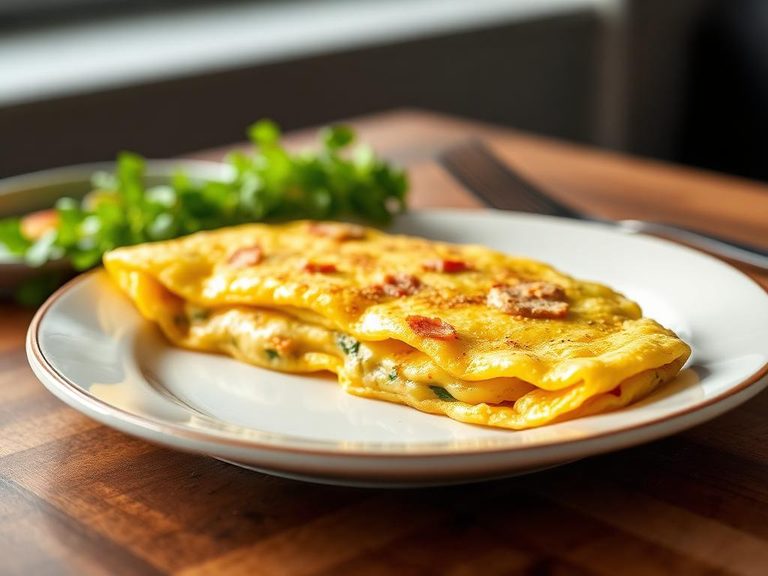
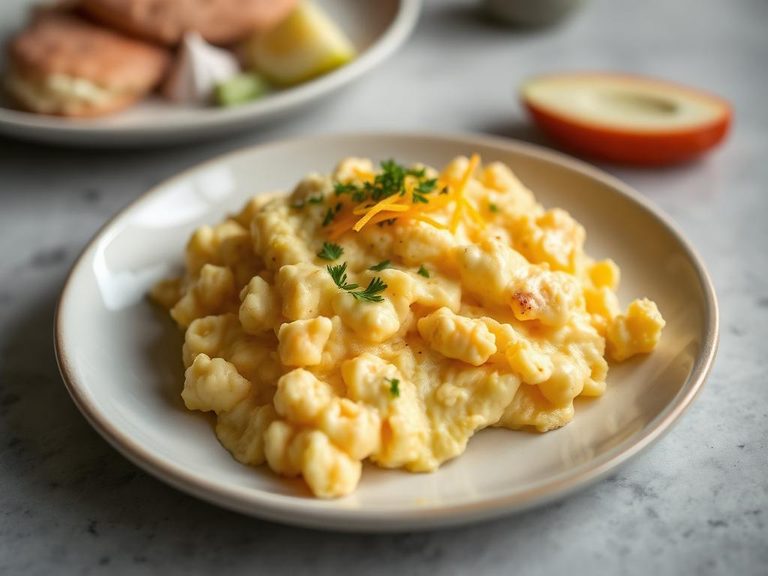
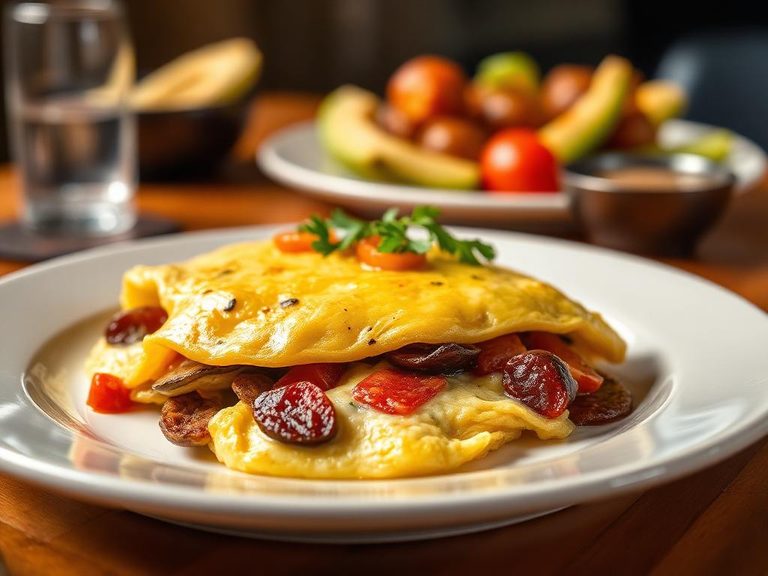
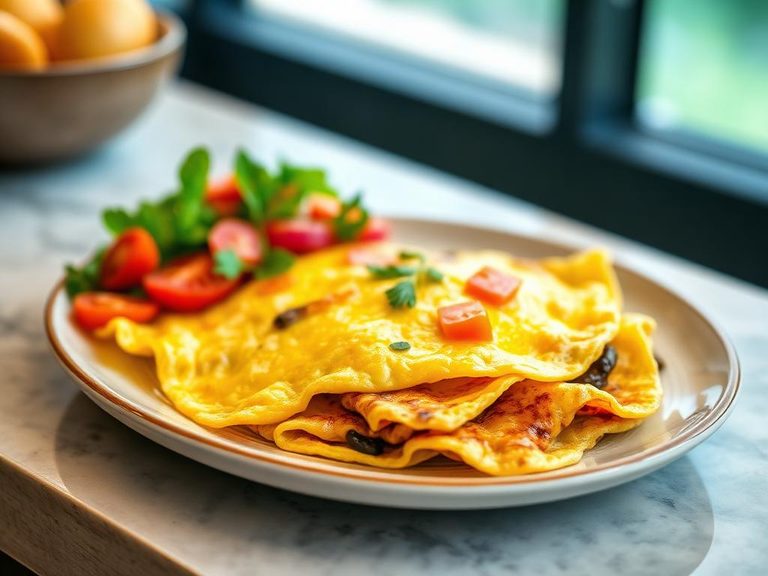
🌍 Where it's eaten
💡 Did you know?
The 'omelette' name is believed to derive from the French 'lamelle' (a thin strip) or 'les amelettes,' and a popular but likely apocryphal story credits Napoleon Bonaparte with popularizing the 'omelette aux fines herbes' after a roadside breakfast.
Full nutrition (USDA data · scales with serving)
| Water | 68.8 g |
| Energy | 194 kcal |
| Protein | 12.7 g |
| Total lipid (fat) | 15.3 g |
| Carbohydrate, by difference | 1.4 g |
| Fiber, total dietary | 0.00 g |
| Total Sugars | 0.51 g |
| Calcium, Ca | 151 mg |
| Iron, Fe | 1.4 mg |
| Magnesium, Mg | 13.0 mg |
| Phosphorus, P | 222 mg |
| Potassium, K | 128 mg |
| Sodium, Na | 364 mg |
| Zinc, Zn | 1.4 mg |
| Copper, Cu | 0.00 mg |
| Selenium, Se | 28.2 ug |
| Vitamin C, total ascorbic acid | 0.00 mg |
| Thiamin | 0.05 mg |
| Riboflavin | 0.37 mg |
| Niacin | 0.01 mg |
| Vitamin B-6 | 0.22 mg |
| Folate, total | 45.0 ug |
| Folic acid | 0.00 ug |
| Folate, food | 45.0 ug |
| Folate, DFE | 45.0 ug |
| Choline, total | 222 mg |
| Vitamin B-12 | 0.85 ug |
| Vitamin B-12, added | 0.00 ug |
| Vitamin A, RAE | 227 ug |
| Retinol | 222 ug |
| Carotene, beta | 44.0 ug |
| Carotene, alpha | 0.00 ug |
| Cryptoxanthin, beta | 11.0 ug |
| Lycopene | 0.00 ug |
| Lutein + zeaxanthin | 414 ug |
| Vitamin E (alpha-tocopherol) | 2.0 mg |
| Vitamin E, added | 0.00 mg |
| Vitamin D (D2 + D3) | 2.7 ug |
| Vitamin K (phylloquinone) | 6.2 ug |
| Alcohol, ethyl | 0.00 g |
| Caffeine | 0.00 mg |
| Theobromine | 0.00 mg |
Fat & fatty acid profile (per 100g)
| Fatty acids, total saturated | 5.4 g |
| SFA 4:0 | 0.07 g |
| SFA 6:0 | 0.06 g |
| SFA 8:0 | 0.04 g |
| SFA 10:0 | 0.09 g |
| SFA 12:0 | 0.11 g |
| SFA 14:0 | 0.36 g |
| SFA 16:0 | 3.2 g |
| SFA 18:0 | 1.3 g |
| Fatty acids, total monounsaturated | 5.1 g |
| MUFA 16:1 | 0.26 g |
| MUFA 18:1 | 4.9 g |
| MUFA 20:1 | 0.02 g |
| MUFA 22:1 | 0.00 g |
| Fatty acids, total polyunsaturated | 3.1 g |
| PUFA 18:2 | 2.6 g |
| PUFA 18:3 | 0.17 g |
| PUFA 18:4 | 0.00 g |
| PUFA 20:4 | 0.01 g |
| PUFA 20:5 n-3 (EPA) | 0.00 g |
| PUFA 22:5 n-3 (DPA) | 0.00 g |
| PUFA 22:6 n-3 (DHA) | 0.00 g |
| Cholesterol | 347 mg |
Amino acid profile (per 100g)
Estimated from Egg, whole, cooked, omelet — USDA does not publish this profile for Egg omelet or scrambled egg.
| Tryptophan | 0.14 g |
| Threonine | 0.47 g |
| Isoleucine | 0.56 g |
| Leucine | 0.91 g |
| Lysine | 0.77 g |
| Methionine | 0.32 g |
| Cystine | 0.23 g |
| Phenylalanine | 0.57 g |
| Tyrosine | 0.42 g |
| Valine | 0.72 g |
| Arginine | 0.69 g |
| Histidine | 0.26 g |
| Alanine | 0.62 g |
| Aspartic acid | 1.1 g |
| Glutamic acid | 1.4 g |
| Glycine | 0.36 g |
| Proline | 0.43 g |
| Serine | 0.82 g |
FAQ
Is this dish suitable for a low-carb or keto diet?
Yes, it's an excellent choice. With only 1.45g of carbs per 100g, it fits perfectly into low-carb and ketogenic eating plans, providing high protein and fat for satiety.
How does margarine affect the nutrition compared to butter?
Margarine is often higher in polyunsaturated fats and can be lower in saturated fat than butter, but its nutritional profile varies widely by brand and hydrogenation process. It may contain trans fats if partially hydrogenated, so checking the label is key.
Can I make this with egg whites only?
You can, but the texture will be leaner and less rich. The dish's signature flavor and mouthfeel come from the yolks and the cheese. Using whole eggs is recommended for the classic taste and texture.
Nutrient density (calculated · NRF9.3)
Nutrient Rich Foods index: beneficial nutrients (protein, fiber, vitamins, minerals) minus saturated fat, added sugar & sodium, per 100 kcal.
NRF9.3 index — Fulgoni, Keast & Drewnowski, 2009. Computed from USDA nutrients.
Weight-loss friendliness (composite index)
Energy density 1.94 kcal/g · 26% calories from protein · 0.0 g fiber · 0.5 g sugar per 100 g.
Composite of energy density (Rolls et al., 1999), protein & fiber satiety, minus sugar. A calculated heuristic — ranks satiety-per-calorie, not a clinical measure.
Dietary load (calculated from USDA values)
Potential renal acid load. Positive = acid-forming, negative = alkaline-forming.
Sodium-to-potassium ratio: 2.84 (lower is better — aim for ≤ 1)
Sodium:potassium per WHO potassium guidance. Computed from USDA nutrients.