

Doughnuts, yeast-leavened, with jelly filling
Whole food · Baked Products

Photo: Wikipedia
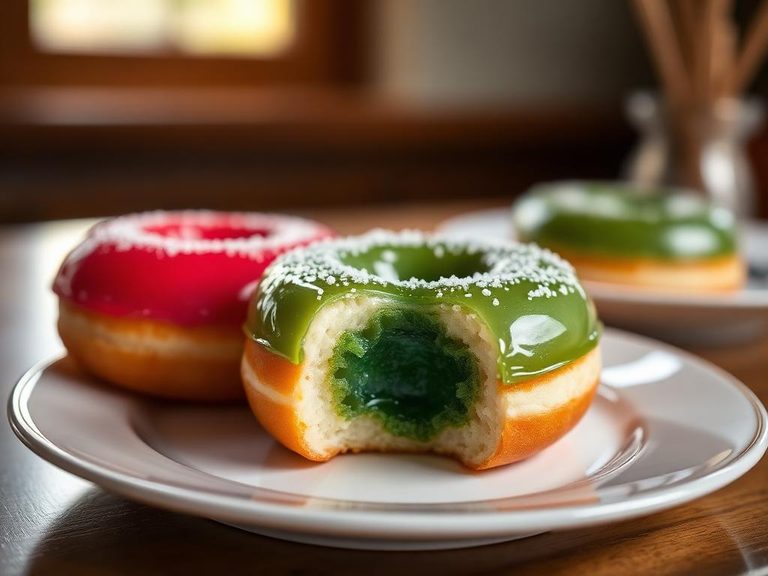
A golden, yeast-leavened dough ring, deep-fried to a crisp exterior and pillowy interior, then injected with a vibrant, sweet fruit jam. Each bite offers a satisfying contrast between the airy, slightly chewy dough and the smooth, sugary filling. Nutritionally, it's a high-energy treat, delivering a significant 340 kcal and 18.7g of fat per 100g, primarily from refined carbs and sugars.
Calorie split: 7% protein · 45% carbs · 48% fat
↓ Full nutrition💚 Why it's loved
People adore the perfect marriage of textures—the light, airy crumb of the yeast dough against the smooth, sweet burst of fruit jelly. It's a nostalgic, celebratory treat enjoyed worldwide, from American diners to Polish bakeries, symbolizing simple, joyful indulgence.
⚠️ Watch-outs & how to enjoy it better
The high sugar (21.1g per 100g) and refined carbohydrate content can cause rapid blood-sugar spikes and subsequent crashes, making it a poor choice for those managing diabetes or insulin resistance. The significant fat content, often from frying in palm oil, also makes it calorie-dense. To counteract this, enjoy a small portion (half a doughnut) and pair it with a source of protein or healthy fat, like a handful of nuts or a hard-boiled egg, to slow sugar absorption.
Key benefits
- Quick source of energy from carbohydrates and fats
- Provides a small amount of protein (5.9g per 100g)
- Contains trace amounts of minerals like iron from enriched flour
- Offers a psychological boost as an indulgent comfort food
🍽️ Popular dishes


🌍 Where it's eaten
💡 Did you know?
The tradition of eating jelly-filled doughnuts (Pączki) on Fat Thursday in Poland is so significant that bakeries report selling millions of them in a single day, with the most popular fillings being rose hip and plum jam.
Full nutrition (USDA data · scales with serving)
| Water | 35.6 g |
| Energy | 340 kcal |
| Energy | 1423 kj |
| Protein | 5.9 g |
| Total lipid (fat) | 18.7 g |
| Ash | 0.80 g |
| Carbohydrate, by difference | 39.0 g |
| Fiber, total dietary | 0.90 g |
| Total Sugars | 21.1 g |
| Calcium, Ca | 25.0 mg |
| Iron, Fe | 1.8 mg |
| Magnesium, Mg | 20.0 mg |
| Phosphorus, P | 85.0 mg |
| Potassium, K | 79.0 mg |
| Sodium, Na | 455 mg |
| Zinc, Zn | 0.75 mg |
| Copper, Cu | 0.14 mg |
| Manganese, Mn | 0.20 mg |
| Selenium, Se | 12.5 ug |
| Vitamin C, total ascorbic acid | 0.00 mg |
| Thiamin | 0.31 mg |
| Riboflavin | 0.14 mg |
| Niacin | 2.1 mg |
| Pantothenic acid | 0.88 mg |
| Vitamin B-6 | 0.10 mg |
| Folate, total | 68.0 ug |
| Folic acid | 51.0 ug |
| Folate, food | 17.0 ug |
| Folate, DFE | 104 ug |
| Choline, total | 29.1 mg |
| Vitamin B-12 | 0.22 ug |
| Vitamin B-12, added | 0.00 ug |
| Vitamin A, RAE | 17.0 ug |
| Retinol | 16.0 ug |
| Carotene, beta | 8.0 ug |
| Carotene, alpha | 3.0 ug |
| Cryptoxanthin, beta | 3.0 ug |
| Vitamin A, IU | 71.0 iu |
| Lycopene | 0.00 ug |
| Lutein + zeaxanthin | 108 ug |
| Vitamin E (alpha-tocopherol) | 0.43 mg |
| Vitamin E, added | 0.00 mg |
| Vitamin D (D2 + D3), International Units | 0.00 iu |
| Vitamin D (D2 + D3) | 0.00 ug |
| Vitamin K (phylloquinone) | 7.1 ug |
| Alcohol, ethyl | 0.00 g |
| Caffeine | 0.00 mg |
| Theobromine | 0.00 mg |
Fat & fatty acid profile (per 100g)
| Fatty acids, total saturated | 4.8 g |
| SFA 4:0 | 0.00 g |
| SFA 6:0 | 0.00 g |
| SFA 8:0 | 0.00 g |
| SFA 10:0 | 0.00 g |
| SFA 12:0 | 0.00 g |
| SFA 14:0 | 0.09 g |
| SFA 16:0 | 2.6 g |
| SFA 18:0 | 2.1 g |
| Fatty acids, total monounsaturated | 10.2 g |
| MUFA 16:1 | 0.11 g |
| MUFA 18:1 | 10.1 g |
| MUFA 20:1 | 0.01 g |
| MUFA 22:1 | 0.00 g |
| Fatty acids, total polyunsaturated | 2.4 g |
| PUFA 18:2 | 2.2 g |
| PUFA 18:3 | 0.11 g |
| PUFA 18:4 | 0.00 g |
| PUFA 20:4 | 0.03 g |
| PUFA 20:5 n-3 (EPA) | 0.01 g |
| PUFA 22:5 n-3 (DPA) | 0.00 g |
| PUFA 22:6 n-3 (DHA) | 0.01 g |
| Cholesterol | 26.0 mg |
Amino acid profile (per 100g)
| Tryptophan | 0.07 g |
| Threonine | 0.19 g |
| Isoleucine | 0.24 g |
| Leucine | 0.43 g |
| Lysine | 0.21 g |
| Methionine | 0.10 g |
| Cystine | 0.12 g |
| Phenylalanine | 0.28 g |
| Tyrosine | 0.18 g |
| Valine | 0.27 g |
| Arginine | 0.25 g |
| Histidine | 0.13 g |
| Alanine | 0.22 g |
| Aspartic acid | 0.35 g |
| Glutamic acid | 1.7 g |
| Glycine | 0.21 g |
| Proline | 0.58 g |
| Serine | 0.30 g |
FAQ
How is a jelly doughnut different from a Boston cream doughnut?
The primary difference is the filling and topping. A jelly doughnut is injected with fruit jam or jelly and typically dusted with sugar. A Boston cream doughnut is filled with vanilla custard or cream and topped with a chocolate glaze.
What is the best way to store leftover jelly doughnuts?
Store them in an airtight container at room temperature for 1-2 days. To prevent the dough from becoming soggy, place a paper towel in the container to absorb excess moisture. Avoid refrigerating, as it accelerates staling.
Can I make a baked version for a healthier alternative?
Yes, baked jelly doughnut holes or rings are a common alternative. While they significantly reduce the fat content from frying, the dough and filling remain high in refined sugar and carbs. They are a better option but should still be enjoyed in moderation.
Nutrient density (calculated · NRF9.3)
Nutrient Rich Foods index: beneficial nutrients (protein, fiber, vitamins, minerals) minus saturated fat, added sugar & sodium, per 100 kcal.
NRF9.3 index — Fulgoni, Keast & Drewnowski, 2009. Computed from USDA nutrients.
Weight-loss friendliness (composite index)
Energy density 3.40 kcal/g · 7% calories from protein · 0.9 g fiber · 21.1 g sugar per 100 g.
Composite of energy density (Rolls et al., 1999), protein & fiber satiety, minus sugar. A calculated heuristic — ranks satiety-per-calorie, not a clinical measure.
Dietary load (calculated from USDA values)
Potential renal acid load. Positive = acid-forming, negative = alkaline-forming.
Sodium-to-potassium ratio: 5.76 (lower is better — aim for ≤ 1)
Sodium:potassium per WHO potassium guidance. Computed from USDA nutrients.