

Couscous, plain, cooked
Common food

Photo: Wikipedia
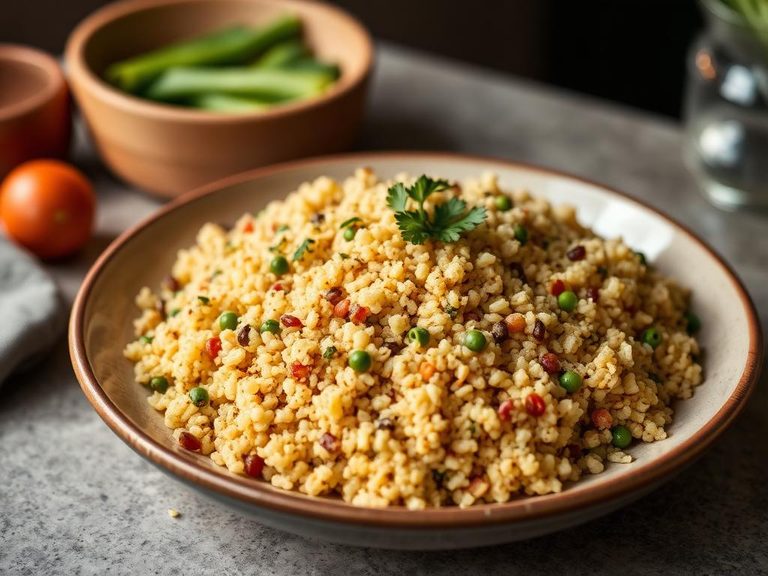
Plain cooked couscous consists of tiny, granular semolina wheat pellets that steam into a light, fluffy, and tender side dish. Its flavor is subtly nutty and neutral, acting as a perfect canvas for other ingredients. Nutritionally, it's a low-fat, carbohydrate-focused food that provides a quick source of energy and a modest amount of protein.
Calorie split: 14% protein · 85% carbs · 1% fat
↓ Full nutrition💚 Why it's loved
People love couscous for its incredible versatility and ability to soak up the flavors of stews, salads, and spices. It's a beloved comfort food in many cultures, symbolizing hospitality and shared meals.
⚠️ Watch-outs & how to enjoy it better
As a refined wheat product, it can cause a rapid rise in blood sugar and lacks the fiber of whole grains. To counteract this, pair it with protein (like chickpeas or lamb) and healthy fats (like olive oil) to slow digestion, or opt for whole-wheat couscous. It is also a common gluten-containing grain.
Key benefits
- Quick-cooking and convenient staple food
- Low in fat and naturally cholesterol-free
- Good source of plant-based protein
- Provides energy from complex carbohydrates
- Versatile base for absorbing flavors
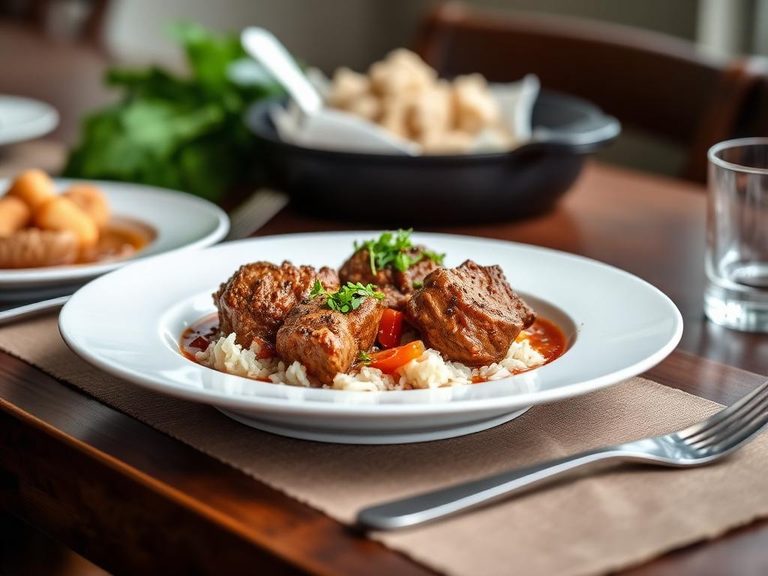
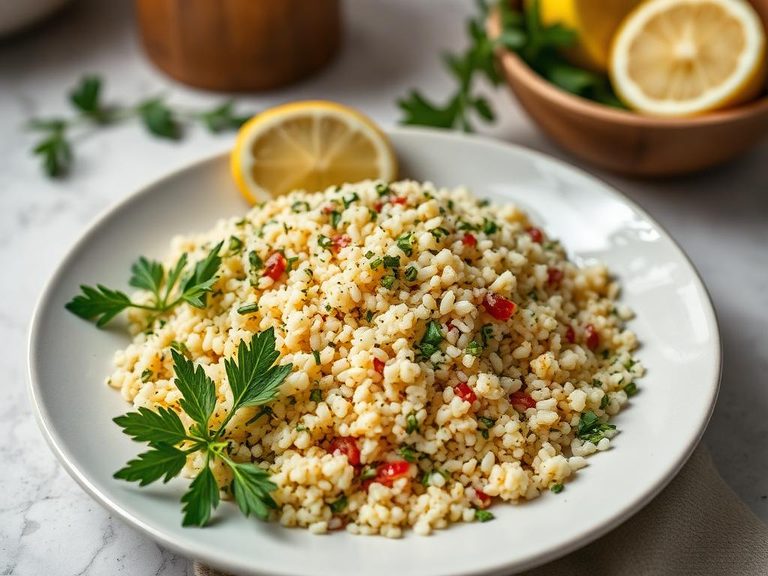
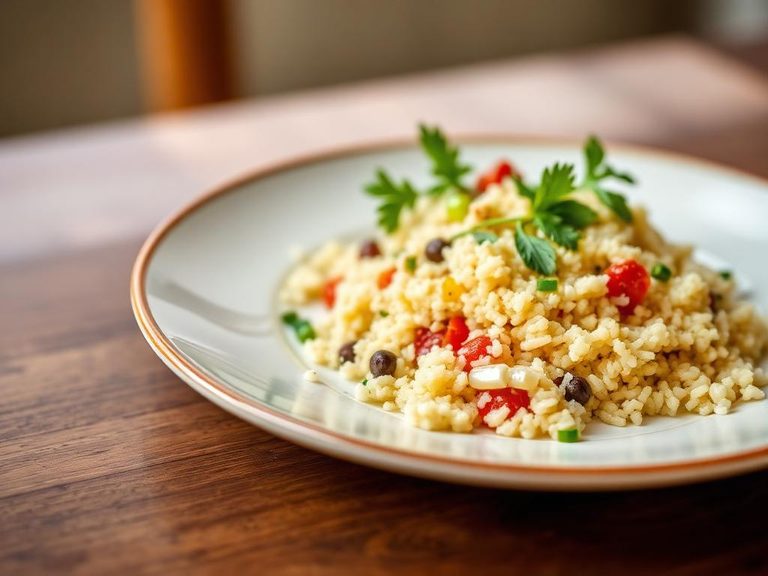
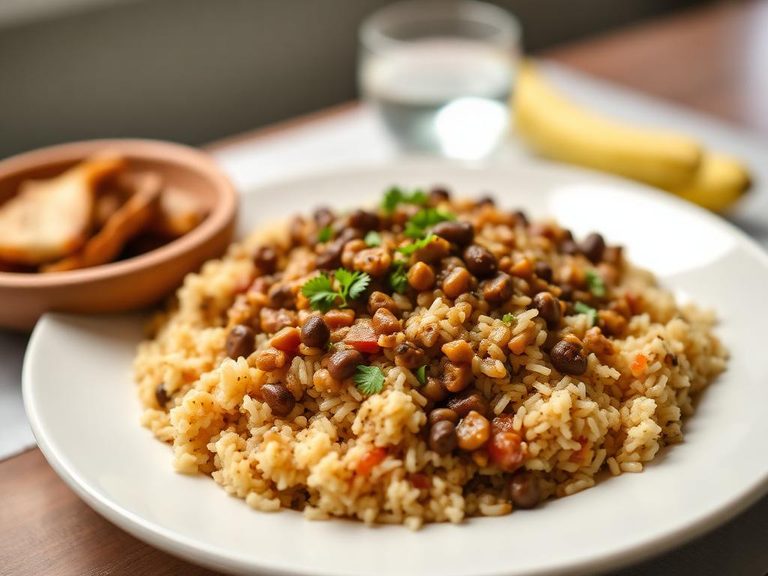
🍽️ Popular dishes

🌍 Where it's eaten
💡 Did you know?
The word 'couscous' comes from the Berber word 'seksu,' meaning 'well-rolled' or 'well-formed,' referring to the process of rolling the semolina grains by hand.
Full nutrition (USDA data · scales with serving)
| Water | 72.2 g |
| Energy | 111 kcal |
| Protein | 3.8 g |
| Total lipid (fat) | 0.16 g |
| Carbohydrate, by difference | 23.1 g |
| Fiber, total dietary | 1.4 g |
| Total Sugars | 0.10 g |
| Calcium, Ca | 8.0 mg |
| Iron, Fe | 0.38 mg |
| Magnesium, Mg | 8.0 mg |
| Phosphorus, P | 22.0 mg |
| Potassium, K | 58.0 mg |
| Sodium, Na | 189 mg |
| Zinc, Zn | 0.26 mg |
| Copper, Cu | 0.04 mg |
| Selenium, Se | 27.4 ug |
| Vitamin C, total ascorbic acid | 0.00 mg |
| Thiamin | 0.06 mg |
| Riboflavin | 0.03 mg |
| Niacin | 0.98 mg |
| Vitamin B-6 | 0.05 mg |
| Folate, total | 15.0 ug |
| Folic acid | 0.00 ug |
| Folate, food | 15.0 ug |
| Folate, DFE | 15.0 ug |
| Choline, total | 3.3 mg |
| Vitamin B-12 | 0.00 ug |
| Vitamin B-12, added | 0.00 ug |
| Vitamin A, RAE | 0.00 ug |
| Retinol | 0.00 ug |
| Carotene, beta | 0.00 ug |
| Carotene, alpha | 0.00 ug |
| Cryptoxanthin, beta | 0.00 ug |
| Lycopene | 0.00 ug |
| Lutein + zeaxanthin | 25.0 ug |
| Vitamin E (alpha-tocopherol) | 0.13 mg |
| Vitamin E, added | 0.00 mg |
| Vitamin D (D2 + D3) | 0.00 ug |
| Vitamin K (phylloquinone) | 0.10 ug |
| Alcohol, ethyl | 0.00 g |
| Caffeine | 0.00 mg |
| Theobromine | 0.00 mg |
Fat & fatty acid profile (per 100g)
| Fatty acids, total saturated | 0.03 g |
| SFA 4:0 | 0.00 g |
| SFA 6:0 | 0.00 g |
| SFA 8:0 | 0.00 g |
| SFA 10:0 | 0.00 g |
| SFA 12:0 | 0.00 g |
| SFA 14:0 | 0.00 g |
| SFA 16:0 | 0.03 g |
| SFA 18:0 | 0.00 g |
| Fatty acids, total monounsaturated | 0.02 g |
| MUFA 16:1 | 0.00 g |
| MUFA 18:1 | 0.02 g |
| MUFA 20:1 | 0.00 g |
| MUFA 22:1 | 0.00 g |
| Fatty acids, total polyunsaturated | 0.06 g |
| PUFA 18:2 | 0.06 g |
| PUFA 18:3 | 0.00 g |
| PUFA 18:4 | 0.00 g |
| PUFA 20:4 | 0.00 g |
| PUFA 20:5 n-3 (EPA) | 0.00 g |
| PUFA 22:5 n-3 (DPA) | 0.00 g |
| PUFA 22:6 n-3 (DHA) | 0.00 g |
| Cholesterol | 0.00 mg |
Amino acid profile (per 100g)
Estimated from Couscous, dry — USDA does not publish this profile for Couscous.
| Tryptophan | 0.16 g |
| Threonine | 0.34 g |
| Isoleucine | 0.49 g |
| Leucine | 0.87 g |
| Lysine | 0.24 g |
| Methionine | 0.20 g |
| Cystine | 0.36 g |
| Phenylalanine | 0.62 g |
| Tyrosine | 0.34 g |
| Valine | 0.54 g |
| Arginine | 0.47 g |
| Histidine | 0.26 g |
| Alanine | 0.37 g |
| Aspartic acid | 0.52 g |
| Glutamic acid | 4.6 g |
| Glycine | 0.40 g |
| Proline | 1.4 g |
| Serine | 0.60 g |
FAQ
What is the difference between couscous and quinoa?
Couscous is a pasta made from semolina wheat, while quinoa is a seed. Couscous is higher in carbohydrates and contains gluten, whereas quinoa is a complete protein and is gluten-free.
How do I keep couscous from getting clumpy?
After steaming or soaking, fluff the grains gently with a fork to separate them. Avoid stirring vigorously, which can make it gummy. A drizzle of olive oil or a pat of butter can also help keep grains separate.
Is couscous a grain or a pasta?
It's technically a tiny pasta made from crushed durum wheat semolina. However, it's often treated and served like a grain in culinary contexts.
Nutrient density (calculated · NRF9.3)
Nutrient Rich Foods index: beneficial nutrients (protein, fiber, vitamins, minerals) minus saturated fat, added sugar & sodium, per 100 kcal.
NRF9.3 index — Fulgoni, Keast & Drewnowski, 2009. Computed from USDA nutrients.
Weight-loss friendliness (composite index)
Energy density 1.11 kcal/g · 14% calories from protein · 1.4 g fiber · 0.1 g sugar per 100 g.
Composite of energy density (Rolls et al., 1999), protein & fiber satiety, minus sugar. A calculated heuristic — ranks satiety-per-calorie, not a clinical measure.
Dietary load (calculated from USDA values)
Potential renal acid load. Positive = acid-forming, negative = alkaline-forming.
Sodium-to-potassium ratio: 3.26 (lower is better — aim for ≤ 1)
Sodium:potassium per WHO potassium guidance. Computed from USDA nutrients.