

Cookies, oatmeal, commercially prepared, regular
Whole food · Baked Products
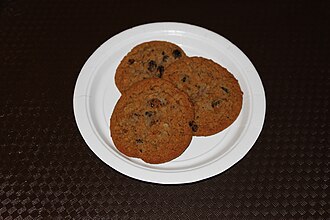
Photo: Wikipedia
A classic, chewy-sweet treat made with rolled oats, brown sugar, and butter, offering a comforting, hearty texture with caramelized notes. Nutritionally dense at 450 kcal per 100g, it delivers significant energy alongside a notable 24.66g of sugar and 18.1g of fat, making it more of a dessert than a health food.
Calorie split: 5% protein · 59% carbs · 35% fat
↓ Full nutrition💚 Why it's loved
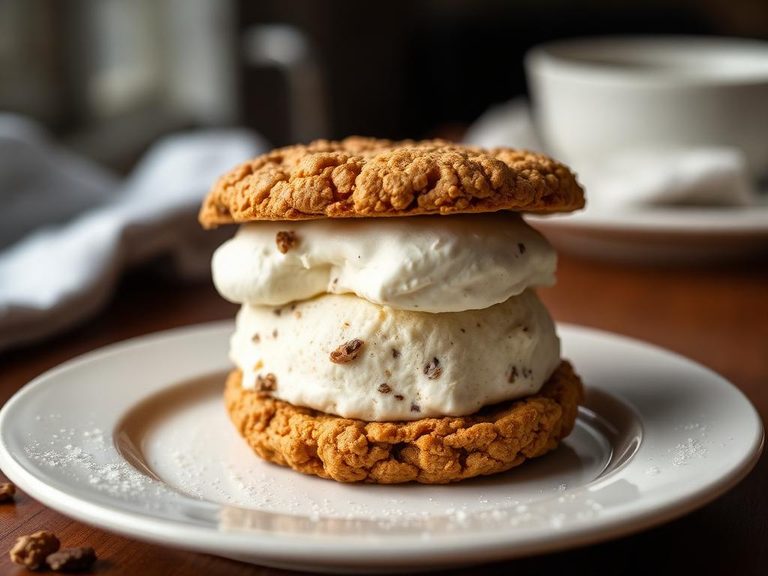
People love it for its nostalgic, home-baked flavor and satisfying chewy texture, often evoking memories of childhood. Its versatility makes it a beloved companion to coffee, milk, or ice cream, and it's a staple in many cultural comfort food traditions.
⚠️ Watch-outs & how to enjoy it better
The high sugar and fat content can lead to blood-sugar spikes and is a concern for those managing weight or diabetes. To mitigate this, pair a single cookie with a source of protein or healthy fat (like a handful of nuts or a glass of milk) to slow sugar absorption, and practice strict portion control. Individuals with gluten or oat allergies should avoid it entirely.
Key benefits
- Provides quick energy from 68.7g of carbohydrates
- Offers some dietary fiber (2.8g) from oats
- Contains a modest amount of plant-based protein (6.2g)
- Convenient, shelf-stable, and widely available snack
- Can be a comforting, mood-boosting treat in moderation
🍽️ Popular dishes
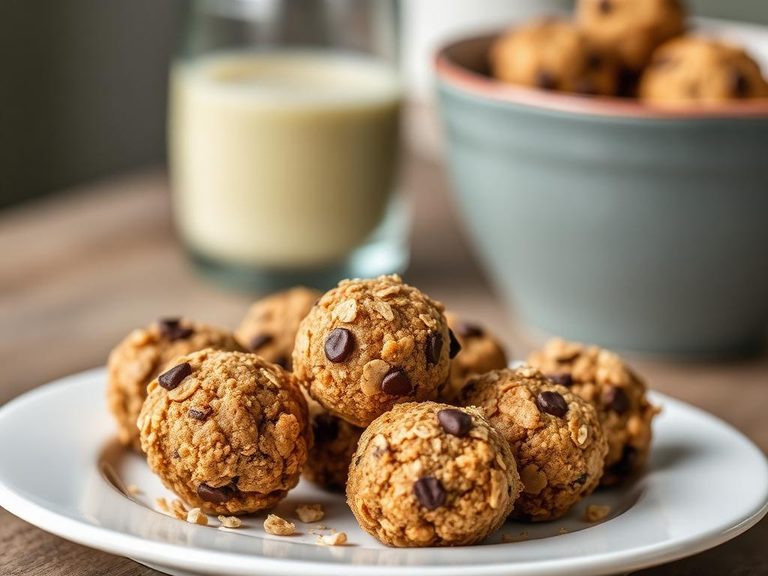
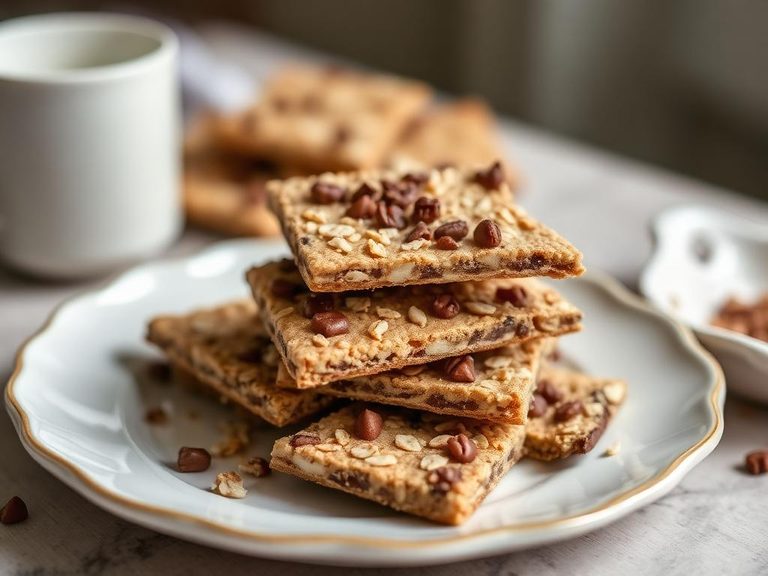
🌍 Where it's eaten
💡 Did you know?
The oatmeal cookie's popularity in America surged after a recipe for 'oatmeal cookies' was published in a 1896 Fannie Farmer cookbook, though they were initially called 'oatmeal cakes.'
Full nutrition (USDA data · scales with serving)
| Water | 5.7 g |
| Energy | 450 kcal |
| Energy | 1883 kj |
| Protein | 6.2 g |
| Total lipid (fat) | 18.1 g |
| Ash | 1.4 g |
| Carbohydrate, by difference | 68.7 g |
| Fiber, total dietary | 2.8 g |
| Total Sugars | 24.7 g |
| Calcium, Ca | 37.0 mg |
| Iron, Fe | 2.6 mg |
| Magnesium, Mg | 33.0 mg |
| Phosphorus, P | 138 mg |
| Potassium, K | 142 mg |
| Sodium, Na | 520 mg |
| Zinc, Zn | 0.79 mg |
| Copper, Cu | 0.13 mg |
| Manganese, Mn | 0.84 mg |
| Selenium, Se | 9.8 ug |
| Vitamin C, total ascorbic acid | 0.50 mg |
| Thiamin | 0.27 mg |
| Riboflavin | 0.23 mg |
| Niacin | 2.2 mg |
| Pantothenic acid | 0.39 mg |
| Vitamin B-6 | 0.07 mg |
| Folate, total | 59.0 ug |
| Folic acid | 52.0 ug |
| Folate, food | 7.0 ug |
| Folate, DFE | 95.0 ug |
| Choline, total | 12.0 mg |
| Vitamin B-12 | 0.00 ug |
| Vitamin B-12, added | 0.00 ug |
| Vitamin A, RAE | 5.0 ug |
| Retinol | 5.0 ug |
| Carotene, beta | 0.00 ug |
| Carotene, alpha | 0.00 ug |
| Cryptoxanthin, beta | 0.00 ug |
| Vitamin A, IU | 18.0 iu |
| Lycopene | 0.00 ug |
| Lutein + zeaxanthin | 31.0 ug |
| Vitamin E (alpha-tocopherol) | 0.26 mg |
| Vitamin E, added | 0.00 mg |
| Vitamin D (D2 + D3), International Units | 0.00 iu |
| Vitamin D (D2 + D3) | 0.00 ug |
| Vitamin K (phylloquinone) | 8.0 ug |
| Alcohol, ethyl | 0.00 g |
| Caffeine | 0.00 mg |
| Theobromine | 0.00 mg |
Fat & fatty acid profile (per 100g)
| Fatty acids, total saturated | 4.5 g |
| SFA 4:0 | 0.00 g |
| SFA 6:0 | 0.00 g |
| SFA 8:0 | 0.00 g |
| SFA 10:0 | 0.00 g |
| SFA 12:0 | 0.00 g |
| SFA 14:0 | 0.09 g |
| SFA 16:0 | 2.4 g |
| SFA 18:0 | 2.0 g |
| Fatty acids, total monounsaturated | 10.0 g |
| MUFA 16:1 | 0.00 g |
| MUFA 18:1 | 10.0 g |
| MUFA 20:1 | 0.00 g |
| MUFA 22:1 | 0.00 g |
| Fatty acids, total polyunsaturated | 2.5 g |
| PUFA 18:2 | 2.4 g |
| PUFA 18:3 | 0.13 g |
| PUFA 18:4 | 0.00 g |
| PUFA 20:4 | 0.00 g |
| PUFA 20:5 n-3 (EPA) | 0.00 g |
| PUFA 22:5 n-3 (DPA) | 0.00 g |
| PUFA 22:6 n-3 (DHA) | 0.00 g |
| Cholesterol | 0.00 mg |
Amino acid profile (per 100g)
| Tryptophan | 0.10 g |
| Threonine | 0.17 g |
| Isoleucine | 0.22 g |
| Leucine | 0.43 g |
| Lysine | 0.24 g |
| Methionine | 0.12 g |
| Cystine | 0.17 g |
| Phenylalanine | 0.29 g |
| Tyrosine | 0.20 g |
| Valine | 0.30 g |
| Arginine | 0.36 g |
| Histidine | 0.14 g |
| Alanine | 0.26 g |
| Aspartic acid | 0.45 g |
| Glutamic acid | 1.6 g |
| Glycine | 0.27 g |
| Proline | 0.48 g |
| Serine | 0.32 g |
FAQ
Are oatmeal cookies healthier than chocolate chip cookies?
Not necessarily. While they contain oats, commercial versions are often similar in sugar and fat content. The 'healthier' perception comes from the oats, but the overall nutritional profile is still that of a dessert.
Can I eat oatmeal cookies on a gluten-free diet?
Only if they are certified gluten-free. Oats are often cross-contaminated with wheat during processing, so regular oatmeal cookies are not safe for those with celiac disease or gluten sensitivity.
Why are my homemade oatmeal cookies so crunchy?
This often happens from overbaking or using too much white sugar. For chewier cookies, use more brown sugar, slightly underbake them, and let them cool on the baking sheet.
Nutrient density (calculated · NRF9.3)
Nutrient Rich Foods index: beneficial nutrients (protein, fiber, vitamins, minerals) minus saturated fat, added sugar & sodium, per 100 kcal.
NRF9.3 index — Fulgoni, Keast & Drewnowski, 2009. Computed from USDA nutrients.
Weight-loss friendliness (composite index)
Energy density 4.50 kcal/g · 6% calories from protein · 2.8 g fiber · 24.7 g sugar per 100 g.
Composite of energy density (Rolls et al., 1999), protein & fiber satiety, minus sugar. A calculated heuristic — ranks satiety-per-calorie, not a clinical measure.
Dietary load (calculated from USDA values)
Potential renal acid load. Positive = acid-forming, negative = alkaline-forming.
Sodium-to-potassium ratio: 3.66 (lower is better — aim for ≤ 1)
Sodium:potassium per WHO potassium guidance. Computed from USDA nutrients.