

Cookie, marshmallow, chocolate-covered
Common food

Photo: Wikipedia
A decadent confection featuring a soft, chewy marshmallow core encased in a crisp, dark or milk chocolate shell, often built upon a cookie base. The texture is a delightful contrast of yielding sweetness and a satisfying snap, creating a rich, indulgent mouthfeel. Nutritionally, it is a high-energy, sugar-dense treat, providing a quick calorie boost with minimal protein or fiber.
Calorie split: 4% protein · 62% carbs · 35% fat
↓ Full nutrition💚 Why it's loved
People adore the classic trio of textures—chewy marshmallow, crisp chocolate, and soft cookie—that delivers an intense, comforting sweetness. It's a nostalgic, versatile treat enjoyed as a standalone snack, a dessert component, or a sweet addition to hot drinks.
⚠️ Watch-outs & how to enjoy it better
This is a high-sugar, high-fat food with a low nutritional density, which can cause rapid blood-sugar spikes and is unsuitable for those managing diabetes or calorie intake. To mitigate, pair it with a source of protein (like nuts) or fiber (like an apple) to slow sugar absorption, and practice strict portion control by sticking to a single, small serving.
Key benefits
- Provides a rapid source of energy from carbohydrates and sugars
- Offers a quick mood boost or comfort food satisfaction
- Can be a convenient, portable snack for immediate calorie needs
- The combination of textures (chewy, crisp) can be satisfying
🍽️ Popular dishes
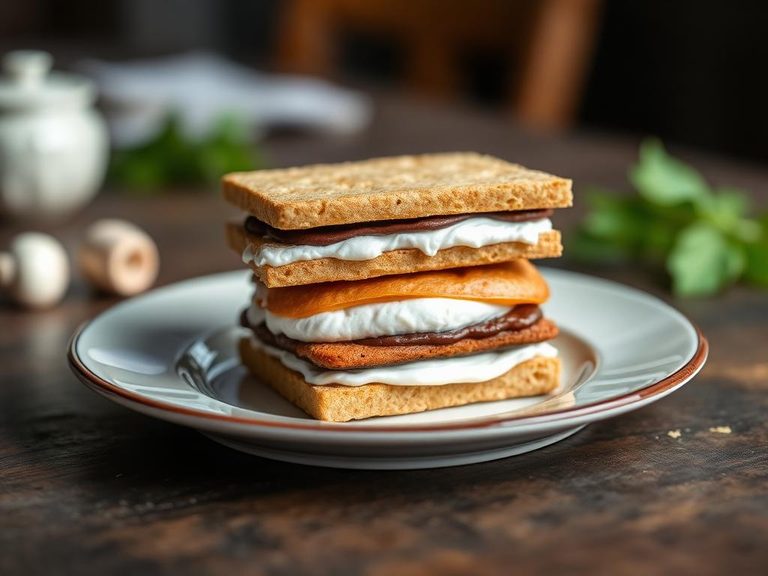
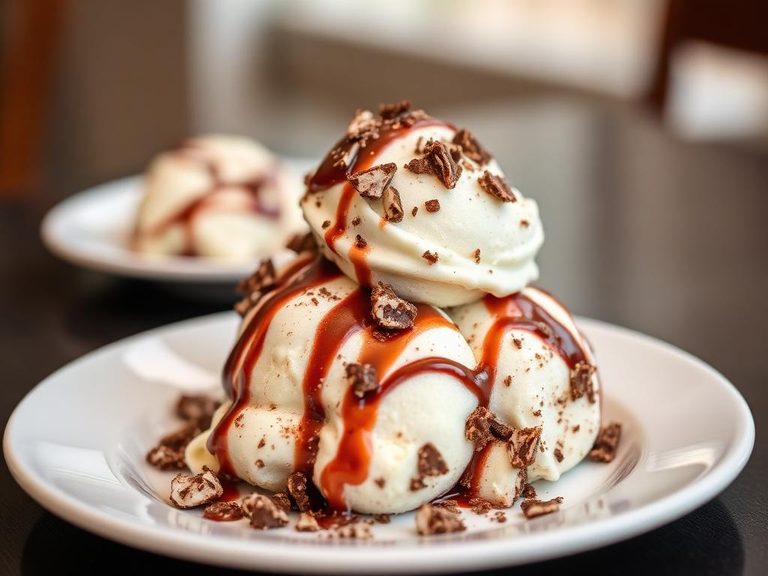
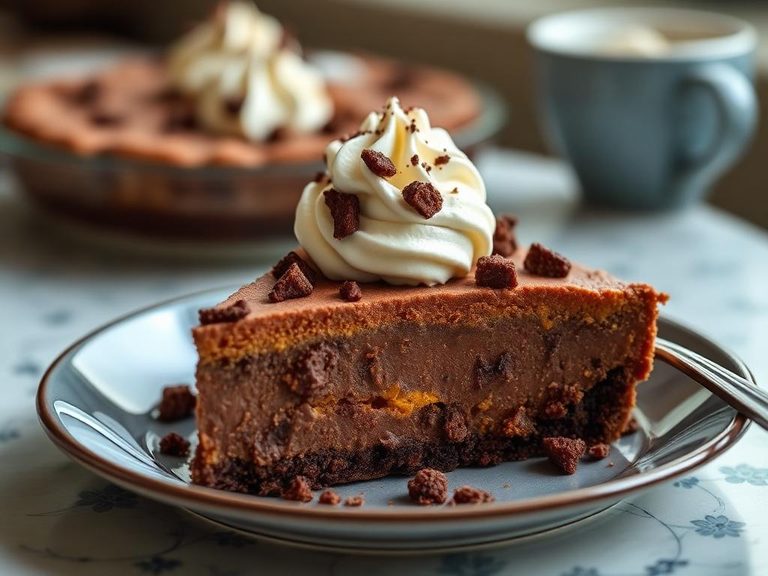
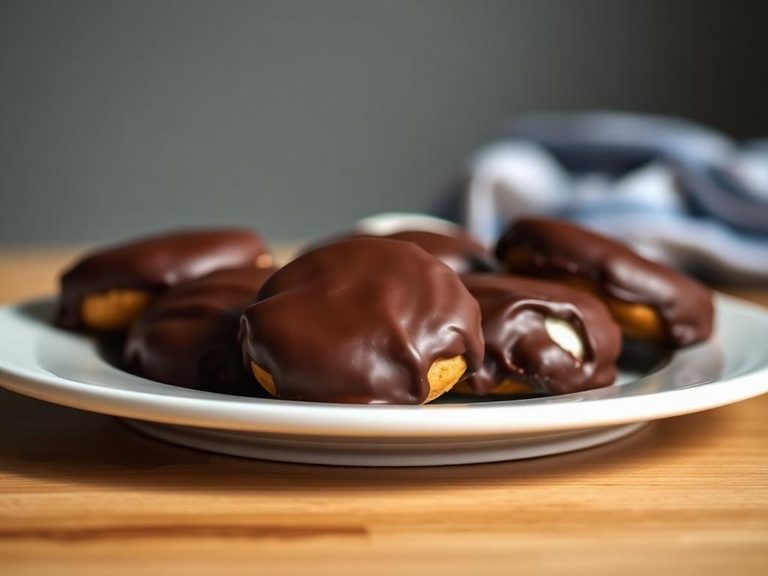
🌍 Where it's eaten
💡 Did you know?
The marshmallow was originally made from the root of the marshmallow plant, which was used as a medicinal remedy for sore throats before becoming a sweet confection.
Full nutrition (USDA data · scales with serving)
| Water | 10.1 g |
| Energy | 421 kcal |
| Protein | 4.0 g |
| Total lipid (fat) | 16.9 g |
| Carbohydrate, by difference | 67.7 g |
| Fiber, total dietary | 2.0 g |
| Total Sugars | 44.8 g |
| Calcium, Ca | 46.0 mg |
| Iron, Fe | 2.5 mg |
| Magnesium, Mg | 36.0 mg |
| Phosphorus, P | 97.0 mg |
| Potassium, K | 182 mg |
| Sodium, Na | 188 mg |
| Zinc, Zn | 0.65 mg |
| Copper, Cu | 0.26 mg |
| Selenium, Se | 4.4 ug |
| Vitamin C, total ascorbic acid | 0.10 mg |
| Thiamin | 0.09 mg |
| Riboflavin | 0.21 mg |
| Niacin | 0.78 mg |
| Vitamin B-6 | 0.06 mg |
| Folate, total | 23.0 ug |
| Folic acid | 20.0 ug |
| Folate, food | 3.0 ug |
| Folate, DFE | 37.0 ug |
| Choline, total | 13.6 mg |
| Vitamin B-12 | 0.17 ug |
| Vitamin B-12, added | 0.00 ug |
| Vitamin A, RAE | 1.0 ug |
| Retinol | 1.0 ug |
| Carotene, beta | 0.00 ug |
| Carotene, alpha | 0.00 ug |
| Cryptoxanthin, beta | 0.00 ug |
| Lycopene | 0.00 ug |
| Lutein + zeaxanthin | 3.0 ug |
| Vitamin E (alpha-tocopherol) | 0.14 mg |
| Vitamin E, added | 0.00 mg |
| Vitamin D (D2 + D3) | 0.00 ug |
| Vitamin K (phylloquinone) | 7.0 ug |
| Alcohol, ethyl | 0.00 g |
| Caffeine | 5.0 mg |
| Theobromine | 159 mg |
Fat & fatty acid profile (per 100g)
| Fatty acids, total saturated | 4.7 g |
| SFA 4:0 | 0.00 g |
| SFA 6:0 | 0.00 g |
| SFA 8:0 | 0.00 g |
| SFA 10:0 | 0.00 g |
| SFA 12:0 | 0.00 g |
| SFA 14:0 | 0.09 g |
| SFA 16:0 | 2.4 g |
| SFA 18:0 | 2.2 g |
| Fatty acids, total monounsaturated | 9.3 g |
| MUFA 16:1 | 0.00 g |
| MUFA 18:1 | 9.3 g |
| MUFA 20:1 | 0.00 g |
| MUFA 22:1 | 0.00 g |
| Fatty acids, total polyunsaturated | 1.9 g |
| PUFA 18:2 | 1.8 g |
| PUFA 18:3 | 0.10 g |
| PUFA 18:4 | 0.00 g |
| PUFA 20:4 | 0.00 g |
| PUFA 20:5 n-3 (EPA) | 0.00 g |
| PUFA 22:5 n-3 (DPA) | 0.00 g |
| PUFA 22:6 n-3 (DHA) | 0.00 g |
| Cholesterol | 0.00 mg |
Amino acid profile (per 100g)
Estimated from Pie Crust, Cookie-type, Chocolate, Ready Crust — USDA does not publish this profile for Cookie.
| Tryptophan | 0.08 g |
| Threonine | 0.20 g |
| Isoleucine | 0.23 g |
| Leucine | 0.38 g |
| Lysine | 0.24 g |
| Methionine | 0.07 g |
| Cystine | 0.11 g |
| Phenylalanine | 0.28 g |
| Tyrosine | 0.16 g |
| Valine | 0.32 g |
| Arginine | 0.29 g |
| Histidine | 0.11 g |
| Alanine | 0.24 g |
| Aspartic acid | 0.45 g |
| Glutamic acid | 1.3 g |
| Glycine | 0.24 g |
| Proline | 0.42 g |
| Serine | 0.26 g |
FAQ
What is the main difference between a chocolate-covered marshmallow cookie and a s'more?
A chocolate-covered marshmallow cookie is a pre-made, often commercially produced confection with a cookie base, while a s'more is a campfire treat assembled from a graham cracker, a toasted marshmallow, and a piece of chocolate.
Is this food suitable for a vegan diet?
It depends on the specific brand. Traditional marshmallows contain gelatin (animal-derived), and many chocolates contain milk. However, vegan versions using plant-based gelatin and dairy-free chocolate do exist.
How can I store these to maintain their texture?
Store them in an airtight container at room temperature, away from heat and moisture, to prevent the chocolate from melting and the marshmallow from becoming sticky or stale.
Nutrient density (calculated · NRF9.3)
Nutrient Rich Foods index: beneficial nutrients (protein, fiber, vitamins, minerals) minus saturated fat, added sugar & sodium, per 100 kcal.
NRF9.3 index — Fulgoni, Keast & Drewnowski, 2009. Computed from USDA nutrients.
Weight-loss friendliness (composite index)
Energy density 4.21 kcal/g · 4% calories from protein · 2.0 g fiber · 44.8 g sugar per 100 g.
Composite of energy density (Rolls et al., 1999), protein & fiber satiety, minus sugar. A calculated heuristic — ranks satiety-per-calorie, not a clinical measure.
Dietary load (calculated from USDA values)
Potential renal acid load. Positive = acid-forming, negative = alkaline-forming.
Sodium-to-potassium ratio: 1.03 (lower is better — aim for ≤ 1)
Sodium:potassium per WHO potassium guidance. Computed from USDA nutrients.