

Coffee, Iced Cafe Mocha, with non-dairy milk
Common food

Photo: Wikipedia
A chilled, blended beverage that marries the robust bitterness of espresso with the sweet, creamy notes of chocolate, all smoothed by a non-dairy milk base. The texture is typically frothy and light, with a refreshing, cool finish. Nutritionally, it's a very low-calorie treat, with the majority of its energy coming from a modest 8 grams of carbohydrates, primarily as sugar.
Calorie split: 5% protein · 78% carbs · 17% fat
↓ Full nutrition💚 Why it's loved
People love it for the perfect harmony of coffee's invigorating kick and chocolate's comforting sweetness, served in a refreshing, cool format. It's a versatile treat that feels like a dessert but can be enjoyed as a daytime pick-me-up, embodying a modern café culture staple.
⚠️ Watch-outs & how to enjoy it better
The primary concern is the added sugar content (6.65g per 100g), which can contribute to blood sugar spikes, especially for those with insulin sensitivity. The caffeine content, while moderate, may affect sensitive individuals. To counteract sugar spikes, consider pairing it with a source of protein or healthy fat (like a handful of nuts) or opting for a smaller portion.
Key benefits
- Low-calorie indulgence at 42 kcal per 100g
- Provides a quick energy boost from carbohydrates
- Dairy-free option suitable for lactose intolerance
- Contains antioxidants from coffee and cocoa
- Can be customized with various non-dairy milks
🍽️ Popular dishes
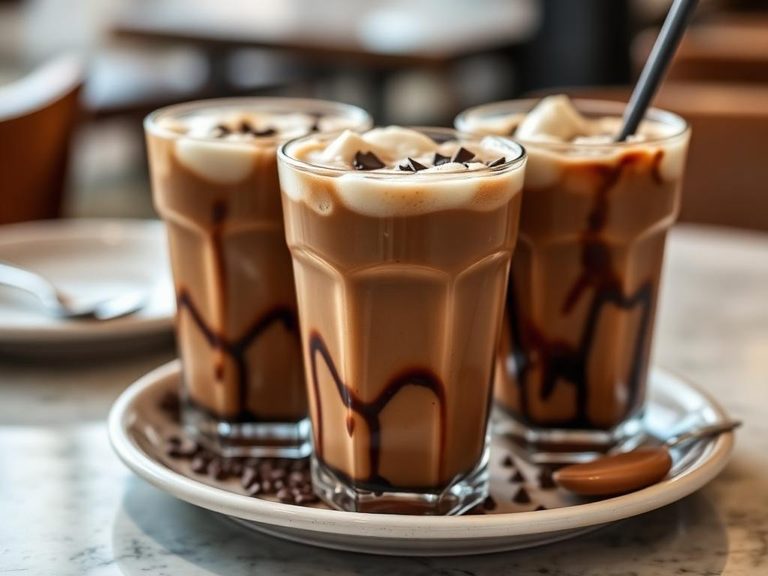
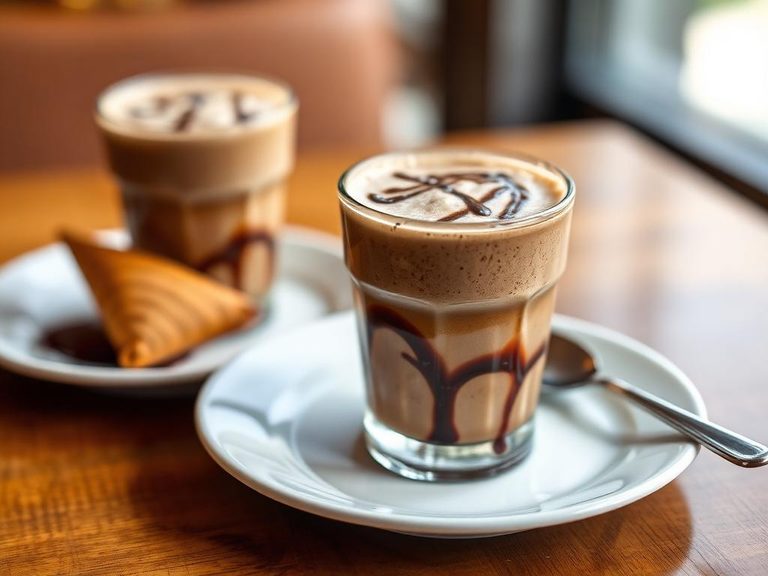
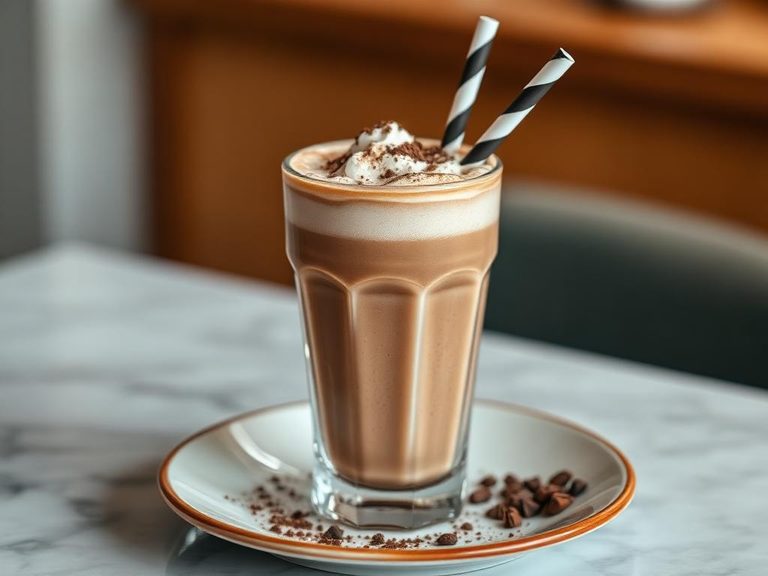

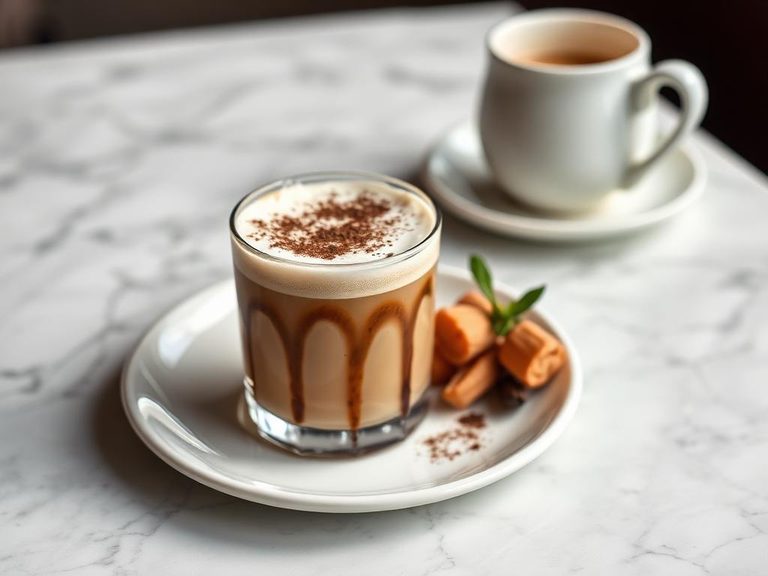
🌍 Where it's eaten
💡 Did you know?
The term 'mocha' originally referred to a high-quality coffee bean from the port city of Mocha (Al Mokha) in Yemen, known for its natural chocolatey notes, which inspired the coffee-chocolate drink.
Full nutrition (USDA data · scales with serving)
| Water | 90.2 g |
| Energy | 42.0 kcal |
| Protein | 0.55 g |
| Total lipid (fat) | 0.78 g |
| Carbohydrate, by difference | 8.1 g |
| Fiber, total dietary | 0.00 g |
| Total Sugars | 6.7 g |
| Calcium, Ca | 73.0 mg |
| Iron, Fe | 0.17 mg |
| Magnesium, Mg | 21.0 mg |
| Phosphorus, P | 23.0 mg |
| Potassium, K | 54.0 mg |
| Sodium, Na | 41.0 mg |
| Zinc, Zn | 0.15 mg |
| Copper, Cu | 0.06 mg |
| Selenium, Se | 0.50 ug |
| Vitamin C, total ascorbic acid | 0.00 mg |
| Thiamin | 0.01 mg |
| Riboflavin | 0.05 mg |
| Niacin | 0.88 mg |
| Vitamin B-6 | 0.01 mg |
| Folate, total | 2.0 ug |
| Folic acid | 0.00 ug |
| Folate, food | 2.0 ug |
| Folate, DFE | 2.0 ug |
| Choline, total | 3.7 mg |
| Vitamin B-12 | 0.18 ug |
| Vitamin B-12, added | 0.18 ug |
| Vitamin A, RAE | 17.0 ug |
| Retinol | 17.0 ug |
| Carotene, beta | 0.00 ug |
| Carotene, alpha | 0.00 ug |
| Cryptoxanthin, beta | 0.00 ug |
| Lycopene | 0.00 ug |
| Lutein + zeaxanthin | 2.0 ug |
| Vitamin E (alpha-tocopherol) | 0.97 mg |
| Vitamin E, added | 0.92 mg |
| Vitamin D (D2 + D3) | 0.50 ug |
| Vitamin K (phylloquinone) | 0.40 ug |
| Alcohol, ethyl | 0.00 g |
| Caffeine | 35.0 mg |
| Theobromine | 15.0 mg |
Fat & fatty acid profile (per 100g)
| Fatty acids, total saturated | 0.09 g |
| SFA 4:0 | 0.00 g |
| SFA 6:0 | 0.00 g |
| SFA 8:0 | 0.00 g |
| SFA 10:0 | 0.00 g |
| SFA 12:0 | 0.00 g |
| SFA 14:0 | 0.00 g |
| SFA 16:0 | 0.06 g |
| SFA 18:0 | 0.01 g |
| Fatty acids, total monounsaturated | 0.36 g |
| MUFA 16:1 | 0.00 g |
| MUFA 18:1 | 0.36 g |
| MUFA 20:1 | 0.00 g |
| MUFA 22:1 | 0.00 g |
| Fatty acids, total polyunsaturated | 0.25 g |
| PUFA 18:2 | 0.22 g |
| PUFA 18:3 | 0.03 g |
| PUFA 18:4 | 0.00 g |
| PUFA 20:4 | 0.00 g |
| PUFA 20:5 n-3 (EPA) | 0.00 g |
| PUFA 22:5 n-3 (DPA) | 0.00 g |
| PUFA 22:6 n-3 (DHA) | 0.00 g |
| Cholesterol | 0.00 mg |
Amino acid profile (per 100g)
Estimated from Cream, fluid, light (coffee cream or table cream) — USDA does not publish this profile for Coffee.
| Tryptophan | 0.07 g |
| Threonine | 0.13 g |
| Isoleucine | 0.15 g |
| Leucine | 0.24 g |
| Lysine | 0.13 g |
| Methionine | 0.07 g |
| Cystine | 0.01 g |
| Phenylalanine | 0.14 g |
| Tyrosine | 0.14 g |
| Valine | 0.18 g |
| Arginine | 0.07 g |
| Histidine | 0.07 g |
| Alanine | 0.09 g |
| Aspartic acid | 0.22 g |
| Glutamic acid | 0.59 g |
| Glycine | 0.07 g |
| Proline | 0.31 g |
| Serine | 0.10 g |
FAQ
How does the calorie count compare to a regular dairy-based iced mocha?
It is typically significantly lower. A standard iced mocha with whole milk can have 150-250+ calories for a similar serving, making the non-dairy version a lighter choice.
Is the protein content (0.55g/100g) enough to be filling?
No, the protein content is very low. This drink is primarily a carbohydrate and fluid source. For satiety, you would need to pair it with a protein-rich food.
What non-dairy milk is most commonly used in this version?
Almond, oat, and soy milks are popular choices. Oat milk often provides a creamier texture that mimics dairy well, while almond milk keeps the calorie count very low.
Nutrient density (calculated · NRF9.3)
Nutrient Rich Foods index: beneficial nutrients (protein, fiber, vitamins, minerals) minus saturated fat, added sugar & sodium, per 100 kcal.
NRF9.3 index — Fulgoni, Keast & Drewnowski, 2009. Computed from USDA nutrients.
Weight-loss friendliness (composite index)
Energy density 0.42 kcal/g · 5% calories from protein · 0.0 g fiber · 6.7 g sugar per 100 g.
Composite of energy density (Rolls et al., 1999), protein & fiber satiety, minus sugar. A calculated heuristic — ranks satiety-per-calorie, not a clinical measure.
Dietary load (calculated from USDA values)
Potential renal acid load. Positive = acid-forming, negative = alkaline-forming.
Sodium-to-potassium ratio: 0.76 (lower is better — aim for ≤ 1)
Sodium:potassium per WHO potassium guidance. Computed from USDA nutrients.