

Coffee, Cafe Mocha, with non-dairy milk
Common food

Photo: Wikipedia
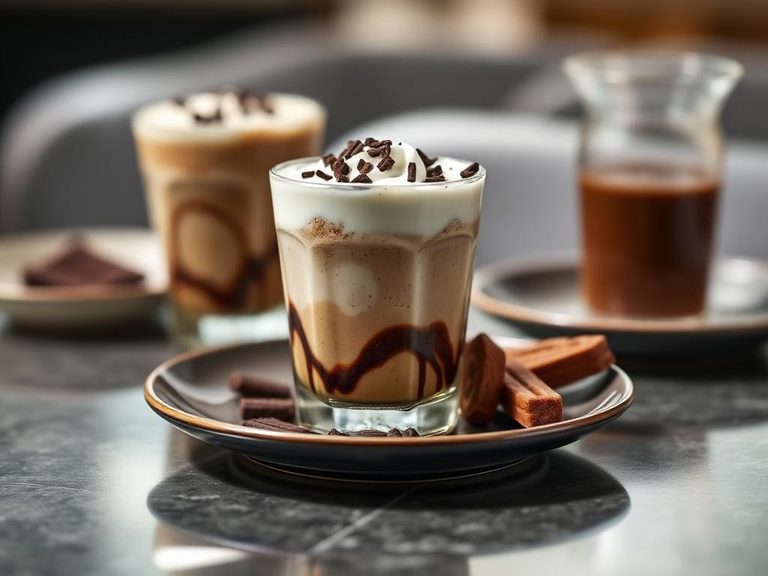
A velvety, indulgent espresso-based drink that blends rich chocolate with the smoothness of steamed non-dairy milk. Its light, airy texture and balanced bittersweet flavor make it a popular lower-calorie alternative to traditional mochas. With only 50 kcal per 100g, it offers a modest energy boost without excessive fat or sugar.
Calorie split: 7% protein · 70% carbs · 22% fat
↓ Full nutrition💚 Why it's loved
People love it for its comforting, dessert-like flavor that feels like a treat without the guilt. It's a versatile drink that can be customized with different non-dairy milks and sweeteners, fitting seamlessly into modern café culture.
⚠️ Watch-outs & how to enjoy it better
The high sugar content (7.08g per 100g) can lead to blood-sugar spikes, especially for those with insulin resistance. To counteract this, pair it with a source of protein or healthy fat (like nuts or a small meal) and opt for a smaller portion. Some non-dairy milks may contain added sugars or allergens like soy, so checking labels is wise.
Key benefits
- Lower in calories than traditional dairy-based mochas
- Provides a quick energy boost from carbohydrates
- Contains antioxidants from coffee and cocoa
- Suitable for lactose-intolerant or vegan diets
- Offers a small amount of protein from non-dairy milk
🍽️ Popular dishes


🌍 Where it's eaten
💡 Did you know?
The term 'mocha' originally referred to a type of coffee bean from the port city of Mocha in Yemen, which had a natural chocolate-like flavor profile.
Full nutrition (USDA data · scales with serving)
| Water | 88.7 g |
| Energy | 50.0 kcal |
| Protein | 0.88 g |
| Total lipid (fat) | 1.2 g |
| Carbohydrate, by difference | 8.8 g |
| Fiber, total dietary | 0.10 g |
| Total Sugars | 7.1 g |
| Calcium, Ca | 116 mg |
| Iron, Fe | 0.26 mg |
| Magnesium, Mg | 23.0 mg |
| Phosphorus, P | 33.0 mg |
| Potassium, K | 68.0 mg |
| Sodium, Na | 54.0 mg |
| Zinc, Zn | 0.21 mg |
| Copper, Cu | 0.07 mg |
| Selenium, Se | 0.60 ug |
| Vitamin C, total ascorbic acid | 0.00 mg |
| Thiamin | 0.01 mg |
| Riboflavin | 0.06 mg |
| Niacin | 0.89 mg |
| Vitamin B-6 | 0.01 mg |
| Folate, total | 4.0 ug |
| Folic acid | 0.00 ug |
| Folate, food | 4.0 ug |
| Folate, DFE | 4.0 ug |
| Choline, total | 5.6 mg |
| Vitamin B-12 | 0.28 ug |
| Vitamin B-12, added | 0.28 ug |
| Vitamin A, RAE | 27.0 ug |
| Retinol | 27.0 ug |
| Carotene, beta | 0.00 ug |
| Carotene, alpha | 0.00 ug |
| Cryptoxanthin, beta | 0.00 ug |
| Lycopene | 0.00 ug |
| Lutein + zeaxanthin | 3.0 ug |
| Vitamin E (alpha-tocopherol) | 1.6 mg |
| Vitamin E, added | 1.5 mg |
| Vitamin D (D2 + D3) | 0.80 ug |
| Vitamin K (phylloquinone) | 0.70 ug |
| Alcohol, ethyl | 0.00 g |
| Caffeine | 34.0 mg |
| Theobromine | 15.0 mg |
Fat & fatty acid profile (per 100g)
| Fatty acids, total saturated | 0.13 g |
| SFA 4:0 | 0.00 g |
| SFA 6:0 | 0.00 g |
| SFA 8:0 | 0.00 g |
| SFA 10:0 | 0.00 g |
| SFA 12:0 | 0.00 g |
| SFA 14:0 | 0.00 g |
| SFA 16:0 | 0.09 g |
| SFA 18:0 | 0.03 g |
| Fatty acids, total monounsaturated | 0.59 g |
| MUFA 16:1 | 0.00 g |
| MUFA 18:1 | 0.58 g |
| MUFA 20:1 | 0.01 g |
| MUFA 22:1 | 0.00 g |
| Fatty acids, total polyunsaturated | 0.40 g |
| PUFA 18:2 | 0.35 g |
| PUFA 18:3 | 0.05 g |
| PUFA 18:4 | 0.00 g |
| PUFA 20:4 | 0.00 g |
| PUFA 20:5 n-3 (EPA) | 0.00 g |
| PUFA 22:5 n-3 (DPA) | 0.00 g |
| PUFA 22:6 n-3 (DHA) | 0.00 g |
| Cholesterol | 0.00 mg |
Amino acid profile (per 100g)
Estimated from Cream, fluid, light (coffee cream or table cream) — USDA does not publish this profile for Coffee.
| Tryptophan | 0.07 g |
| Threonine | 0.13 g |
| Isoleucine | 0.15 g |
| Leucine | 0.24 g |
| Lysine | 0.13 g |
| Methionine | 0.07 g |
| Cystine | 0.01 g |
| Phenylalanine | 0.14 g |
| Tyrosine | 0.14 g |
| Valine | 0.18 g |
| Arginine | 0.07 g |
| Histidine | 0.07 g |
| Alanine | 0.09 g |
| Aspartic acid | 0.22 g |
| Glutamic acid | 0.59 g |
| Glycine | 0.07 g |
| Proline | 0.31 g |
| Serine | 0.10 g |
FAQ
Is a cafe mocha with non-dairy milk vegan?
Yes, if made with plant-based milk like almond, soy, or oat, and without any dairy-based toppings or syrups.
How does the sugar content compare to a regular coffee?
A cafe mocha is significantly higher in sugar due to added chocolate or syrup, while black coffee has virtually no sugar.
Can I make a lower-sugar version at home?
Yes, use unsweetened non-dairy milk, unsweetened cocoa powder, and a small amount of natural sweetener like stevia or a pinch of cinnamon to reduce sugar.
Nutrient density (calculated · NRF9.3)
Nutrient Rich Foods index: beneficial nutrients (protein, fiber, vitamins, minerals) minus saturated fat, added sugar & sodium, per 100 kcal.
NRF9.3 index — Fulgoni, Keast & Drewnowski, 2009. Computed from USDA nutrients.
Weight-loss friendliness (composite index)
Energy density 0.50 kcal/g · 7% calories from protein · 0.1 g fiber · 7.1 g sugar per 100 g.
Composite of energy density (Rolls et al., 1999), protein & fiber satiety, minus sugar. A calculated heuristic — ranks satiety-per-calorie, not a clinical measure.
Dietary load (calculated from USDA values)
Potential renal acid load. Positive = acid-forming, negative = alkaline-forming.
Sodium-to-potassium ratio: 0.79 (lower is better — aim for ≤ 1)
Sodium:potassium per WHO potassium guidance. Computed from USDA nutrients.