

Coffee, espresso
Common food
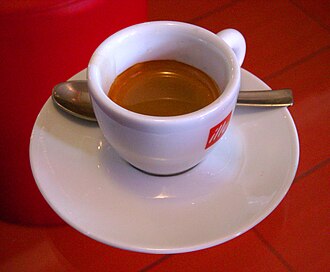
Photo: Wikipedia
Espresso is a concentrated coffee beverage brewed by forcing hot water through finely-ground coffee beans under high pressure. It has a rich, syrupy body with a complex flavor profile that can range from sweet and fruity to bitter and roasty, often topped with a reddish-brown foam called crema. Nutritionally, it is extremely low in calories, providing just 9 kcal per 100g, with minimal macronutrients.
Calorie split: 5% protein · 76% carbs · 18% fat
↓ Full nutrition💚 Why it's loved
People love espresso for its intense, concentrated flavor and the ritualistic art of its preparation. It's the versatile heart of café culture, forming the foundation for lattes, cappuccinos, and more, while being enjoyed solo as a potent, flavorful shot.
⚠️ Watch-outs & how to enjoy it better
The high caffeine content can cause jitters, anxiety, or disrupt sleep in sensitive individuals. Its acidity may also aggravate acid reflux or stomach issues for some. To counteract, consume in moderation, avoid drinking it on an empty stomach, and consider pairing it with a small amount of food.
Key benefits
- Provides a quick, potent caffeine boost for alertness
- Rich in antioxidants like chlorogenic acids
- Contains virtually no calories or sugar when served black
- May temporarily enhance physical performance
- Serves as the base for a wide variety of coffee drinks
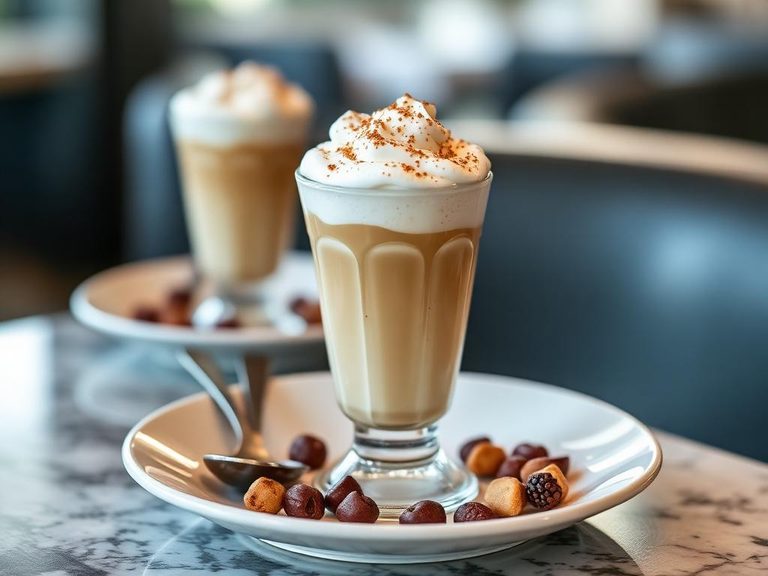
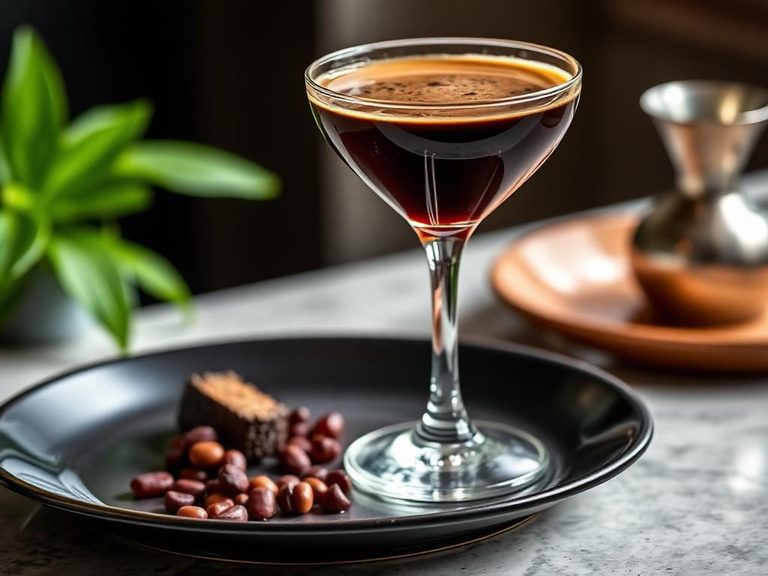
🍽️ Popular dishes

🌍 Where it's eaten
💡 Did you know?
The word 'espresso' means 'expressed' or 'forced out' in Italian, referring to the high-pressure brewing method, not 'extra strong' as commonly thought.
Full nutrition (USDA data · scales with serving)
| Water | 97.8 g |
| Energy | 9.0 kcal |
| Protein | 0.12 g |
| Total lipid (fat) | 0.18 g |
| Carbohydrate, by difference | 1.7 g |
| Fiber, total dietary | 0.00 g |
| Total Sugars | 0.00 g |
| Calcium, Ca | 2.0 mg |
| Iron, Fe | 0.13 mg |
| Magnesium, Mg | 80.0 mg |
| Phosphorus, P | 7.0 mg |
| Potassium, K | 115 mg |
| Sodium, Na | 14.0 mg |
| Zinc, Zn | 0.05 mg |
| Copper, Cu | 0.05 mg |
| Selenium, Se | 0.00 ug |
| Vitamin C, total ascorbic acid | 0.20 mg |
| Thiamin | 0.00 mg |
| Riboflavin | 0.18 mg |
| Niacin | 5.2 mg |
| Vitamin B-6 | 0.00 mg |
| Folate, total | 1.0 ug |
| Folic acid | 0.00 ug |
| Folate, food | 1.0 ug |
| Folate, DFE | 1.0 ug |
| Choline, total | 2.6 mg |
| Vitamin B-12 | 0.00 ug |
| Vitamin B-12, added | 0.00 ug |
| Vitamin A, RAE | 0.00 ug |
| Retinol | 0.00 ug |
| Carotene, beta | 0.00 ug |
| Carotene, alpha | 0.00 ug |
| Cryptoxanthin, beta | 0.00 ug |
| Lycopene | 0.00 ug |
| Lutein + zeaxanthin | 0.00 ug |
| Vitamin E (alpha-tocopherol) | 0.01 mg |
| Vitamin E, added | 0.00 mg |
| Vitamin D (D2 + D3) | 0.00 ug |
| Vitamin K (phylloquinone) | 0.10 ug |
| Alcohol, ethyl | 0.00 g |
| Caffeine | 212 mg |
| Theobromine | 0.00 mg |
Fat & fatty acid profile (per 100g)
| Fatty acids, total saturated | 0.09 g |
| SFA 4:0 | 0.00 g |
| SFA 6:0 | 0.00 g |
| SFA 8:0 | 0.00 g |
| SFA 10:0 | 0.00 g |
| SFA 12:0 | 0.00 g |
| SFA 14:0 | 0.00 g |
| SFA 16:0 | 0.05 g |
| SFA 18:0 | 0.00 g |
| Fatty acids, total monounsaturated | 0.00 g |
| MUFA 16:1 | 0.00 g |
| MUFA 18:1 | 0.00 g |
| MUFA 20:1 | 0.00 g |
| MUFA 22:1 | 0.00 g |
| Fatty acids, total polyunsaturated | 0.09 g |
| PUFA 18:2 | 0.09 g |
| PUFA 18:3 | 0.00 g |
| PUFA 18:4 | 0.00 g |
| PUFA 20:4 | 0.00 g |
| PUFA 20:5 n-3 (EPA) | 0.00 g |
| PUFA 22:5 n-3 (DPA) | 0.00 g |
| PUFA 22:6 n-3 (DHA) | 0.00 g |
| Cholesterol | 0.00 mg |
Amino acid profile (per 100g)
Estimated from Cream, fluid, light (coffee cream or table cream) — USDA does not publish this profile for Coffee.
| Tryptophan | 0.07 g |
| Threonine | 0.13 g |
| Isoleucine | 0.15 g |
| Leucine | 0.24 g |
| Lysine | 0.13 g |
| Methionine | 0.07 g |
| Cystine | 0.01 g |
| Phenylalanine | 0.14 g |
| Tyrosine | 0.14 g |
| Valine | 0.18 g |
| Arginine | 0.07 g |
| Histidine | 0.07 g |
| Alanine | 0.09 g |
| Aspartic acid | 0.22 g |
| Glutamic acid | 0.59 g |
| Glycine | 0.07 g |
| Proline | 0.31 g |
| Serine | 0.10 g |
FAQ
How is espresso different from regular coffee?
Espresso is brewed under high pressure for a short time, creating a concentrated, syrupy shot with crema. Regular drip coffee uses gravity and longer steeping, resulting in a larger, less concentrated volume.
Does espresso have more caffeine than drip coffee?
Per ounce, yes—espresso is much more concentrated. However, a standard serving of drip coffee (e.g., 8 oz) typically contains more total caffeine than a single shot of espresso (1 oz).
Why does espresso have crema?
Crema is a golden-brown foam formed when hot, pressurized water emulsifies coffee oils and releases carbon dioxide from freshly roasted beans. It's a sign of a well-extracted shot.
Nutrient density (calculated · NRF9.3)
Nutrient Rich Foods index: beneficial nutrients (protein, fiber, vitamins, minerals) minus saturated fat, added sugar & sodium, per 100 kcal.
NRF9.3 index — Fulgoni, Keast & Drewnowski, 2009. Computed from USDA nutrients.
Weight-loss friendliness (composite index)
Energy density 0.09 kcal/g · 5% calories from protein · 0.0 g fiber · 0.0 g sugar per 100 g.
Composite of energy density (Rolls et al., 1999), protein & fiber satiety, minus sugar. A calculated heuristic — ranks satiety-per-calorie, not a clinical measure.
Dietary load (calculated from USDA values)
Potential renal acid load. Positive = acid-forming, negative = alkaline-forming.
Sodium-to-potassium ratio: 0.12 (lower is better — aim for ≤ 1)
Sodium:potassium per WHO potassium guidance. Computed from USDA nutrients.