

Cheeseburger, on wheat bun, 1 large patty
Common food

Photo: Wikipedia
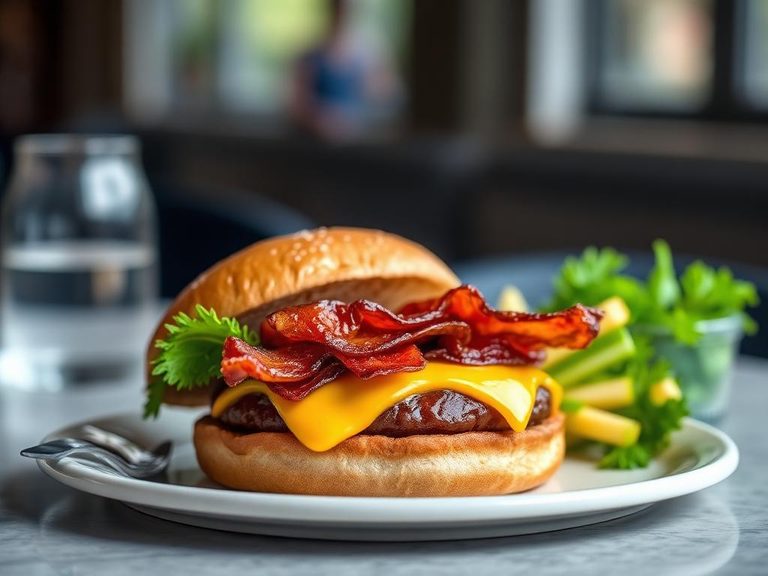
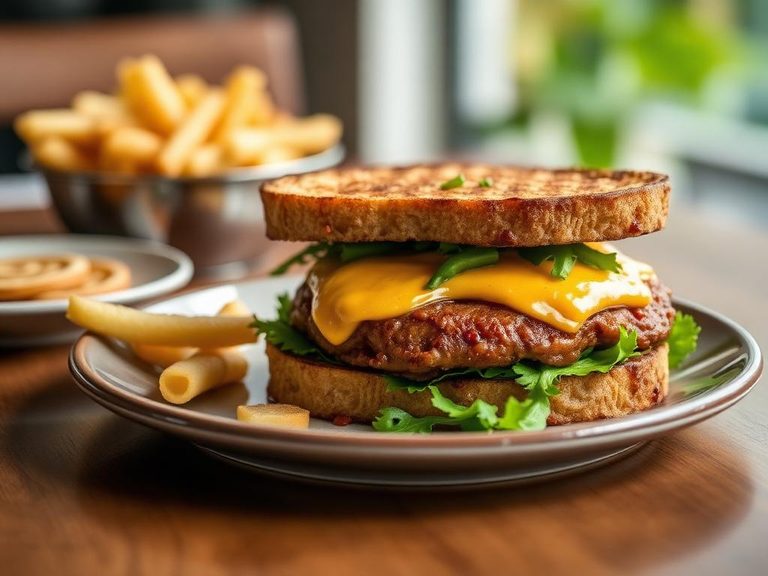
A classic cheeseburger served on a whole wheat bun, featuring a single large beef patty that delivers a satisfying, savory bite with a slightly nutty, textured bun. The wheat bun adds a subtle earthiness and chewiness that complements the rich, juicy beef and melted cheese. Nutritionally, it offers a solid protein punch (19.21g per 100g) with a moderate fat content, making it a more balanced option than many fast-food burgers.
Calorie split: 26% protein · 19% carbs · 54% fat
↓ Full nutrition💚 Why it's loved
People love it for the iconic combination of savory, juicy beef, melted cheese, and the comforting, slightly nutty flavor of the wheat bun. It's a versatile meal that can be dressed up with various toppings and is deeply embedded in American casual dining culture.
⚠️ Watch-outs & how to enjoy it better
The high sodium and saturated fat content can be a concern for those monitoring heart health or blood pressure. To counteract, pair with a side of steamed vegetables or a fresh salad, and opt for leaner beef or a smaller portion size. Also, be mindful of the wheat bun if you have gluten sensitivity; consider a gluten-free alternative or an open-faced option.
Key benefits
- High-quality protein source from beef patty
- Whole wheat bun provides dietary fiber (1.6g per 100g)
- Balanced macronutrient profile with moderate carbs and fats
- Satisfying and filling meal option
- Contains essential nutrients like iron and B vitamins from beef
🍽️ Popular dishes



🌍 Where it's eaten
💡 Did you know?
The cheeseburger was reportedly invented in the 1920s or 1930s, with multiple diners and restaurants claiming the title, including Lionel Sternberger in Pasadena, California, who allegedly added cheese to a hamburger at his father's restaurant, The Rite Spot, around 1924.
Full nutrition (USDA data · scales with serving)
| Water | 46.9 g |
| Energy | 295 kcal |
| Protein | 19.2 g |
| Total lipid (fat) | 17.6 g |
| Carbohydrate, by difference | 13.9 g |
| Fiber, total dietary | 1.6 g |
| Total Sugars | 1.9 g |
| Calcium, Ca | 192 mg |
| Iron, Fe | 2.3 mg |
| Magnesium, Mg | 31.0 mg |
| Phosphorus, P | 234 mg |
| Potassium, K | 247 mg |
| Sodium, Na | 437 mg |
| Zinc, Zn | 3.5 mg |
| Copper, Cu | 0.10 mg |
| Selenium, Se | 23.4 ug |
| Vitamin C, total ascorbic acid | 0.00 mg |
| Thiamin | 0.14 mg |
| Riboflavin | 0.22 mg |
| Niacin | 4.4 mg |
| Vitamin B-6 | 0.30 mg |
| Folate, total | 35.0 ug |
| Folic acid | 4.0 ug |
| Folate, food | 31.0 ug |
| Folate, DFE | 38.0 ug |
| Choline, total | 50.9 mg |
| Vitamin B-12 | 1.7 ug |
| Vitamin B-12, added | 0.00 ug |
| Vitamin A, RAE | 41.0 ug |
| Retinol | 40.0 ug |
| Carotene, beta | 12.0 ug |
| Carotene, alpha | 0.00 ug |
| Cryptoxanthin, beta | 1.0 ug |
| Lycopene | 0.00 ug |
| Lutein + zeaxanthin | 21.0 ug |
| Vitamin E (alpha-tocopherol) | 0.21 mg |
| Vitamin E, added | 0.00 mg |
| Vitamin D (D2 + D3) | 0.70 ug |
| Vitamin K (phylloquinone) | 3.3 ug |
| Alcohol, ethyl | 0.00 g |
| Caffeine | 0.00 mg |
| Theobromine | 0.00 mg |
Fat & fatty acid profile (per 100g)
| Fatty acids, total saturated | 7.6 g |
| SFA 4:0 | 0.09 g |
| SFA 6:0 | 0.07 g |
| SFA 8:0 | 0.05 g |
| SFA 10:0 | 0.11 g |
| SFA 12:0 | 0.13 g |
| SFA 14:0 | 0.79 g |
| SFA 16:0 | 4.0 g |
| SFA 18:0 | 2.0 g |
| Fatty acids, total monounsaturated | 6.4 g |
| MUFA 16:1 | 0.46 g |
| MUFA 18:1 | 5.8 g |
| MUFA 20:1 | 0.04 g |
| MUFA 22:1 | 0.00 g |
| Fatty acids, total polyunsaturated | 0.98 g |
| PUFA 18:2 | 0.88 g |
| PUFA 18:3 | 0.09 g |
| PUFA 18:4 | 0.00 g |
| PUFA 20:4 | 0.01 g |
| PUFA 20:5 n-3 (EPA) | 0.00 g |
| PUFA 22:5 n-3 (DPA) | 0.01 g |
| PUFA 22:6 n-3 (DHA) | 0.00 g |
| Cholesterol | 60.0 mg |
Amino acid profile (per 100g)
Estimated from Fast foods, cheeseburger; double, regular patty; double decker bun with condiments and special sauce — USDA does not publish this profile for Cheeseburger.
| Tryptophan | 0.11 g |
| Threonine | 0.39 g |
| Isoleucine | 0.44 g |
| Leucine | 0.81 g |
| Lysine | 0.67 g |
| Methionine | 0.24 g |
| Cystine | 0.15 g |
| Phenylalanine | 0.45 g |
| Tyrosine | 0.24 g |
| Valine | 0.52 g |
| Arginine | 0.58 g |
| Histidine | 0.29 g |
| Alanine | 0.61 g |
| Aspartic acid | 0.74 g |
| Glutamic acid | 2.4 g |
| Glycine | 0.70 g |
| Proline | 0.86 g |
| Serine | 0.44 g |
FAQ
Is a cheeseburger on a wheat bun healthier than one on a white bun?
Yes, a whole wheat bun typically provides more fiber and nutrients than a refined white bun, which can help with satiety and digestive health. However, the overall healthiness still depends on the patty size, cheese type, and toppings.
How much protein is in a typical cheeseburger on a wheat bun?
A typical cheeseburger on a wheat bun contains around 19-25 grams of protein per 100g, depending on the patty size and cheese. For a 200g serving, that's roughly 38-50 grams of protein, making it a substantial protein source.
Can I make a cheeseburger on a wheat bun lower in fat?
Yes, you can use leaner beef (e.g., 90% lean), reduce the cheese portion, and add more vegetables like lettuce, tomato, and onion. Grilling instead of frying can also help reduce fat content.
Nutrient density (calculated · NRF9.3)
Nutrient Rich Foods index: beneficial nutrients (protein, fiber, vitamins, minerals) minus saturated fat, added sugar & sodium, per 100 kcal.
NRF9.3 index — Fulgoni, Keast & Drewnowski, 2009. Computed from USDA nutrients.
Weight-loss friendliness (composite index)
Energy density 2.95 kcal/g · 26% calories from protein · 1.6 g fiber · 1.9 g sugar per 100 g.
Composite of energy density (Rolls et al., 1999), protein & fiber satiety, minus sugar. A calculated heuristic — ranks satiety-per-calorie, not a clinical measure.
Dietary load (calculated from USDA values)
Potential renal acid load. Positive = acid-forming, negative = alkaline-forming.
Sodium-to-potassium ratio: 1.77 (lower is better — aim for ≤ 1)
Sodium:potassium per WHO potassium guidance. Computed from USDA nutrients.