

Candies, jellybeans
Whole food · Sweets
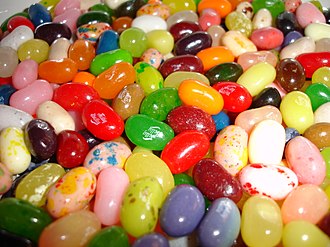
Photo: Wikipedia
Jellybeans are small, bean-shaped candies with a firm, sugar-shell exterior that gives a satisfying snap, giving way to a soft, chewy, and intensely sweet interior. They are a pure carbohydrate energy source, delivering a quick burst of fuel with virtually no protein, fat, or fiber. Each piece is a concentrated hit of sugar, with a 100g serving containing a staggering 70g of sugar.
Calorie split: 0% protein · 100% carbs · 0% fat
↓ Full nutrition💚 Why it's loved
People love jellybeans for their playful, explosion of flavors—from classic cherry and lemon to exotic popcorn and cotton candy—and the fun, ritualistic experience of sorting and savoring them. They are deeply embedded in holiday traditions, particularly Easter, and their small size makes them a versatile, shareable candy for all ages.
⚠️ Watch-outs & how to enjoy it better
The primary downside is the extremely high sugar content (70g per 100g), which can cause rapid blood-sugar spikes and offers no nutritional benefit. To counteract this, practice strict portion control (e.g., a small handful of 15-20 beans) and avoid eating them on an empty stomach. Pairing them with a source of protein or fat, like a handful of nuts, can help slow the sugar absorption.
Key benefits
- Quick source of energy for immediate fuel
- Fat-free and cholesterol-free
- Available in a vast array of artificial and natural flavors
- A classic, portable treat for celebrations and holidays
🍽️ Popular dishes
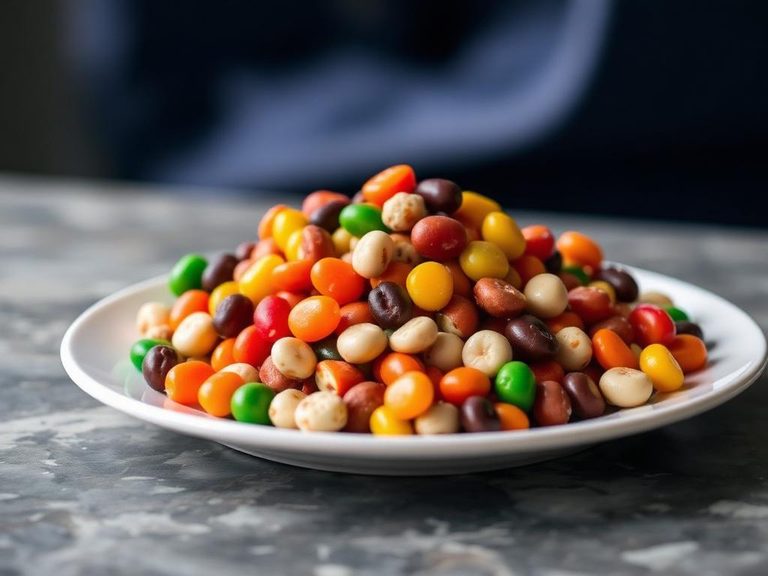
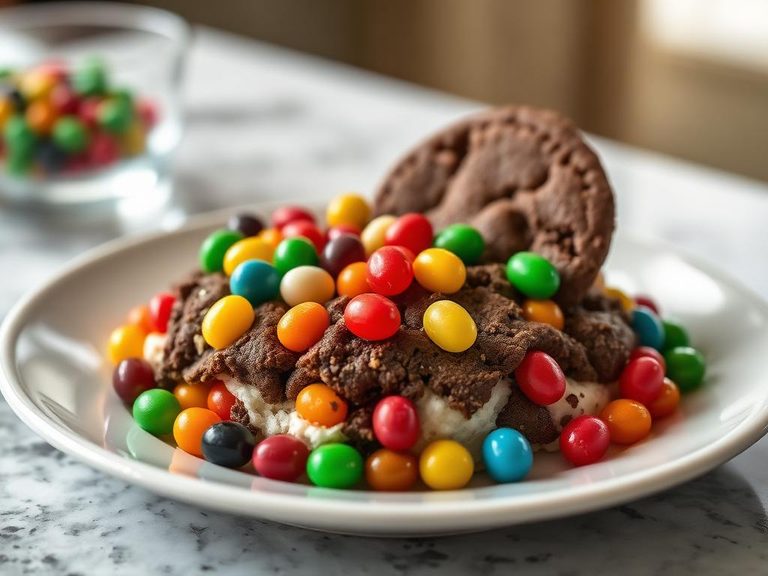
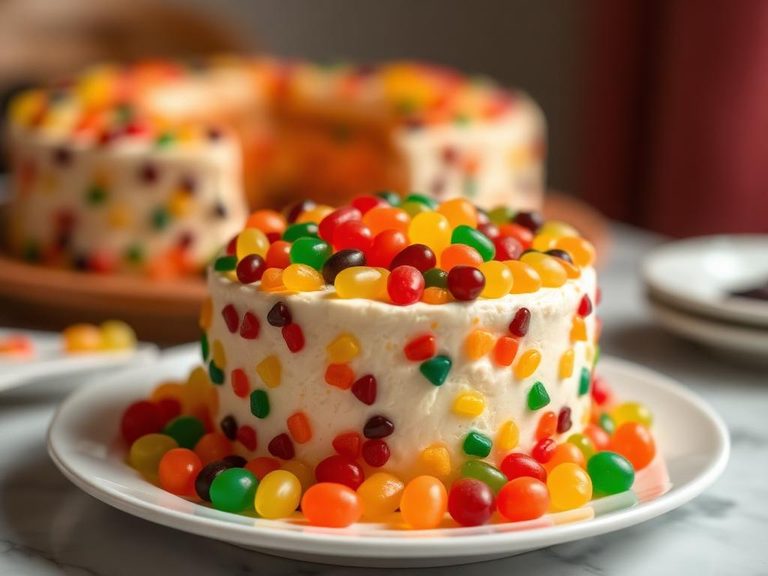
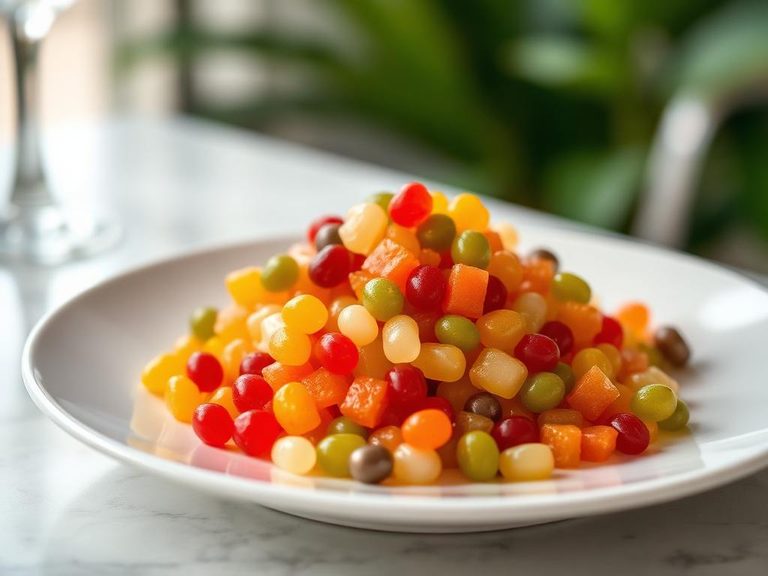
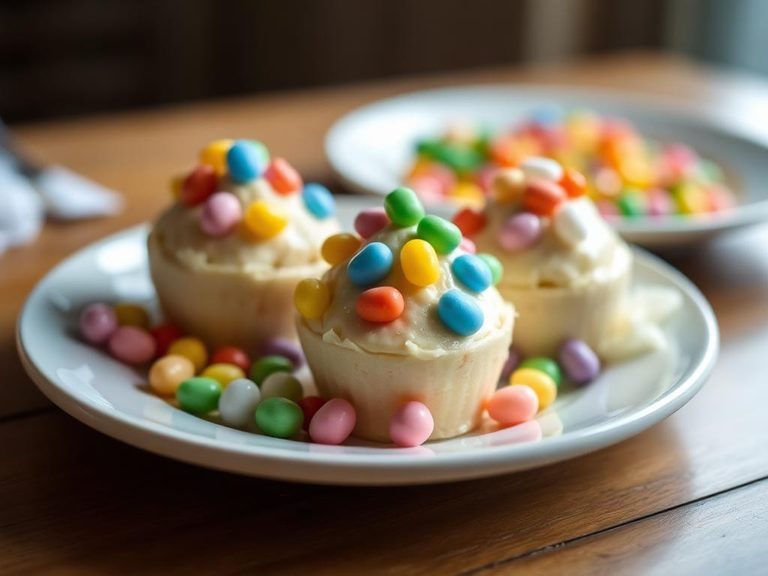
🌍 Where it's eaten
💡 Did you know?
The world's largest jellybean was created in 2014 and measured 6.5 feet tall and 3.5 feet wide, weighing in at over 12,000 pounds.
Full nutrition (USDA data · scales with serving)
| Water | 6.3 g |
| Energy | 375 kcal |
| Energy | 1568 kj |
| Protein | 0.00 g |
| Total lipid (fat) | 0.05 g |
| Ash | 0.10 g |
| Carbohydrate, by difference | 93.5 g |
| Fiber, total dietary | 0.20 g |
| Total Sugars | 70.0 g |
| Calcium, Ca | 3.0 mg |
| Iron, Fe | 0.13 mg |
| Magnesium, Mg | 2.0 mg |
| Phosphorus, P | 4.0 mg |
| Potassium, K | 37.0 mg |
| Sodium, Na | 50.0 mg |
| Zinc, Zn | 0.05 mg |
| Copper, Cu | 0.03 mg |
| Manganese, Mn | 0.04 mg |
| Selenium, Se | 1.1 ug |
| Vitamin C, total ascorbic acid | 0.00 mg |
| Thiamin | 0.00 mg |
| Riboflavin | 0.01 mg |
| Niacin | 0.01 mg |
| Pantothenic acid | 0.01 mg |
| Vitamin B-6 | 0.00 mg |
| Folate, total | 0.00 ug |
| Folic acid | 0.00 ug |
| Folate, food | 0.00 ug |
| Folate, DFE | 0.00 ug |
| Choline, total | 0.00 mg |
| Vitamin B-12 | 0.00 ug |
| Vitamin B-12, added | 0.00 ug |
| Vitamin A, RAE | 0.00 ug |
| Retinol | 0.00 ug |
| Carotene, beta | 0.00 ug |
| Carotene, alpha | 0.00 ug |
| Cryptoxanthin, beta | 0.00 ug |
| Vitamin A, IU | 0.00 iu |
| Lycopene | 0.00 ug |
| Lutein + zeaxanthin | 0.00 ug |
| Vitamin E (alpha-tocopherol) | 0.00 mg |
| Vitamin E, added | 0.00 mg |
| Vitamin D (D2 + D3), International Units | 0.00 iu |
| Vitamin D (D2 + D3) | 0.00 ug |
| Vitamin K (phylloquinone) | 0.00 ug |
| Alcohol, ethyl | 0.00 g |
| Caffeine | 0.00 mg |
| Theobromine | 0.00 mg |
Fat & fatty acid profile (per 100g)
| Fatty acids, total saturated | 0.00 g |
| SFA 4:0 | 0.00 g |
| SFA 6:0 | 0.00 g |
| SFA 8:0 | 0.00 g |
| SFA 10:0 | 0.00 g |
| SFA 12:0 | 0.00 g |
| SFA 14:0 | 0.00 g |
| SFA 16:0 | 0.00 g |
| SFA 18:0 | 0.00 g |
| Fatty acids, total monounsaturated | 0.00 g |
| MUFA 16:1 | 0.00 g |
| MUFA 18:1 | 0.00 g |
| MUFA 20:1 | 0.00 g |
| MUFA 22:1 | 0.00 g |
| Fatty acids, total polyunsaturated | 0.00 g |
| PUFA 18:2 | 0.00 g |
| PUFA 18:3 | 0.00 g |
| PUFA 18:4 | 0.00 g |
| PUFA 20:4 | 0.00 g |
| PUFA 20:5 n-3 (EPA) | 0.00 g |
| PUFA 22:5 n-3 (DPA) | 0.00 g |
| PUFA 22:6 n-3 (DHA) | 0.00 g |
| Cholesterol | 0.00 mg |
Amino acid profile (per 100g)
Estimated from Candies, honey-combed, with peanut butter — USDA does not publish this profile for Candies.
| Tryptophan | 0.09 g |
| Threonine | 0.21 g |
| Isoleucine | 0.24 g |
| Leucine | 0.61 g |
| Lysine | 0.27 g |
| Methionine | 0.10 g |
| Cystine | 0.09 g |
| Phenylalanine | 0.47 g |
| Tyrosine | 0.33 g |
| Valine | 0.31 g |
| Arginine | 1.1 g |
| Histidine | 0.22 g |
| Alanine | 0.36 g |
| Aspartic acid | 1.2 g |
| Glutamic acid | 2.0 g |
| Glycine | 0.56 g |
| Proline | 0.55 g |
| Serine | 0.58 g |
FAQ
What gives jellybeans their shiny coating?
The hard, shiny shell is created through a process called 'panning,' where the soft jelly centers are tumbled in large drums while being repeatedly coated with sugar syrup and polished with food-grade wax or shellac.
Are the flavors natural or artificial?
It varies by brand. Classic and gourmet lines often use a mix of natural fruit juices, oils, and artificial flavorings to achieve their distinct tastes. Some premium brands focus exclusively on natural flavors.
Why are some jellybeans labeled 'very cherry' or 'licorice'?
These are often the most iconic and traditional flavors in a mix. 'Very Cherry' is a staple fruit flavor, while 'Licorice' refers to a distinct, polarizing black licorice flavor that is a classic component of the original jellybean assortment.
Nutrient density (calculated · NRF9.3)
Nutrient Rich Foods index: beneficial nutrients (protein, fiber, vitamins, minerals) minus saturated fat, added sugar & sodium, per 100 kcal.
NRF9.3 index — Fulgoni, Keast & Drewnowski, 2009. Computed from USDA nutrients.
Weight-loss friendliness (composite index)
Energy density 3.75 kcal/g · 0% calories from protein · 0.2 g fiber · 70.0 g sugar per 100 g.
Composite of energy density (Rolls et al., 1999), protein & fiber satiety, minus sugar. A calculated heuristic — ranks satiety-per-calorie, not a clinical measure.
Dietary load (calculated from USDA values)
Potential renal acid load. Positive = acid-forming, negative = alkaline-forming.
Sodium-to-potassium ratio: 1.35 (lower is better — aim for ≤ 1)
Sodium:potassium per WHO potassium guidance. Computed from USDA nutrients.