

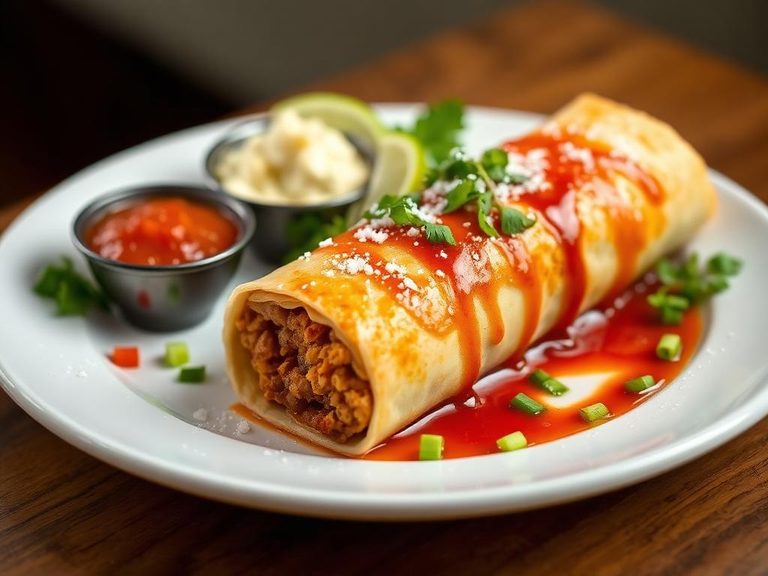
Burrito, with beans, cheese
Common food

Photo: Wikipedia
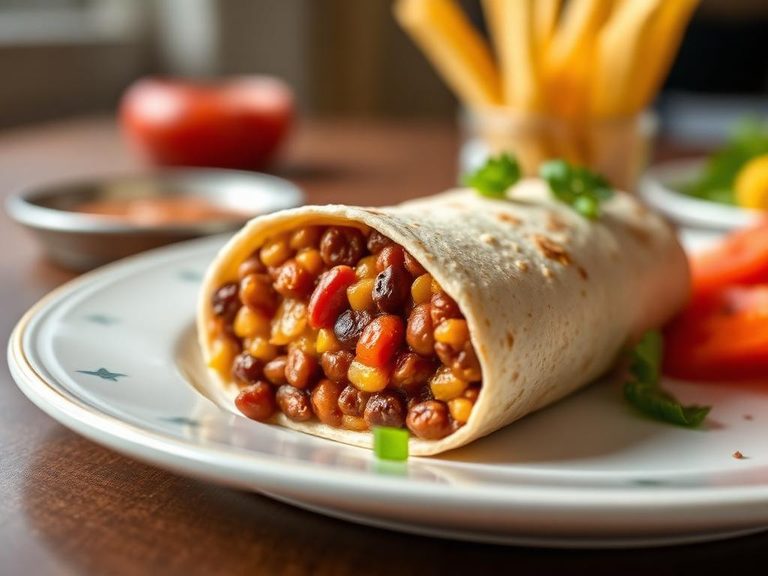
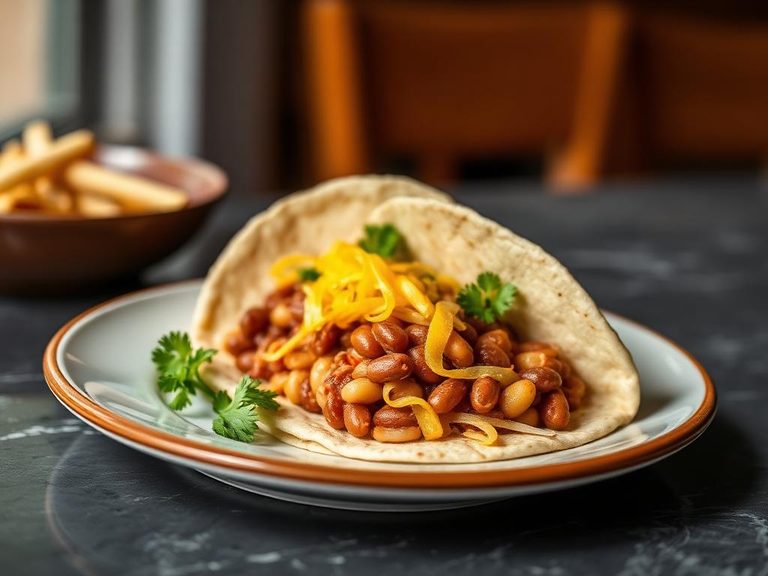
A warm, soft flour tortilla wrapped around a hearty filling of seasoned beans and melted cheese, creating a satisfying blend of savory, earthy, and creamy flavors. The beans provide a substantial, slightly grainy texture, while the cheese adds a gooey, salty richness. With a balanced macronutrient profile, it's a compact source of plant-based protein, fiber, and complex carbohydrates.
Calorie split: 16% protein · 60% carbs · 24% fat
↓ Full nutrition💚 Why it's loved
People love it for its perfect handheld convenience and the comforting, savory combination of soft beans and melted cheese inside a warm tortilla. It's a versatile staple that can be customized with salsas, guacamole, or sour cream.
⚠️ Watch-outs & how to enjoy it better
The flour tortilla and cheese can be high in sodium and refined carbs, potentially causing blood-sugar spikes for some. To counteract, pair with a side of non-starchy vegetables like a simple salad or fajita veggies to add volume and fiber, and opt for a whole-wheat tortilla if possible.
Key benefits
- Good source of plant-based protein from beans
- High in dietary fiber for digestive health
- Provides complex carbohydrates for sustained energy
- Contains calcium from cheese for bone health
- Offers a balanced mix of macros in one package
🍽️ Popular dishes
🌍 Where it's eaten
💡 Did you know?
The word 'burrito' in Spanish translates to 'little donkey,' possibly referring to the bedrolls or packs that donkeys carried, which the wrapped tortilla resembles.
Full nutrition (USDA data · scales with serving)
| Water | 55.0 g |
| Energy | 196 kcal |
| Protein | 8.1 g |
| Total lipid (fat) | 5.2 g |
| Carbohydrate, by difference | 29.5 g |
| Fiber, total dietary | 4.9 g |
| Total Sugars | 1.7 g |
| Calcium, Ca | 103 mg |
| Iron, Fe | 2.4 mg |
| Magnesium, Mg | 40.0 mg |
| Phosphorus, P | 165 mg |
| Potassium, K | 244 mg |
| Sodium, Na | 449 mg |
| Zinc, Zn | 0.85 mg |
| Copper, Cu | 0.14 mg |
| Selenium, Se | 11.4 ug |
| Vitamin C, total ascorbic acid | 0.20 mg |
| Thiamin | 0.28 mg |
| Riboflavin | 0.16 mg |
| Niacin | 1.9 mg |
| Vitamin B-6 | 0.07 mg |
| Folate, total | 86.0 ug |
| Folic acid | 30.0 ug |
| Folate, food | 56.0 ug |
| Folate, DFE | 107 ug |
| Choline, total | 19.5 mg |
| Vitamin B-12 | 0.06 ug |
| Vitamin B-12, added | 0.00 ug |
| Vitamin A, RAE | 10.0 ug |
| Retinol | 10.0 ug |
| Carotene, beta | 0.00 ug |
| Carotene, alpha | 0.00 ug |
| Cryptoxanthin, beta | 0.00 ug |
| Lycopene | 0.00 ug |
| Lutein + zeaxanthin | 3.0 ug |
| Vitamin E (alpha-tocopherol) | 0.29 mg |
| Vitamin E, added | 0.00 mg |
| Vitamin D (D2 + D3) | 0.00 ug |
| Vitamin K (phylloquinone) | 4.4 ug |
| Alcohol, ethyl | 0.00 g |
| Caffeine | 0.00 mg |
| Theobromine | 0.00 mg |
Fat & fatty acid profile (per 100g)
| Fatty acids, total saturated | 2.1 g |
| SFA 4:0 | 0.04 g |
| SFA 6:0 | 0.02 g |
| SFA 8:0 | 0.01 g |
| SFA 10:0 | 0.03 g |
| SFA 12:0 | 0.04 g |
| SFA 14:0 | 0.15 g |
| SFA 16:0 | 1.2 g |
| SFA 18:0 | 0.63 g |
| Fatty acids, total monounsaturated | 1.1 g |
| MUFA 16:1 | 0.04 g |
| MUFA 18:1 | 1.1 g |
| MUFA 20:1 | 0.01 g |
| MUFA 22:1 | 0.00 g |
| Fatty acids, total polyunsaturated | 1.1 g |
| PUFA 18:2 | 0.96 g |
| PUFA 18:3 | 0.17 g |
| PUFA 18:4 | 0.00 g |
| PUFA 20:4 | 0.00 g |
| PUFA 20:5 n-3 (EPA) | 0.00 g |
| PUFA 22:5 n-3 (DPA) | 0.00 g |
| PUFA 22:6 n-3 (DHA) | 0.00 g |
| Cholesterol | 4.0 mg |
Amino acid profile (per 100g)
Estimated from TACO BELL, BURRITO SUPREME with steak — USDA does not publish this profile for Burrito.
| Tryptophan | 0.11 g |
| Threonine | 0.37 g |
| Isoleucine | 0.37 g |
| Leucine | 0.69 g |
| Lysine | 0.62 g |
| Methionine | 0.17 g |
| Cystine | 0.11 g |
| Phenylalanine | 0.42 g |
| Tyrosine | 0.27 g |
| Valine | 0.43 g |
| Arginine | 0.46 g |
| Histidine | 0.25 g |
| Alanine | 0.41 g |
| Aspartic acid | 0.82 g |
| Glutamic acid | 1.9 g |
| Glycine | 0.38 g |
| Proline | 0.59 g |
| Serine | 0.44 g |
FAQ
How many calories are in a typical bean and cheese burrito?
A typical medium-sized (about 118g) bean and cheese burrito contains roughly 230-250 calories, depending on the exact size and ingredients used.
Is a bean and cheese burrito a good source of protein?
Yes, it is. The combination of beans and cheese provides a good amount of plant-based and dairy protein, making it a satisfying meal component.
Can I make a bean and cheese burrito healthier?
Absolutely. Use a whole-wheat or low-carb tortilla, load it with extra vegetables like peppers and onions, use less cheese, and add a lean protein like grilled chicken if desired.
Nutrient density (calculated · NRF9.3)
Nutrient Rich Foods index: beneficial nutrients (protein, fiber, vitamins, minerals) minus saturated fat, added sugar & sodium, per 100 kcal.
NRF9.3 index — Fulgoni, Keast & Drewnowski, 2009. Computed from USDA nutrients.
Weight-loss friendliness (composite index)
Energy density 1.96 kcal/g · 17% calories from protein · 4.9 g fiber · 1.7 g sugar per 100 g.
Composite of energy density (Rolls et al., 1999), protein & fiber satiety, minus sugar. A calculated heuristic — ranks satiety-per-calorie, not a clinical measure.
Dietary load (calculated from USDA values)
Potential renal acid load. Positive = acid-forming, negative = alkaline-forming.
Sodium-to-potassium ratio: 1.84 (lower is better — aim for ≤ 1)
Sodium:potassium per WHO potassium guidance. Computed from USDA nutrients.