

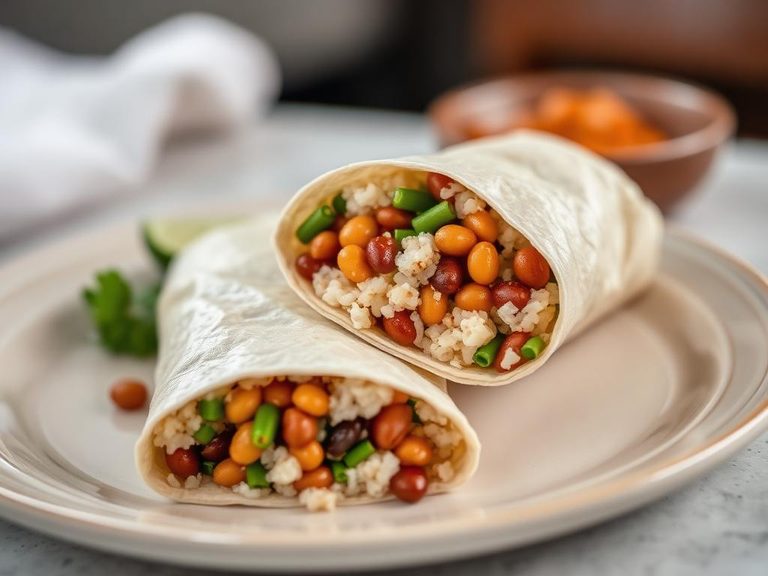
Burrito, with beans and rice, cheese
Common food

Photo: Wikipedia
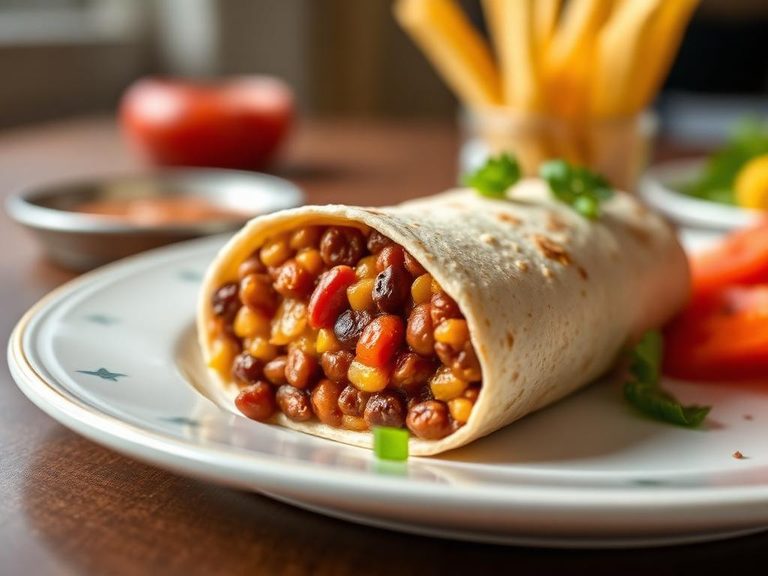
A warm, soft flour tortilla encasing a hearty, savory filling of seasoned beans, fluffy rice, and melted cheese. Each bite offers a satisfying contrast of textures—creamy beans, tender rice, and gooey cheese—with a comforting, savory flavor profile. At 202 kcal per 100g, it's a moderately calorie-dense but protein-rich option, with beans and cheese contributing to its satiating quality.
Calorie split: 14% protein · 64% carbs · 22% fat
↓ Full nutrition💚 Why it's loved
People love it for its perfect handheld convenience and the harmonious blend of savory, creamy, and starchy flavors. It's a deeply comforting food that feels like a complete, satisfying meal in one package.
⚠️ Watch-outs & how to enjoy it better
The refined flour tortilla and cheese can make it high in sodium and saturated fat, which may concern those monitoring heart health or blood pressure. To counteract, opt for a whole-wheat tortilla, use less cheese, and pair with a side of fresh, acidic salsa or a simple salad to add volume and nutrients without excess calories.
Key benefits
- Good source of plant-based protein from beans
- Provides dietary fiber for digestive health
- Contains calcium from cheese for bone support
- Offers complex carbohydrates for sustained energy
- A convenient, portable meal option
🍽️ Popular dishes
🌍 Where it's eaten
💡 Did you know?
The word 'burrito' in Spanish translates to 'little donkey,' possibly referring to the bedrolls or packs donkeys carried, which the wrapped tortilla resembles.
Full nutrition (USDA data · scales with serving)
| Water | 54.1 g |
| Energy | 202 kcal |
| Protein | 6.9 g |
| Total lipid (fat) | 4.9 g |
| Carbohydrate, by difference | 32.2 g |
| Fiber, total dietary | 3.2 g |
| Total Sugars | 1.6 g |
| Calcium, Ca | 98.0 mg |
| Iron, Fe | 2.2 mg |
| Magnesium, Mg | 28.0 mg |
| Phosphorus, P | 144 mg |
| Potassium, K | 158 mg |
| Sodium, Na | 430 mg |
| Zinc, Zn | 0.75 mg |
| Copper, Cu | 0.11 mg |
| Selenium, Se | 12.6 ug |
| Vitamin C, total ascorbic acid | 0.10 mg |
| Thiamin | 0.28 mg |
| Riboflavin | 0.15 mg |
| Niacin | 2.2 mg |
| Vitamin B-6 | 0.08 mg |
| Folate, total | 78.0 ug |
| Folic acid | 46.0 ug |
| Folate, food | 32.0 ug |
| Folate, DFE | 110 ug |
| Choline, total | 12.2 mg |
| Vitamin B-12 | 0.06 ug |
| Vitamin B-12, added | 0.00 ug |
| Vitamin A, RAE | 10.0 ug |
| Retinol | 10.0 ug |
| Carotene, beta | 0.00 ug |
| Carotene, alpha | 0.00 ug |
| Cryptoxanthin, beta | 0.00 ug |
| Lycopene | 0.00 ug |
| Lutein + zeaxanthin | 3.0 ug |
| Vitamin E (alpha-tocopherol) | 0.17 mg |
| Vitamin E, added | 0.00 mg |
| Vitamin D (D2 + D3) | 0.00 ug |
| Vitamin K (phylloquinone) | 3.6 ug |
| Alcohol, ethyl | 0.00 g |
| Caffeine | 0.00 mg |
| Theobromine | 0.00 mg |
Fat & fatty acid profile (per 100g)
| Fatty acids, total saturated | 2.1 g |
| SFA 4:0 | 0.04 g |
| SFA 6:0 | 0.02 g |
| SFA 8:0 | 0.01 g |
| SFA 10:0 | 0.03 g |
| SFA 12:0 | 0.04 g |
| SFA 14:0 | 0.15 g |
| SFA 16:0 | 1.1 g |
| SFA 18:0 | 0.60 g |
| Fatty acids, total monounsaturated | 1.1 g |
| MUFA 16:1 | 0.04 g |
| MUFA 18:1 | 1.1 g |
| MUFA 20:1 | 0.01 g |
| MUFA 22:1 | 0.00 g |
| Fatty acids, total polyunsaturated | 1.1 g |
| PUFA 18:2 | 0.91 g |
| PUFA 18:3 | 0.14 g |
| PUFA 18:4 | 0.00 g |
| PUFA 20:4 | 0.00 g |
| PUFA 20:5 n-3 (EPA) | 0.00 g |
| PUFA 22:5 n-3 (DPA) | 0.00 g |
| PUFA 22:6 n-3 (DHA) | 0.00 g |
| Cholesterol | 4.0 mg |
Amino acid profile (per 100g)
Estimated from TACO BELL, BURRITO SUPREME with steak — USDA does not publish this profile for Burrito.
| Tryptophan | 0.11 g |
| Threonine | 0.37 g |
| Isoleucine | 0.37 g |
| Leucine | 0.69 g |
| Lysine | 0.62 g |
| Methionine | 0.17 g |
| Cystine | 0.11 g |
| Phenylalanine | 0.42 g |
| Tyrosine | 0.27 g |
| Valine | 0.43 g |
| Arginine | 0.46 g |
| Histidine | 0.25 g |
| Alanine | 0.41 g |
| Aspartic acid | 0.82 g |
| Glutamic acid | 1.9 g |
| Glycine | 0.38 g |
| Proline | 0.59 g |
| Serine | 0.44 g |
FAQ
How does the fiber content affect digestion?
The 3.2g of fiber per 100g, primarily from beans, aids in digestive regularity and helps promote a feeling of fullness after eating.
Is this a good post-workout meal?
Yes, the combination of carbohydrates from rice and tortilla for glycogen replenishment, along with protein from beans and cheese for muscle repair, makes it a solid recovery option.
Can I reduce the calorie density?
Absolutely. Use a smaller tortilla, increase the bean and vegetable filling relative to cheese, and avoid adding sour cream or heavy sauces to lower calories per bite.
Nutrient density (calculated · NRF9.3)
Nutrient Rich Foods index: beneficial nutrients (protein, fiber, vitamins, minerals) minus saturated fat, added sugar & sodium, per 100 kcal.
NRF9.3 index — Fulgoni, Keast & Drewnowski, 2009. Computed from USDA nutrients.
Weight-loss friendliness (composite index)
Energy density 2.02 kcal/g · 14% calories from protein · 3.2 g fiber · 1.6 g sugar per 100 g.
Composite of energy density (Rolls et al., 1999), protein & fiber satiety, minus sugar. A calculated heuristic — ranks satiety-per-calorie, not a clinical measure.
Dietary load (calculated from USDA values)
Potential renal acid load. Positive = acid-forming, negative = alkaline-forming.
Sodium-to-potassium ratio: 2.72 (lower is better — aim for ≤ 1)
Sodium:potassium per WHO potassium guidance. Computed from USDA nutrients.