

Bread, raisin
Common food

Photo: Wikipedia
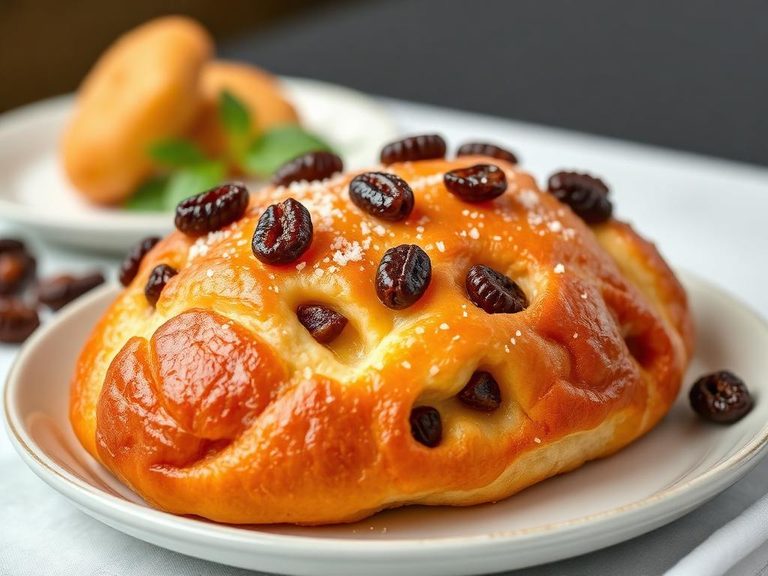
Raisin bread is a soft, enriched loaf studded with sweet, chewy raisins, offering a comforting balance of warm, yeasty dough and bursts of fruity sweetness. Nutritionally, it provides a quick energy source with 270 kcal per 100g, primarily from carbohydrates (52.21g), while its 2.5g of fiber and 8.82g of protein offer modest satiety. Its signature comes from the raisins, which contribute significantly to its 11.32g of sugar content.
Calorie split: 13% protein · 76% carbs · 11% fat
↓ Full nutrition💚 Why it's loved
People love raisin bread for its nostalgic, comforting flavor—the soft, slightly sweet crumb paired with the intense, jammy sweetness of raisins creates a universally appealing taste and texture. It's a versatile staple, perfect toasted with butter, used for French toast, or enjoyed plain, bridging breakfast and snack time across many cultures.
⚠️ Watch-outs & how to enjoy it better
Its high sugar content (11.32g/100g) and refined carbohydrates can lead to rapid blood-sugar spikes, making it a less ideal choice for those managing diabetes or seeking sustained energy. To counteract this, pair a slice with a source of protein or healthy fat (like Greek yogurt, nut butter, or eggs) to slow sugar absorption, and practice portion control by choosing a single, modest slice rather than multiple pieces.
Key benefits
- Quick energy source from natural and added sugars
- Contains dietary fiber (2.5g/100g) for digestive health
- Provides plant-based protein (8.82g/100g)
- Offers micronutrients like iron and potassium from raisins
- Convenient, portable, and versatile breakfast or snack
🍽️ Popular dishes
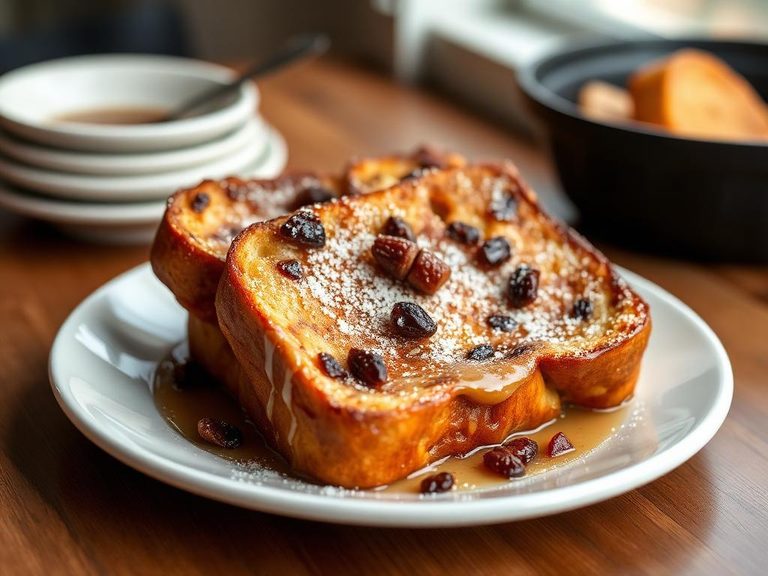
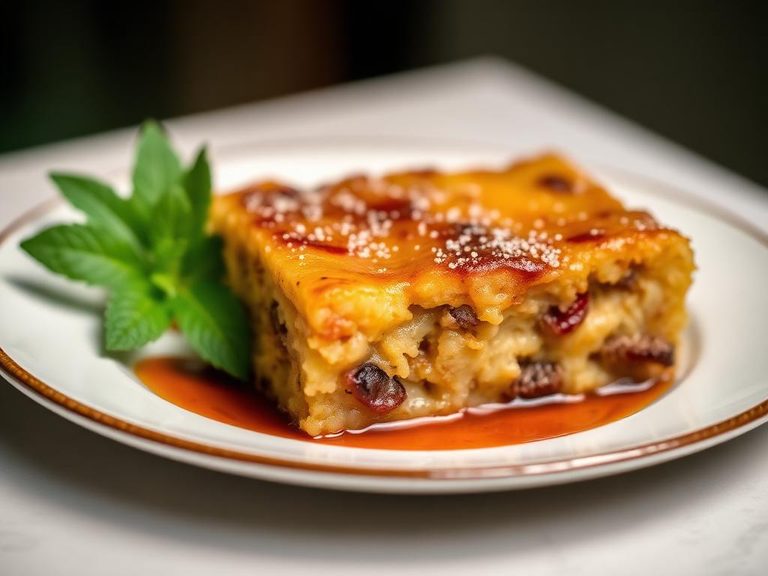
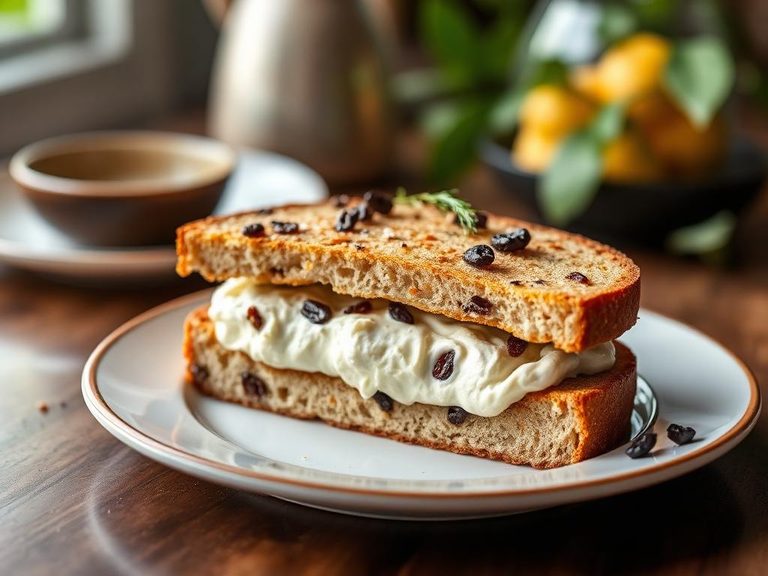
🌍 Where it's eaten
💡 Did you know?
The practice of adding raisins to bread dates back to ancient Rome, where they were considered a luxury ingredient used in special occasion breads.
Full nutrition (USDA data · scales with serving)
| Water | 33.7 g |
| Energy | 270 kcal |
| Protein | 8.8 g |
| Total lipid (fat) | 3.3 g |
| Carbohydrate, by difference | 52.2 g |
| Fiber, total dietary | 2.5 g |
| Total Sugars | 11.3 g |
| Calcium, Ca | 196 mg |
| Iron, Fe | 3.2 mg |
| Magnesium, Mg | 28.0 mg |
| Phosphorus, P | 112 mg |
| Potassium, K | 180 mg |
| Sodium, Na | 408 mg |
| Zinc, Zn | 0.83 mg |
| Copper, Cu | 0.14 mg |
| Selenium, Se | 20.9 ug |
| Vitamin C, total ascorbic acid | 0.20 mg |
| Thiamin | 0.47 mg |
| Riboflavin | 0.23 mg |
| Niacin | 4.4 mg |
| Vitamin B-6 | 0.10 mg |
| Folate, total | 100 ug |
| Folic acid | 77.0 ug |
| Folate, food | 23.0 ug |
| Folate, DFE | 154 ug |
| Choline, total | 14.2 mg |
| Vitamin B-12 | 0.00 ug |
| Vitamin B-12, added | 0.00 ug |
| Vitamin A, RAE | 0.00 ug |
| Retinol | 0.00 ug |
| Carotene, beta | 0.00 ug |
| Carotene, alpha | 0.00 ug |
| Cryptoxanthin, beta | 0.00 ug |
| Lycopene | 0.00 ug |
| Lutein + zeaxanthin | 40.0 ug |
| Vitamin E (alpha-tocopherol) | 0.21 mg |
| Vitamin E, added | 0.00 mg |
| Vitamin D (D2 + D3) | 0.00 ug |
| Vitamin K (phylloquinone) | 0.50 ug |
| Alcohol, ethyl | 0.00 g |
| Caffeine | 0.00 mg |
| Theobromine | 0.00 mg |
Fat & fatty acid profile (per 100g)
| Fatty acids, total saturated | 0.75 g |
| SFA 4:0 | 0.00 g |
| SFA 6:0 | 0.00 g |
| SFA 8:0 | 0.01 g |
| SFA 10:0 | 0.00 g |
| SFA 12:0 | 0.01 g |
| SFA 14:0 | 0.01 g |
| SFA 16:0 | 0.45 g |
| SFA 18:0 | 0.23 g |
| Fatty acids, total monounsaturated | 0.65 g |
| MUFA 16:1 | 0.02 g |
| MUFA 18:1 | 0.64 g |
| MUFA 20:1 | 0.01 g |
| MUFA 22:1 | 0.00 g |
| Fatty acids, total polyunsaturated | 1.7 g |
| PUFA 18:2 | 1.5 g |
| PUFA 18:3 | 0.18 g |
| PUFA 18:4 | 0.00 g |
| PUFA 20:4 | 0.00 g |
| PUFA 20:5 n-3 (EPA) | 0.00 g |
| PUFA 22:5 n-3 (DPA) | 0.00 g |
| PUFA 22:6 n-3 (DHA) | 0.00 g |
| Cholesterol | 0.00 mg |
Amino acid profile (per 100g)
Estimated from Bread, salvadoran sweet cheese (quesadilla salvadorena) — USDA does not publish this profile for Bread.
| Tryptophan | 0.07 g |
| Threonine | 0.21 g |
| Isoleucine | 0.30 g |
| Leucine | 0.65 g |
| Lysine | 0.50 g |
| Methionine | 0.28 g |
| Cystine | 0.06 g |
| Phenylalanine | 0.37 g |
| Tyrosine | 0.23 g |
| Valine | 0.43 g |
| Arginine | 0.25 g |
| Histidine | 0.15 g |
| Alanine | 0.36 g |
| Aspartic acid | 0.59 g |
| Glutamic acid | 1.3 g |
| Glycine | 0.20 g |
| Proline | 0.83 g |
| Serine | 0.45 g |
| Hydroxyproline | 0.00 g |
FAQ
Is raisin bread healthy?
It can be part of a balanced diet. It provides energy, some fiber, and nutrients from raisins, but its high sugar and refined carb content mean it should be enjoyed in moderation, ideally paired with protein or fat.
Why do raisins sink to the bottom of the loaf?
This happens if the raisins are too heavy or the dough isn't strong enough to suspend them. Bakers often coat raisins in a little flour to help them stay evenly distributed during baking.
Can I use raisin bread for savory dishes?
Yes! Its sweetness pairs well with savory flavors. It's excellent for making grilled cheese sandwiches (especially with sharp cheddar), or as a base for a savory bread pudding with sausage and cheese.
Nutrient density (calculated · NRF9.3)
Nutrient Rich Foods index: beneficial nutrients (protein, fiber, vitamins, minerals) minus saturated fat, added sugar & sodium, per 100 kcal.
NRF9.3 index — Fulgoni, Keast & Drewnowski, 2009. Computed from USDA nutrients.
Weight-loss friendliness (composite index)
Energy density 2.70 kcal/g · 13% calories from protein · 2.5 g fiber · 11.3 g sugar per 100 g.
Composite of energy density (Rolls et al., 1999), protein & fiber satiety, minus sugar. A calculated heuristic — ranks satiety-per-calorie, not a clinical measure.
Dietary load (calculated from USDA values)
Potential renal acid load. Positive = acid-forming, negative = alkaline-forming.
Sodium-to-potassium ratio: 2.27 (lower is better — aim for ≤ 1)
Sodium:potassium per WHO potassium guidance. Computed from USDA nutrients.