

Bread, paratha
Common food
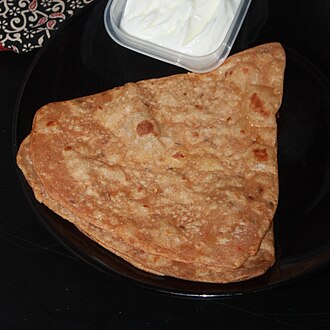
Photo: Wikipedia
Paratha is a rich, flaky, and layered unleavened flatbread, typically pan-fried with ghee or oil, originating from the Indian subcontinent. Its texture is a delightful contrast of crisp, buttery exterior and soft, chewy interior, often stuffed with spiced vegetables or paneer. Nutritionally, it provides a substantial source of energy and dietary fiber, making it a more satiating option than plain roti.
Calorie split: 8% protein · 56% carbs · 36% fat
↓ Full nutrition💚 Why it's loved
People love paratha for its satisfying, buttery flavor and the satisfying contrast between its crisp, layered exterior and soft interior. It's a beloved comfort food that pairs perfectly with yogurt, pickles, or curries, making it a versatile and culturally significant staple.
⚠️ Watch-outs & how to enjoy it better
Due to its high carbohydrate content and the oil/ghee used in cooking, paratha can cause blood-sugar spikes if eaten alone in large quantities. To counteract this, pair it with protein-rich foods like yogurt (raita), lentils (dal), or a side of vegetables to slow digestion and balance the meal. Portion control is also key.
Key benefits
- Provides sustained energy from complex carbohydrates and fiber.
- Good source of dietary fiber (9.6g per 100g), aiding digestion.
- Contains a moderate amount of protein (6.36g per 100g).
- Versatile base for a wide variety of sweet and savory fillings.
- A staple food offering cultural comfort and satiety.
🍽️ Popular dishes


🌍 Where it's eaten
💡 Did you know?
The word 'paratha' is derived from the Sanskrit 'parat' meaning 'layers' and 'atta' meaning 'flour', literally translating to 'layered flour bread'.
Full nutrition (USDA data · scales with serving)
| Water | 33.5 g |
| Energy | 326 kcal |
| Protein | 6.4 g |
| Total lipid (fat) | 13.2 g |
| Carbohydrate, by difference | 45.4 g |
| Fiber, total dietary | 9.6 g |
| Total Sugars | 4.2 g |
| Calcium, Ca | 25.0 mg |
| Iron, Fe | 1.6 mg |
| Magnesium, Mg | 37.0 mg |
| Phosphorus, P | 120 mg |
| Potassium, K | 139 mg |
| Sodium, Na | 452 mg |
| Zinc, Zn | 0.82 mg |
| Copper, Cu | 0.15 mg |
| Selenium, Se | 7.1 ug |
| Vitamin C, total ascorbic acid | 0.00 mg |
| Thiamin | 0.09 mg |
| Riboflavin | 0.08 mg |
| Niacin | 1.8 mg |
| Vitamin B-6 | 0.08 mg |
| Folate, total | 8.0 ug |
| Folic acid | 0.00 ug |
| Folate, food | 8.0 ug |
| Folate, DFE | 8.0 ug |
| Choline, total | 6.3 mg |
| Vitamin B-12 | 0.00 ug |
| Vitamin B-12, added | 0.00 ug |
| Vitamin A, RAE | 2.0 ug |
| Retinol | 2.0 ug |
| Carotene, beta | 0.00 ug |
| Carotene, alpha | 0.00 ug |
| Cryptoxanthin, beta | 0.00 ug |
| Lycopene | 0.00 ug |
| Lutein + zeaxanthin | 11.0 ug |
| Vitamin E (alpha-tocopherol) | 1.4 mg |
| Vitamin E, added | 0.00 mg |
| Vitamin D (D2 + D3) | 0.00 ug |
| Vitamin K (phylloquinone) | 3.4 ug |
| Alcohol, ethyl | 0.00 g |
| Caffeine | 0.00 mg |
| Theobromine | 0.00 mg |
Fat & fatty acid profile (per 100g)
| Fatty acids, total saturated | 5.8 g |
| SFA 4:0 | 0.00 g |
| SFA 6:0 | 0.00 g |
| SFA 8:0 | 0.00 g |
| SFA 10:0 | 0.02 g |
| SFA 12:0 | 0.05 g |
| SFA 14:0 | 0.11 g |
| SFA 16:0 | 4.9 g |
| SFA 18:0 | 0.64 g |
| Fatty acids, total monounsaturated | 3.8 g |
| MUFA 16:1 | 0.02 g |
| MUFA 18:1 | 3.8 g |
| MUFA 20:1 | 0.03 g |
| MUFA 22:1 | 0.00 g |
| Fatty acids, total polyunsaturated | 2.5 g |
| PUFA 18:2 | 2.4 g |
| PUFA 18:3 | 0.07 g |
| PUFA 18:4 | 0.00 g |
| PUFA 20:4 | 0.00 g |
| PUFA 20:5 n-3 (EPA) | 0.00 g |
| PUFA 22:5 n-3 (DPA) | 0.00 g |
| PUFA 22:6 n-3 (DHA) | 0.00 g |
| Cholesterol | 1.0 mg |
Amino acid profile (per 100g)
Estimated from Bread, salvadoran sweet cheese (quesadilla salvadorena) — USDA does not publish this profile for Bread.
| Tryptophan | 0.07 g |
| Threonine | 0.21 g |
| Isoleucine | 0.30 g |
| Leucine | 0.65 g |
| Lysine | 0.50 g |
| Methionine | 0.28 g |
| Cystine | 0.06 g |
| Phenylalanine | 0.37 g |
| Tyrosine | 0.23 g |
| Valine | 0.43 g |
| Arginine | 0.25 g |
| Histidine | 0.15 g |
| Alanine | 0.36 g |
| Aspartic acid | 0.59 g |
| Glutamic acid | 1.3 g |
| Glycine | 0.20 g |
| Proline | 0.83 g |
| Serine | 0.45 g |
| Hydroxyproline | 0.00 g |
FAQ
Is paratha healthier than roti or naan?
Paratha is generally higher in calories and fat than a plain roti (chapati) because it is typically cooked with oil or ghee. It is often more comparable to naan in terms of richness, though naan is leavened and paratha is not.
Can paratha be part of a weight-loss diet?
It can be, but portion control is essential. Opting for a smaller size, using minimal oil/ghee, and filling it with high-fiber vegetables (like spinach or cauliflower) can make it a more diet-friendly choice.
What is the best way to store leftover paratha?
Store cooled parathas in an airtight container or wrap them in a clean kitchen towel and then foil. They can be refrigerated for 2-3 days or frozen for up to a month. Reheat on a hot tawa (griddle) with a little oil to restore crispness.
Nutrient density (calculated · NRF9.3)
Nutrient Rich Foods index: beneficial nutrients (protein, fiber, vitamins, minerals) minus saturated fat, added sugar & sodium, per 100 kcal.
NRF9.3 index — Fulgoni, Keast & Drewnowski, 2009. Computed from USDA nutrients.
Weight-loss friendliness (composite index)
Energy density 3.26 kcal/g · 8% calories from protein · 9.6 g fiber · 4.2 g sugar per 100 g.
Composite of energy density (Rolls et al., 1999), protein & fiber satiety, minus sugar. A calculated heuristic — ranks satiety-per-calorie, not a clinical measure.
Dietary load (calculated from USDA values)
Potential renal acid load. Positive = acid-forming, negative = alkaline-forming.
Sodium-to-potassium ratio: 3.25 (lower is better — aim for ≤ 1)
Sodium:potassium per WHO potassium guidance. Computed from USDA nutrients.