

Beverages, tea, black, ready to drink, decaffeinated
Whole food · Beverages

Photo: Wikipedia
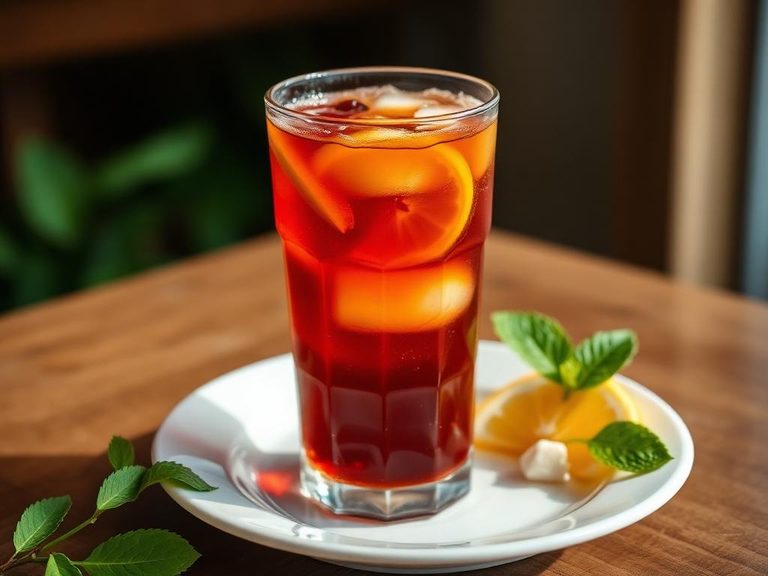
This is a smooth, ready-to-drink black tea that's been decaffeinated, offering the classic, robust flavor of black tea without the caffeine kick. It has a clear, deep amber color and a taste that can range from brisk and astringent to slightly malty, depending on the brand. Nutritionally, it's very light, with its calories coming almost entirely from a small amount of added sugar.
Calorie split: 0% protein · 100% carbs · 0% fat
↓ Full nutrition💚 Why it's loved
People love it for delivering the familiar, comforting taste of black tea at any hour, making it a perfect evening or caffeine-free alternative. Its versatility shines as a base for homemade iced tea, lattes, or mixed cocktails.
⚠️ Watch-outs & how to enjoy it better
The primary downside is the added sugar (nearly 8g per 100g), which can contribute to unnecessary calorie intake and blood sugar spikes if consumed in large quantities. To counteract this, opt for smaller portion sizes, dilute it with sparkling water, or choose unsweetened versions when available.
Key benefits
- Provides hydration without caffeine.
- Contains antioxidants like theaflavins from black tea.
- Offers a consistent, convenient flavor profile.
- Can be enjoyed hot or cold as a base for other drinks.
🍽️ Popular dishes



🌍 Where it's eaten
💡 Did you know?
The decaffeination process for this tea typically uses either a chemical solvent (like ethyl acetate) or a natural CO2 method, which can subtly alter the tea's original flavor compounds.
Full nutrition (USDA data · scales with serving)
| Water | 91.2 g |
| Energy | 38.0 kcal |
| Energy | 157 kj |
| Protein | 0.00 g |
| Total lipid (fat) | 0.00 g |
| Ash | 0.03 g |
| Carbohydrate, by difference | 8.8 g |
| Fiber, total dietary | 0.00 g |
| Total Sugars | 7.9 g |
| Calcium, Ca | 11.0 mg |
| Iron, Fe | 0.00 mg |
| Magnesium, Mg | 2.0 mg |
| Phosphorus, P | 4.0 mg |
| Potassium, K | 27.0 mg |
| Sodium, Na | 8.0 mg |
| Zinc, Zn | 0.01 mg |
| Copper, Cu | 0.01 mg |
| Selenium, Se | 0.00 ug |
| Vitamin C, total ascorbic acid | 0.00 mg |
| Thiamin | 0.00 mg |
| Riboflavin | 0.00 mg |
| Niacin | 0.00 mg |
| Vitamin B-6 | 0.00 mg |
| Folate, total | 0.00 ug |
| Folic acid | 0.00 ug |
| Folate, food | 0.00 ug |
| Folate, DFE | 0.00 ug |
| Choline, total | 0.00 mg |
| Vitamin B-12 | 0.00 ug |
| Vitamin B-12, added | 0.00 ug |
| Vitamin A, RAE | 0.00 ug |
| Retinol | 0.00 ug |
| Carotene, beta | 0.00 ug |
| Carotene, alpha | 0.00 ug |
| Cryptoxanthin, beta | 0.00 ug |
| Vitamin A, IU | 0.00 iu |
| Lycopene | 0.00 ug |
| Lutein + zeaxanthin | 0.00 ug |
| Vitamin E (alpha-tocopherol) | 0.00 mg |
| Vitamin E, added | 0.00 mg |
| Vitamin D (D2 + D3), International Units | 0.00 iu |
| Vitamin D (D2 + D3) | 0.00 ug |
| Vitamin K (phylloquinone) | 0.00 ug |
| Alcohol, ethyl | 0.00 g |
| Caffeine | 1.0 mg |
| Theobromine | 1.0 mg |
Fat & fatty acid profile (per 100g)
| Fatty acids, total saturated | 0.00 g |
| SFA 4:0 | 0.00 g |
| SFA 6:0 | 0.00 g |
| SFA 8:0 | 0.00 g |
| SFA 10:0 | 0.00 g |
| SFA 12:0 | 0.00 g |
| SFA 14:0 | 0.00 g |
| SFA 16:0 | 0.00 g |
| SFA 18:0 | 0.00 g |
| Fatty acids, total monounsaturated | 0.00 g |
| MUFA 16:1 | 0.00 g |
| MUFA 18:1 | 0.00 g |
| MUFA 20:1 | 0.00 g |
| MUFA 22:1 | 0.00 g |
| Fatty acids, total polyunsaturated | 0.00 g |
| PUFA 18:2 | 0.00 g |
| PUFA 18:3 | 0.00 g |
| PUFA 18:4 | 0.00 g |
| PUFA 20:4 | 0.00 g |
| PUFA 20:5 n-3 (EPA) | 0.00 g |
| PUFA 22:5 n-3 (DPA) | 0.00 g |
| PUFA 22:6 n-3 (DHA) | 0.00 g |
| Cholesterol | 0.00 mg |
Amino acid profile (per 100g)
Estimated from Beverages, carbonated, tonic water — USDA does not publish this profile for Beverages.
| Tryptophan | 0.00 g |
| Threonine | 0.00 g |
| Isoleucine | 0.00 g |
| Leucine | 0.00 g |
| Lysine | 0.00 g |
| Methionine | 0.00 g |
| Cystine | 0.00 g |
| Phenylalanine | 0.00 g |
| Tyrosine | 0.00 g |
| Valine | 0.00 g |
| Arginine | 0.00 g |
| Histidine | 0.00 g |
| Alanine | 0.00 g |
| Aspartic acid | 0.00 g |
| Glutamic acid | 0.00 g |
| Glycine | 0.00 g |
| Proline | 0.00 g |
| Serine | 0.00 g |
FAQ
Is decaffeinated black tea completely caffeine-free?
No. Decaffeination removes most, but not all, caffeine. A typical serving may still contain 2-10 mg of caffeine, compared to 40-70 mg in regular black tea.
Why does ready-to-drink tea have sugar added?
Sugar is commonly added to balance the natural bitterness and astringency of black tea, enhance flavor, and improve mouthfeel, making it more palatable to a wide audience.
How does the nutrition differ from brewed black tea?
Brewed black tea itself has virtually zero calories. The calories and sugar in ready-to-drink versions come entirely from added sweeteners, not the tea leaves.
Nutrient density (calculated · NRF9.3)
Nutrient Rich Foods index: beneficial nutrients (protein, fiber, vitamins, minerals) minus saturated fat, added sugar & sodium, per 100 kcal.
NRF9.3 index — Fulgoni, Keast & Drewnowski, 2009. Computed from USDA nutrients.
Weight-loss friendliness (composite index)
Energy density 0.38 kcal/g · 0% calories from protein · 0.0 g fiber · 7.9 g sugar per 100 g.
Composite of energy density (Rolls et al., 1999), protein & fiber satiety, minus sugar. A calculated heuristic — ranks satiety-per-calorie, not a clinical measure.
Dietary load (calculated from USDA values)
Potential renal acid load. Positive = acid-forming, negative = alkaline-forming.
Sodium-to-potassium ratio: 0.30 (lower is better — aim for ≤ 1)
Sodium:potassium per WHO potassium guidance. Computed from USDA nutrients.