

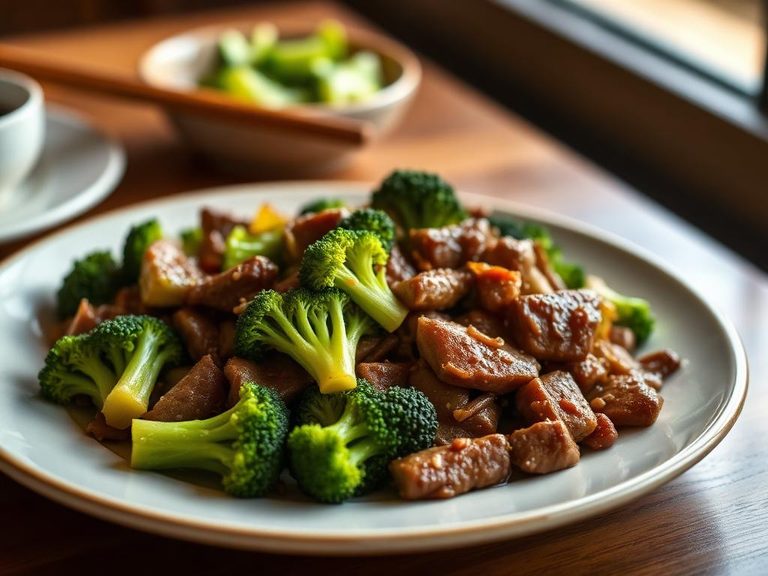
Beef, potatoes, and vegetables including carrots, broccoli, and/or dark-green leafy; gravy
Common food

Photo: Wikipedia
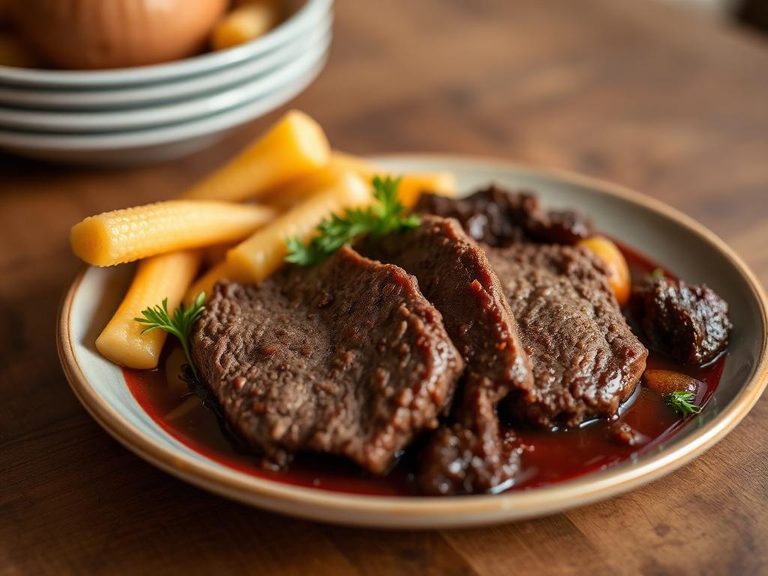
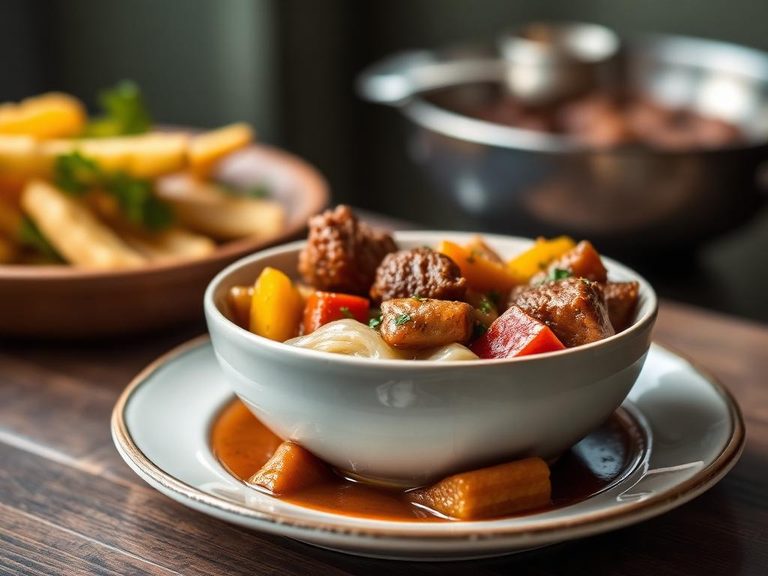
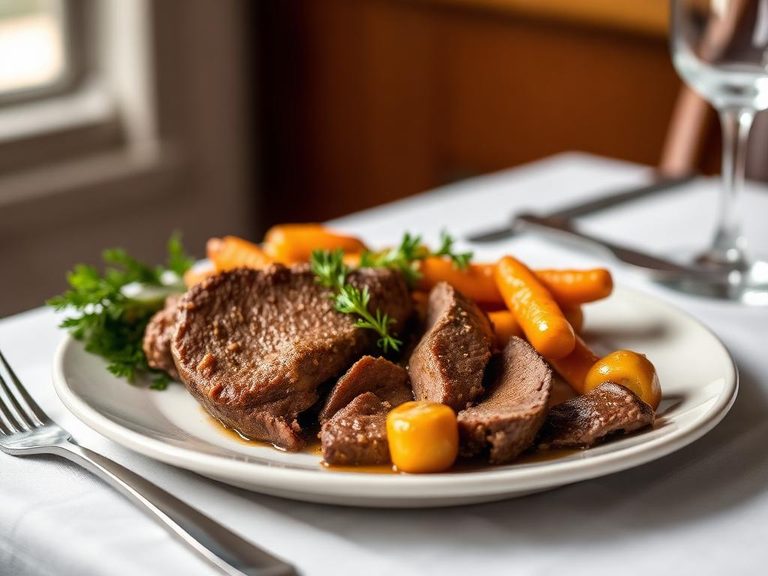
This is a hearty, savory plate of tender beef, soft potatoes, and crisp-tender vegetables like carrots or broccoli, all tied together with a rich, savory gravy. The textures range from the yielding beef to the creamy potato, with a satisfying bite from the vegetables. Nutritionally, it offers a balanced mix of protein, carbohydrates, and fats, with a notable fiber content from the vegetables.
Calorie split: 16% protein · 34% carbs · 50% fat
↓ Full nutrition💚 Why it's loved
People love this dish for its comforting, familiar flavors and the way it satisfies a deep hunger. It's a versatile one-plate meal that feels like a warm hug, often tied to family dinners and home cooking traditions.
⚠️ Watch-outs & how to enjoy it better
The dish can be high in sodium, especially from the gravy, and the carbohydrate content may cause blood-sugar spikes for some. To counteract this, opt for low-sodium gravy, ensure a good portion of the plate is non-starchy vegetables, and pair the meal with a side salad or extra greens to increase fiber and slow digestion.
Key benefits
- Provides a good source of protein for muscle maintenance.
- Contains fiber from vegetables and potatoes for digestive health.
- Offers a balanced mix of macronutrients in one meal.
- Rich in vitamins like A (from carrots) and C (from broccoli).
- The fat content aids in the absorption of fat-soluble vitamins.
🍽️ Popular dishes
🌍 Where it's eaten
💡 Did you know?
The Maillard reaction, which creates the deep brown color and complex flavors in the seared beef and gravy, is the same chemical process that gives bread its crust and coffee its roasted notes.
Full nutrition (USDA data · scales with serving)
| Water | 75.2 g |
| Energy | 129 kcal |
| Protein | 5.2 g |
| Total lipid (fat) | 7.2 g |
| Carbohydrate, by difference | 11.2 g |
| Fiber, total dietary | 1.4 g |
| Total Sugars | 0.94 g |
| Calcium, Ca | 13.0 mg |
| Iron, Fe | 0.59 mg |
| Magnesium, Mg | 14.0 mg |
| Phosphorus, P | 55.0 mg |
| Potassium, K | 215 mg |
| Sodium, Na | 302 mg |
| Zinc, Zn | 0.87 mg |
| Copper, Cu | 0.10 mg |
| Selenium, Se | 4.5 ug |
| Vitamin C, total ascorbic acid | 6.9 mg |
| Thiamin | 0.07 mg |
| Riboflavin | 0.05 mg |
| Niacin | 1.4 mg |
| Vitamin B-6 | 0.19 mg |
| Folate, total | 12.0 ug |
| Folic acid | 0.00 ug |
| Folate, food | 12.0 ug |
| Folate, DFE | 12.0 ug |
| Choline, total | 24.0 mg |
| Vitamin B-12 | 0.22 ug |
| Vitamin B-12, added | 0.00 ug |
| Vitamin A, RAE | 78.0 ug |
| Retinol | 0.00 ug |
| Carotene, beta | 762 ug |
| Carotene, alpha | 323 ug |
| Cryptoxanthin, beta | 0.00 ug |
| Lycopene | 0.00 ug |
| Lutein + zeaxanthin | 158 ug |
| Vitamin E (alpha-tocopherol) | 1.3 mg |
| Vitamin E, added | 0.00 mg |
| Vitamin D (D2 + D3) | 0.00 ug |
| Vitamin K (phylloquinone) | 15.3 ug |
| Alcohol, ethyl | 0.00 g |
| Caffeine | 0.00 mg |
| Theobromine | 0.00 mg |
Fat & fatty acid profile (per 100g)
| Fatty acids, total saturated | 1.3 g |
| SFA 4:0 | 0.00 g |
| SFA 6:0 | 0.00 g |
| SFA 8:0 | 0.00 g |
| SFA 10:0 | 0.00 g |
| SFA 12:0 | 0.01 g |
| SFA 14:0 | 0.04 g |
| SFA 16:0 | 0.92 g |
| SFA 18:0 | 0.31 g |
| Fatty acids, total monounsaturated | 3.0 g |
| MUFA 16:1 | 0.10 g |
| MUFA 18:1 | 2.8 g |
| MUFA 20:1 | 0.04 g |
| MUFA 22:1 | 0.00 g |
| Fatty acids, total polyunsaturated | 2.2 g |
| PUFA 18:2 | 1.9 g |
| PUFA 18:3 | 0.26 g |
| PUFA 18:4 | 0.00 g |
| PUFA 20:4 | 0.00 g |
| PUFA 20:5 n-3 (EPA) | 0.00 g |
| PUFA 22:5 n-3 (DPA) | 0.00 g |
| PUFA 22:6 n-3 (DHA) | 0.00 g |
| Cholesterol | 13.0 mg |
Amino acid profile (per 100g)
Estimated from Beef, variety meats and by-products, mechanically separated beef, raw — USDA does not publish this profile for Beef.
| Tryptophan | 0.17 g |
| Threonine | 0.47 g |
| Isoleucine | 0.58 g |
| Leucine | 1.2 g |
| Lysine | 1.2 g |
| Methionine | 0.43 g |
| Cystine | 0.23 g |
| Phenylalanine | 0.64 g |
| Tyrosine | 0.38 g |
| Valine | 0.92 g |
| Arginine | 1.2 g |
| Histidine | 0.44 g |
| Alanine | 1.0 g |
| Aspartic acid | 1.3 g |
| Glutamic acid | 2.1 g |
| Glycine | 1.2 g |
| Proline | 0.92 g |
| Serine | 0.57 g |
FAQ
Is this dish gluten-free?
It can be, but traditional gravy is often thickened with wheat flour. To make it gluten-free, use a thickener like cornstarch or arrowroot powder and ensure all other ingredients are gluten-free.
Can I make it healthier?
Yes. Use a leaner cut of beef, reduce the salt in the gravy, and increase the proportion of vegetables to meat and potatoes. You can also use low-sodium broth as a base.
What's the best cut of beef for this?
For slow-cooking methods like pot roast or stew, tougher, well-marbled cuts like chuck roast, brisket, or short ribs become incredibly tender. For quicker cooking, sirloin or tenderloin can be used.
Nutrient density (calculated · NRF9.3)
Nutrient Rich Foods index: beneficial nutrients (protein, fiber, vitamins, minerals) minus saturated fat, added sugar & sodium, per 100 kcal.
NRF9.3 index — Fulgoni, Keast & Drewnowski, 2009. Computed from USDA nutrients.
Weight-loss friendliness (composite index)
Energy density 1.29 kcal/g · 16% calories from protein · 1.4 g fiber · 0.9 g sugar per 100 g.
Composite of energy density (Rolls et al., 1999), protein & fiber satiety, minus sugar. A calculated heuristic — ranks satiety-per-calorie, not a clinical measure.
Dietary load (calculated from USDA values)
Potential renal acid load. Positive = acid-forming, negative = alkaline-forming.
Sodium-to-potassium ratio: 1.40 (lower is better — aim for ≤ 1)
Sodium:potassium per WHO potassium guidance. Computed from USDA nutrients.