

Chicken or turkey, potatoes, and vegetables including carrots, broccoli, and/or dark-green leafy; gravy
Common food
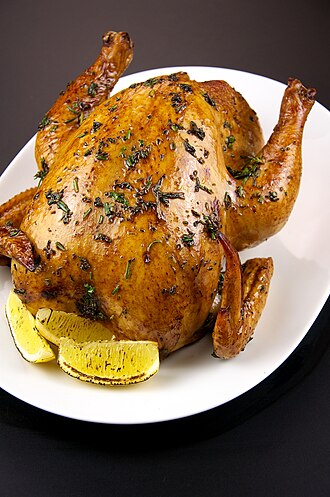
Photo: Wikipedia
This is a classic, comforting plate of roasted poultry (chicken or turkey) served with hearty potatoes and a medley of vegetables like carrots, broccoli, or dark greens, all brought together with a savory gravy. The taste is deeply savory and satisfying, with the tender, juicy meat complementing the soft, starchy potatoes and the slight sweetness or earthiness of the vegetables, all coated in a rich, umami-packed sauce. Nutritionally, it's a well-balanced, protein-rich meal with a moderate calorie count, making it a solid choice for a nourishing dinner.
Calorie split: 15% protein · 36% carbs · 49% fat
↓ Full nutrition💚 Why it's loved
People love this meal for its profound comfort-food appeal—it's the quintessential 'Sunday dinner' that evokes warmth and home cooking. The combination is endlessly versatile, allowing for different poultry, potato preparations, and seasonal vegetables, making it a adaptable canvas for family recipes and cultural traditions.
⚠️ Watch-outs & how to enjoy it better
The primary downside is the potential for high sodium content, especially from the gravy and processed poultry, which can be a concern for blood pressure management. To counteract this, opt for low-sodium broth in your gravy, use herbs and spices for flavor instead of salt, and choose fresh, unseasoned poultry. Additionally, those watching blood sugar should be mindful of portion sizes for the potatoes and gravy, and can pair the meal with extra non-starchy vegetables to increase fiber and slow carb absorption.
Key benefits
- High-quality protein supports muscle maintenance and satiety.
- Provides a balanced mix of macronutrients (protein, carbs, fat).
- Vegetables offer essential vitamins (like A from carrots) and fiber.
- Iron from dark leafy greens and poultry supports energy levels.
- A complete, satisfying meal that can aid in portion control.
🍽️ Popular dishes



🌍 Where it's eaten
💡 Did you know?
The practice of serving meat with potatoes and vegetables is a relatively modern concept in Europe; before the 18th century, root vegetables and greens were often served in separate courses from the main meat dish.
Full nutrition (USDA data · scales with serving)
| Water | 76.0 g |
| Energy | 123 kcal |
| Protein | 4.7 g |
| Total lipid (fat) | 6.8 g |
| Carbohydrate, by difference | 11.2 g |
| Fiber, total dietary | 1.4 g |
| Total Sugars | 0.94 g |
| Calcium, Ca | 14.0 mg |
| Iron, Fe | 0.36 mg |
| Magnesium, Mg | 15.0 mg |
| Phosphorus, P | 60.0 mg |
| Potassium, K | 218 mg |
| Sodium, Na | 342 mg |
| Zinc, Zn | 0.40 mg |
| Copper, Cu | 0.10 mg |
| Selenium, Se | 3.5 ug |
| Vitamin C, total ascorbic acid | 6.9 mg |
| Thiamin | 0.07 mg |
| Riboflavin | 0.06 mg |
| Niacin | 1.7 mg |
| Vitamin B-6 | 0.17 mg |
| Folate, total | 11.0 ug |
| Folic acid | 0.00 ug |
| Folate, food | 11.0 ug |
| Folate, DFE | 11.0 ug |
| Choline, total | 17.4 mg |
| Vitamin B-12 | 0.05 ug |
| Vitamin B-12, added | 0.00 ug |
| Vitamin A, RAE | 79.0 ug |
| Retinol | 1.0 ug |
| Carotene, beta | 762 ug |
| Carotene, alpha | 323 ug |
| Cryptoxanthin, beta | 0.00 ug |
| Lycopene | 0.00 ug |
| Lutein + zeaxanthin | 158 ug |
| Vitamin E (alpha-tocopherol) | 1.3 mg |
| Vitamin E, added | 0.00 mg |
| Vitamin D (D2 + D3) | 0.00 ug |
| Vitamin K (phylloquinone) | 15.1 ug |
| Alcohol, ethyl | 0.00 g |
| Caffeine | 0.00 mg |
| Theobromine | 0.00 mg |
Fat & fatty acid profile (per 100g)
| Fatty acids, total saturated | 1.1 g |
| SFA 4:0 | 0.00 g |
| SFA 6:0 | 0.00 g |
| SFA 8:0 | 0.00 g |
| SFA 10:0 | 0.00 g |
| SFA 12:0 | 0.00 g |
| SFA 14:0 | 0.01 g |
| SFA 16:0 | 0.81 g |
| SFA 18:0 | 0.22 g |
| Fatty acids, total monounsaturated | 2.8 g |
| MUFA 16:1 | 0.11 g |
| MUFA 18:1 | 2.7 g |
| MUFA 20:1 | 0.04 g |
| MUFA 22:1 | 0.00 g |
| Fatty acids, total polyunsaturated | 2.3 g |
| PUFA 18:2 | 2.0 g |
| PUFA 18:3 | 0.25 g |
| PUFA 18:4 | 0.00 g |
| PUFA 20:4 | 0.00 g |
| PUFA 20:5 n-3 (EPA) | 0.00 g |
| PUFA 22:5 n-3 (DPA) | 0.00 g |
| PUFA 22:6 n-3 (DHA) | 0.00 g |
| Cholesterol | 16.0 mg |
Amino acid profile (per 100g)
Estimated from Turnover, chicken- or turkey-, and vegetable-filled, reduced fat, frozen — USDA does not publish this profile for Chicken or turkey.
| Tryptophan | 0.16 g |
| Threonine | 0.41 g |
| Isoleucine | 0.47 g |
| Leucine | 0.80 g |
| Lysine | 0.61 g |
| Methionine | 0.23 g |
| Cystine | 0.13 g |
| Phenylalanine | 0.47 g |
| Tyrosine | 0.37 g |
| Valine | 0.53 g |
| Arginine | 0.51 g |
| Histidine | 0.30 g |
| Alanine | 0.45 g |
| Aspartic acid | 0.80 g |
| Glutamic acid | 2.2 g |
| Glycine | 0.38 g |
| Proline | 0.87 g |
| Serine | 0.42 g |
| Hydroxyproline | 0.00 g |
FAQ
Is this meal considered healthy?
Yes, it can be a very healthy, balanced meal. It provides lean protein, complex carbohydrates, and vegetables. The healthiness largely depends on preparation—using less fat in cooking, making gravy from pan drippings with minimal added fat, and loading up on the vegetables will maximize its nutritional benefits.
How can I make it lower in calories?
To reduce calories, focus on portion control for the potatoes and gravy. Use skinless poultry, steam or roast the vegetables with minimal oil, and make a lighter gravy using a broth base thickened with a small amount of cornstarch or pureed vegetables instead of a traditional fat-and-flour roux.
What's the best way to reheat leftovers?
For best texture, reheat components separately if possible. Warm the poultry and vegetables in a 350°F (175°C) oven until heated through to prevent sogginess. Heat the gravy gently on the stovetop. If reheating together, cover the dish with foil to retain moisture.
Nutrient density (calculated · NRF9.3)
Nutrient Rich Foods index: beneficial nutrients (protein, fiber, vitamins, minerals) minus saturated fat, added sugar & sodium, per 100 kcal.
NRF9.3 index — Fulgoni, Keast & Drewnowski, 2009. Computed from USDA nutrients.
Weight-loss friendliness (composite index)
Energy density 1.23 kcal/g · 15% calories from protein · 1.4 g fiber · 0.9 g sugar per 100 g.
Composite of energy density (Rolls et al., 1999), protein & fiber satiety, minus sugar. A calculated heuristic — ranks satiety-per-calorie, not a clinical measure.
Dietary load (calculated from USDA values)
Potential renal acid load. Positive = acid-forming, negative = alkaline-forming.
Sodium-to-potassium ratio: 1.57 (lower is better — aim for ≤ 1)
Sodium:potassium per WHO potassium guidance. Computed from USDA nutrients.