

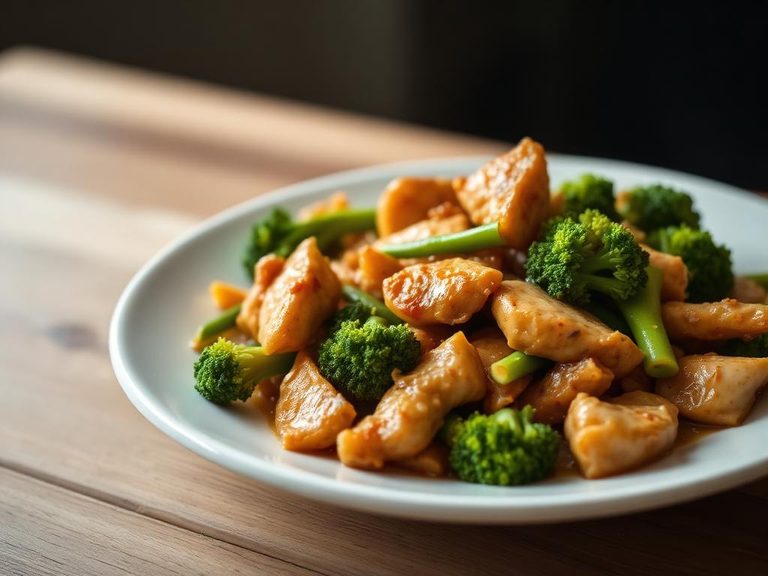
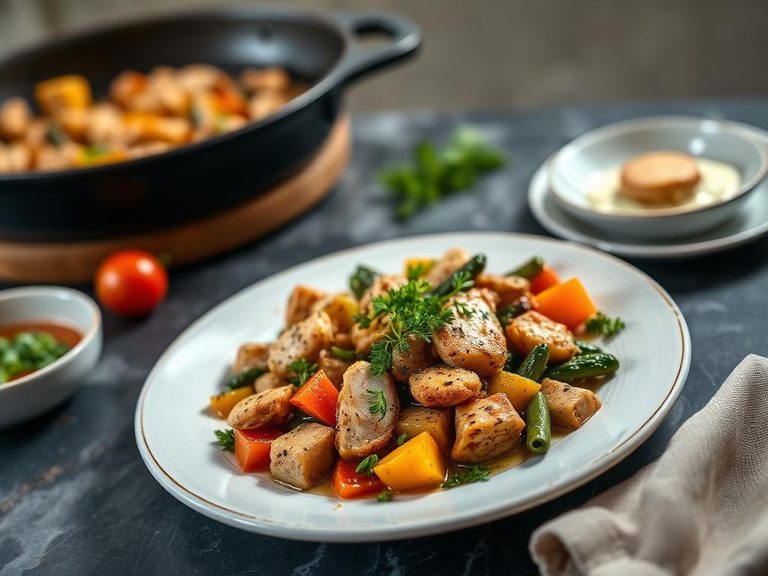
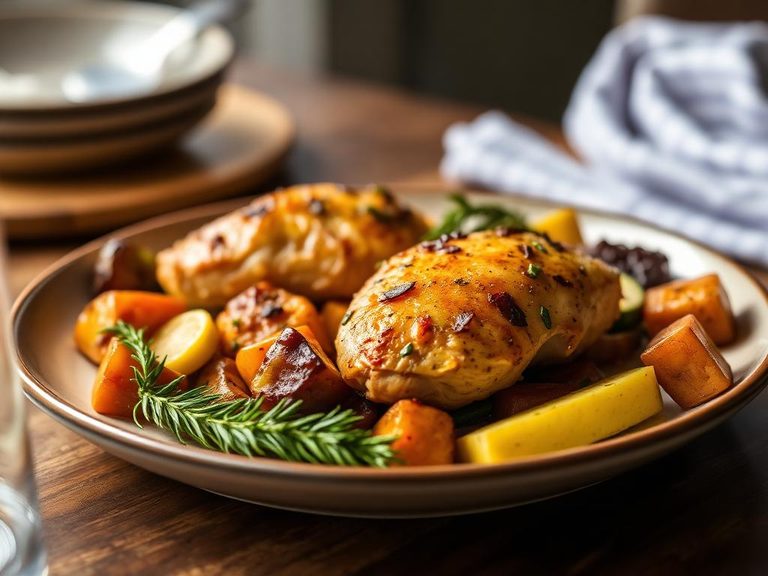
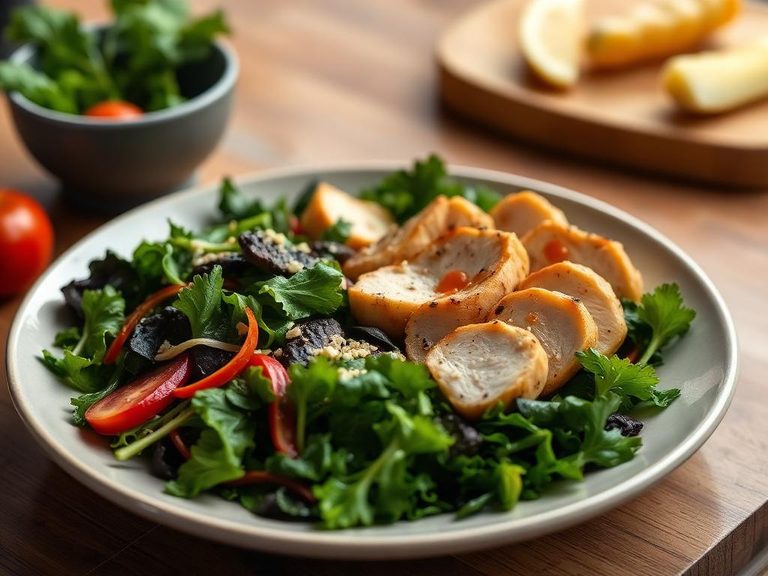
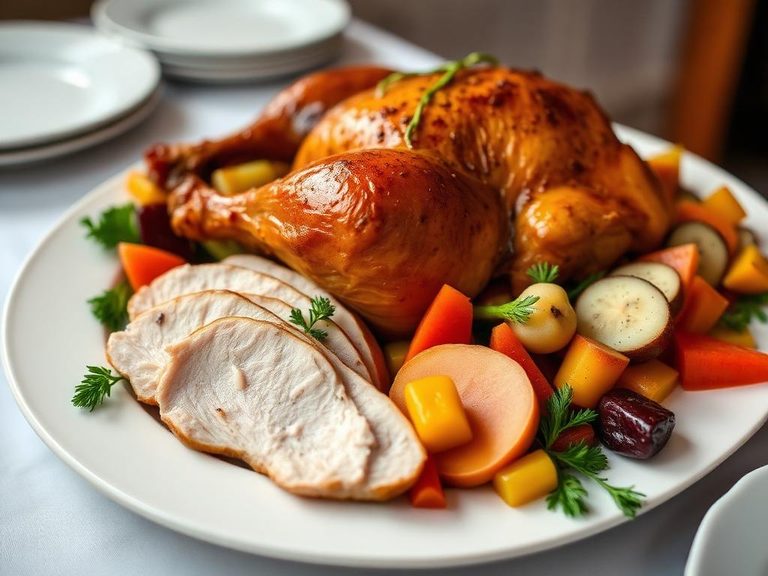
Chicken or turkey and vegetables including carrots, broccoli, and/or dark-green leafy; no potatoes, gravy
Common food
A clean, savory mix of tender poultry and crisp-tender vegetables like carrots, broccoli, and dark greens. The texture is a satisfying contrast of soft meat and firm veggies, with a fresh, herb-forward flavor profile. It's a low-calorie, high-protein meal that delivers a solid dose of vitamins A, C, and K.
Calorie split: 25% protein · 16% carbs · 59% fat
↓ Full nutrition💚 Why it's loved
People love this combination for its clean, satisfying flavors and incredible versatility—it can be seasoned in countless ways, from lemon-herb to garlic-ginger. It's a staple in health-conscious and home cooking because it's a complete, balanced meal on a plate.
⚠️ Watch-outs & how to enjoy it better
The primary caution is for those on low-potassium diets, as broccoli and dark greens are high in potassium. To manage, use smaller portions of the vegetables and ensure they are cooked (boiling can leach some potassium). Also, be mindful of added salt or sauces, which can spike sodium intake.
Key benefits
- High in satiating protein for muscle maintenance
- Rich in fiber for digestive health
- Excellent source of immune-supporting Vitamin C
- Provides Vitamin A for vision and skin health
- Naturally low in carbohydrates
🍽️ Popular dishes
🌍 Where it's eaten
💡 Did you know?
Broccoli is a man-made vegetable, selectively bred from wild cabbage by Italian farmers over 2,000 years ago.
Full nutrition (USDA data · scales with serving)
| Water | 79.8 g |
| Energy | 112 kcal |
| Protein | 7.1 g |
| Total lipid (fat) | 7.4 g |
| Carbohydrate, by difference | 4.5 g |
| Fiber, total dietary | 1.0 g |
| Total Sugars | 1.0 g |
| Calcium, Ca | 19.0 mg |
| Iron, Fe | 0.40 mg |
| Magnesium, Mg | 11.0 mg |
| Phosphorus, P | 77.0 mg |
| Potassium, K | 136 mg |
| Sodium, Na | 367 mg |
| Zinc, Zn | 0.51 mg |
| Copper, Cu | 0.04 mg |
| Selenium, Se | 5.9 ug |
| Vitamin C, total ascorbic acid | 6.5 mg |
| Thiamin | 0.04 mg |
| Riboflavin | 0.09 mg |
| Niacin | 2.0 mg |
| Vitamin B-6 | 0.10 mg |
| Folate, total | 14.0 ug |
| Folic acid | 0.00 ug |
| Folate, food | 13.0 ug |
| Folate, DFE | 13.0 ug |
| Choline, total | 20.9 mg |
| Vitamin B-12 | 0.08 ug |
| Vitamin B-12, added | 0.00 ug |
| Vitamin A, RAE | 141 ug |
| Retinol | 2.0 ug |
| Carotene, beta | 1358 ug |
| Carotene, alpha | 577 ug |
| Cryptoxanthin, beta | 0.00 ug |
| Lycopene | 0.00 ug |
| Lutein + zeaxanthin | 274 ug |
| Vitamin E (alpha-tocopherol) | 1.4 mg |
| Vitamin E, added | 0.00 mg |
| Vitamin D (D2 + D3) | 0.00 ug |
| Vitamin K (phylloquinone) | 20.6 ug |
| Alcohol, ethyl | 0.00 g |
| Caffeine | 0.00 mg |
| Theobromine | 0.00 mg |
Fat & fatty acid profile (per 100g)
| Fatty acids, total saturated | 1.3 g |
| SFA 4:0 | 0.00 g |
| SFA 6:0 | 0.00 g |
| SFA 8:0 | 0.00 g |
| SFA 10:0 | 0.00 g |
| SFA 12:0 | 0.00 g |
| SFA 14:0 | 0.02 g |
| SFA 16:0 | 0.98 g |
| SFA 18:0 | 0.26 g |
| Fatty acids, total monounsaturated | 3.1 g |
| MUFA 16:1 | 0.18 g |
| MUFA 18:1 | 2.8 g |
| MUFA 20:1 | 0.04 g |
| MUFA 22:1 | 0.00 g |
| Fatty acids, total polyunsaturated | 2.2 g |
| PUFA 18:2 | 2.0 g |
| PUFA 18:3 | 0.24 g |
| PUFA 18:4 | 0.00 g |
| PUFA 20:4 | 0.01 g |
| PUFA 20:5 n-3 (EPA) | 0.00 g |
| PUFA 22:5 n-3 (DPA) | 0.00 g |
| PUFA 22:6 n-3 (DHA) | 0.00 g |
| Cholesterol | 28.0 mg |
Amino acid profile (per 100g)
Estimated from Turnover, chicken- or turkey-, and vegetable-filled, reduced fat, frozen — USDA does not publish this profile for Chicken or turkey and vegetables including carrots.
| Tryptophan | 0.16 g |
| Threonine | 0.41 g |
| Isoleucine | 0.47 g |
| Leucine | 0.80 g |
| Lysine | 0.61 g |
| Methionine | 0.23 g |
| Cystine | 0.13 g |
| Phenylalanine | 0.47 g |
| Tyrosine | 0.37 g |
| Valine | 0.53 g |
| Arginine | 0.51 g |
| Histidine | 0.30 g |
| Alanine | 0.45 g |
| Aspartic acid | 0.80 g |
| Glutamic acid | 2.2 g |
| Glycine | 0.38 g |
| Proline | 0.87 g |
| Serine | 0.42 g |
| Hydroxyproline | 0.00 g |
FAQ
Is this a good meal for weight loss?
Yes, it's very effective. The high protein and fiber content promote fullness on very few calories (112 kcal per 100g), making it ideal for creating a calorie deficit.
Can I eat this on a low-carb diet?
Absolutely. With only about 4.5g of carbs per 100g (and 1g of fiber), it fits perfectly into low-carb and ketogenic dietary patterns.
How can I add more flavor without adding calories?
Use generous amounts of herbs (rosemary, thyme, oregano), spices (paprika, cumin, pepper), garlic, onion, citrus zest, or a splash of vinegar or mustard.
Nutrient density (calculated · NRF9.3)
Nutrient Rich Foods index: beneficial nutrients (protein, fiber, vitamins, minerals) minus saturated fat, added sugar & sodium, per 100 kcal.
NRF9.3 index — Fulgoni, Keast & Drewnowski, 2009. Computed from USDA nutrients.
Weight-loss friendliness (composite index)
Energy density 1.12 kcal/g · 25% calories from protein · 1.0 g fiber · 1.0 g sugar per 100 g.
Composite of energy density (Rolls et al., 1999), protein & fiber satiety, minus sugar. A calculated heuristic — ranks satiety-per-calorie, not a clinical measure.
Dietary load (calculated from USDA values)
Potential renal acid load. Positive = acid-forming, negative = alkaline-forming.
Sodium-to-potassium ratio: 2.70 (lower is better — aim for ≤ 1)
Sodium:potassium per WHO potassium guidance. Computed from USDA nutrients.