

Beef and vegetables including carrots, broccoli, and/or dark-green leafy; no potatoes, gravy
Common food
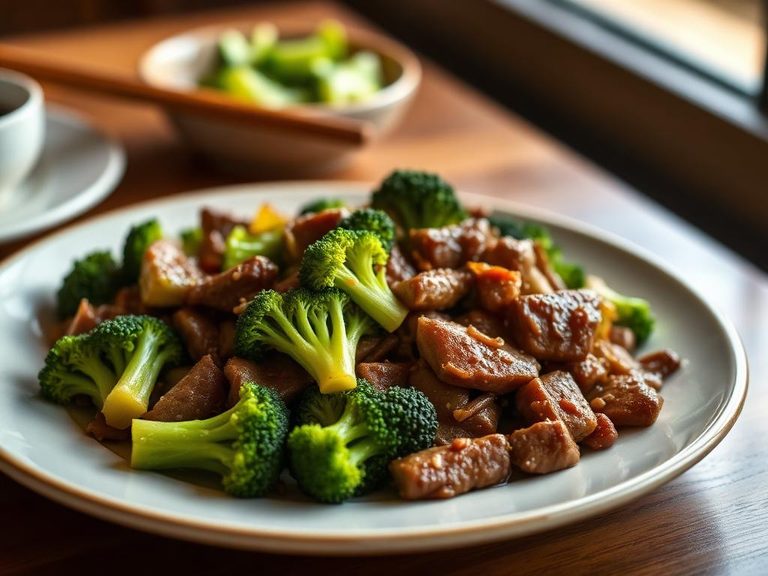
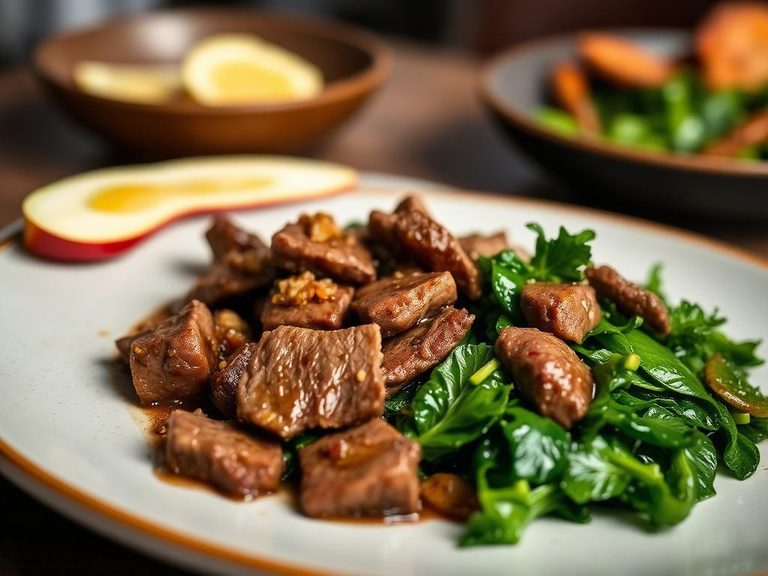
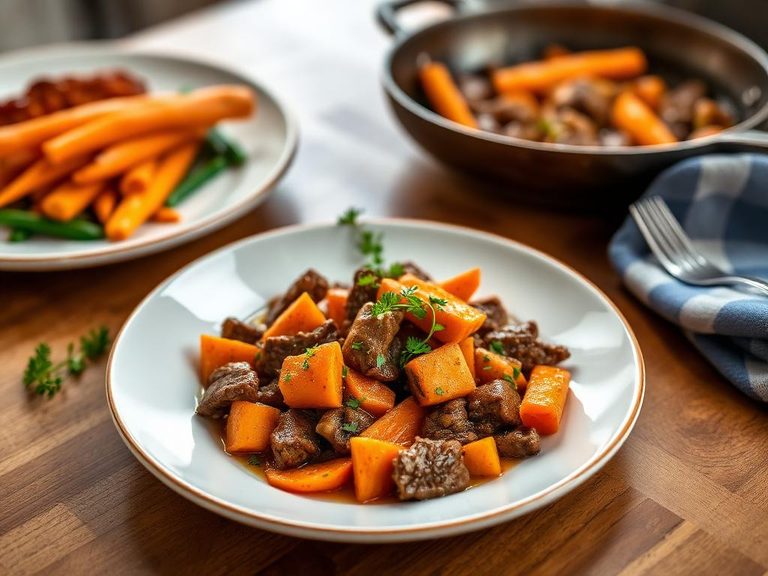
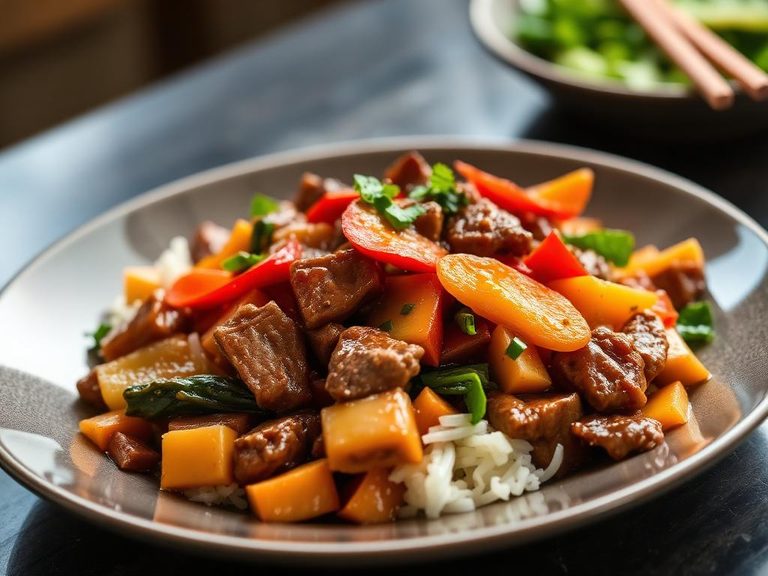
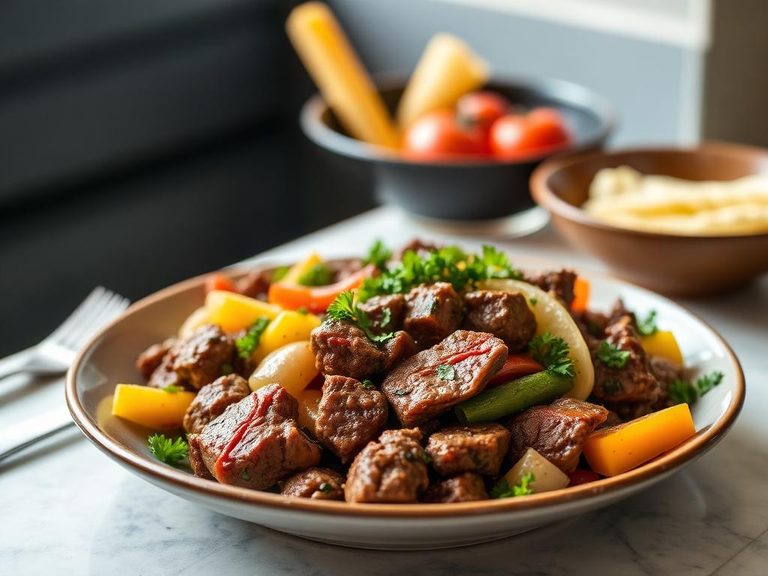
A lean, savory stir-fry or sauté of tender beef strips with vibrant carrots, broccoli, and dark greens, cooked without heavy sauces. The texture is a satisfying mix of juicy meat and crisp-tender vegetables, with a fresh, umami-rich flavor profile. It's a protein-packed, low-carb meal that delivers iron and vitamins without excess calories.
Calorie split: 28% protein · 15% carbs · 57% fat
↓ Full nutrition💚 Why it's loved
People love it for its clean, savory taste and the satisfying contrast between the hearty beef and fresh vegetables. It's a versatile base that adapts to many cuisines, from a simple weeknight dinner to an elegant bistro plate.
⚠️ Watch-outs & how to enjoy it better
The iron in beef and oxalates in leafy greens can inhibit each other's absorption, and some may find the lean cut less flavorful without added fat. To counteract, pair with a source of vitamin C (like a squeeze of lemon or bell peppers) to boost iron uptake, and consider a small amount of healthy fat like sesame oil for better nutrient absorption and flavor.
Key benefits
- High-quality protein for muscle maintenance
- Rich in iron from beef and leafy greens
- Good source of beta-carotene from carrots
- Low in carbohydrates, suitable for low-carb diets
- Provides dietary fiber from vegetables
🍽️ Popular dishes
🌍 Where it's eaten
💡 Did you know?
The combination of beef and broccoli is a classic American Chinese dish, but broccoli itself was virtually unknown in China until the 20th century, having been introduced from Italy.
Full nutrition (USDA data · scales with serving)
| Water | 78.9 g |
| Energy | 115 kcal |
| Protein | 8.1 g |
| Total lipid (fat) | 7.3 g |
| Carbohydrate, by difference | 4.5 g |
| Fiber, total dietary | 1.0 g |
| Total Sugars | 1.0 g |
| Calcium, Ca | 17.0 mg |
| Iron, Fe | 0.82 mg |
| Magnesium, Mg | 10.0 mg |
| Phosphorus, P | 67.0 mg |
| Potassium, K | 130 mg |
| Sodium, Na | 310 mg |
| Zinc, Zn | 1.4 mg |
| Copper, Cu | 0.04 mg |
| Selenium, Se | 7.8 ug |
| Vitamin C, total ascorbic acid | 6.6 mg |
| Thiamin | 0.04 mg |
| Riboflavin | 0.08 mg |
| Niacin | 1.5 mg |
| Vitamin B-6 | 0.14 mg |
| Folate, total | 14.0 ug |
| Folic acid | 0.00 ug |
| Folate, food | 14.0 ug |
| Folate, DFE | 14.0 ug |
| Choline, total | 32.8 mg |
| Vitamin B-12 | 0.40 ug |
| Vitamin B-12, added | 0.00 ug |
| Vitamin A, RAE | 140 ug |
| Retinol | 0.00 ug |
| Carotene, beta | 1368 ug |
| Carotene, alpha | 581 ug |
| Cryptoxanthin, beta | 0.00 ug |
| Lycopene | 0.00 ug |
| Lutein + zeaxanthin | 276 ug |
| Vitamin E (alpha-tocopherol) | 1.3 mg |
| Vitamin E, added | 0.00 mg |
| Vitamin D (D2 + D3) | 0.00 ug |
| Vitamin K (phylloquinone) | 20.4 ug |
| Alcohol, ethyl | 0.00 g |
| Caffeine | 0.00 mg |
| Theobromine | 0.00 mg |
Fat & fatty acid profile (per 100g)
| Fatty acids, total saturated | 1.6 g |
| SFA 4:0 | 0.00 g |
| SFA 6:0 | 0.00 g |
| SFA 8:0 | 0.00 g |
| SFA 10:0 | 0.00 g |
| SFA 12:0 | 0.01 g |
| SFA 14:0 | 0.07 g |
| SFA 16:0 | 1.1 g |
| SFA 18:0 | 0.40 g |
| Fatty acids, total monounsaturated | 3.0 g |
| MUFA 16:1 | 0.16 g |
| MUFA 18:1 | 2.8 g |
| MUFA 20:1 | 0.04 g |
| MUFA 22:1 | 0.00 g |
| Fatty acids, total polyunsaturated | 1.8 g |
| PUFA 18:2 | 1.6 g |
| PUFA 18:3 | 0.21 g |
| PUFA 18:4 | 0.00 g |
| PUFA 20:4 | 0.01 g |
| PUFA 20:5 n-3 (EPA) | 0.00 g |
| PUFA 22:5 n-3 (DPA) | 0.00 g |
| PUFA 22:6 n-3 (DHA) | 0.00 g |
| Cholesterol | 23.0 mg |
Amino acid profile (per 100g)
Estimated from Restaurant, Chinese, beef and vegetables — USDA does not publish this profile for Beef and vegetables including carrots.
| Tryptophan | 0.08 g |
| Threonine | 0.31 g |
| Isoleucine | 0.31 g |
| Leucine | 0.53 g |
| Lysine | 0.55 g |
| Methionine | 0.16 g |
| Cystine | 0.07 g |
| Phenylalanine | 0.32 g |
| Tyrosine | 0.27 g |
| Valine | 0.33 g |
| Arginine | 0.52 g |
| Histidine | 0.21 g |
| Alanine | 0.38 g |
| Aspartic acid | 0.67 g |
| Glutamic acid | 1.3 g |
| Glycine | 0.28 g |
| Proline | 0.26 g |
| Serine | 0.29 g |
FAQ
Is this dish suitable for a keto diet?
Yes, with 4.5g carbs and 7.34g fat per 100g, it fits well within keto macros, especially if you focus on the non-starchy vegetables.
How can I keep the vegetables crisp?
Cook the beef first and set it aside. Stir-fry the vegetables quickly over high heat, adding them in order of density (carrots first, then broccoli, then greens last) to maintain a crisp-tender texture.
What cut of beef is best?
For quick cooking, use lean, tender cuts like sirloin, flank steak, or tenderloin, sliced thinly against the grain for maximum tenderness.
Nutrient density (calculated · NRF9.3)
Nutrient Rich Foods index: beneficial nutrients (protein, fiber, vitamins, minerals) minus saturated fat, added sugar & sodium, per 100 kcal.
NRF9.3 index — Fulgoni, Keast & Drewnowski, 2009. Computed from USDA nutrients.
Weight-loss friendliness (composite index)
Energy density 1.15 kcal/g · 28% calories from protein · 1.0 g fiber · 1.0 g sugar per 100 g.
Composite of energy density (Rolls et al., 1999), protein & fiber satiety, minus sugar. A calculated heuristic — ranks satiety-per-calorie, not a clinical measure.
Dietary load (calculated from USDA values)
Potential renal acid load. Positive = acid-forming, negative = alkaline-forming.
Sodium-to-potassium ratio: 2.38 (lower is better — aim for ≤ 1)
Sodium:potassium per WHO potassium guidance. Computed from USDA nutrients.