

Beef, pot roast
Common food

Photo: Wikipedia
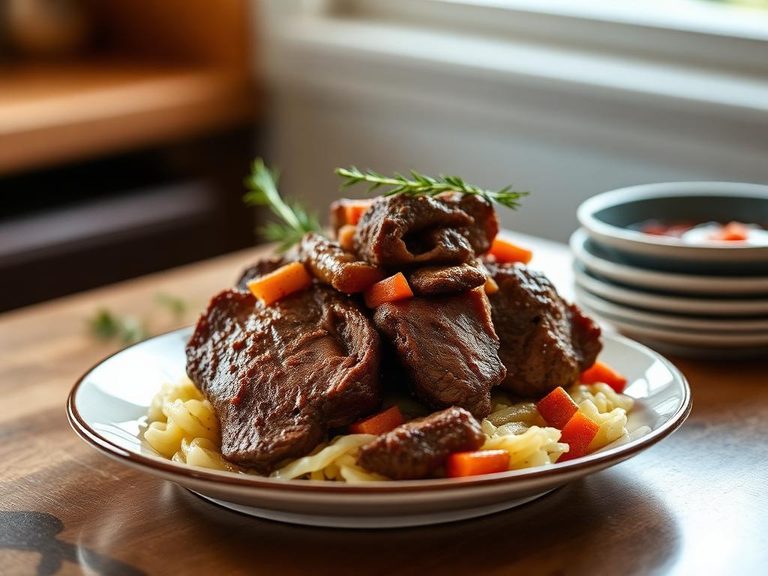
Pot roast is a classic comfort dish where a tough cut of beef, typically chuck roast, is slow-cooked in liquid until it becomes fork-tender and deeply savory. The long, gentle cooking process breaks down collagen into rich gelatin, creating a luscious, fall-apart texture and a flavorful, concentrated braising liquid. Nutritionally, it's a protein powerhouse with minimal carbohydrates, making it a satisfying centerpiece for low-carb or ketogenic meals.
Calorie split: 45% protein · 0% carbs · 55% fat
↓ Full nutrition💚 Why it's loved
People adore pot roast for its profound, savory depth of flavor and the comforting, melt-in-your-mouth texture that only hours of gentle cooking can achieve. It's a versatile one-pot meal that embodies home cooking and family gatherings across many cultures.
⚠️ Watch-outs & how to enjoy it better
The primary concern is its high saturated fat content, which should be moderated by those managing heart health. Choosing a leaner cut like bottom round and skimming the fat from the finished braising liquid can significantly reduce this. As a red meat, it may also be high in sodium if heavily seasoned or prepared with commercial broth; using low-sodium stock and controlling added salt helps.
Key benefits
- Excellent source of complete protein for muscle maintenance
- Rich in bioavailable iron and zinc from red meat
- Provides B vitamins, especially B12, for nerve function
- Slow-cooked collagen supports joint and gut health
- Zero carbohydrates, suitable for ketogenic diets
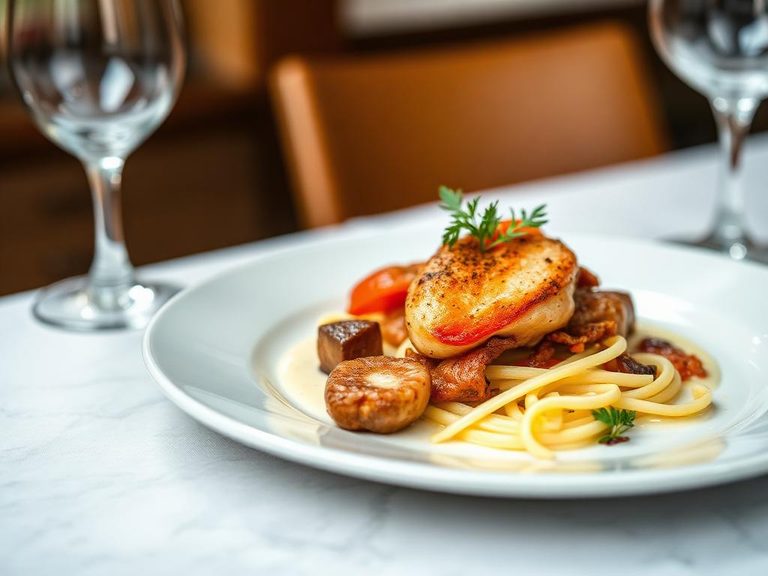
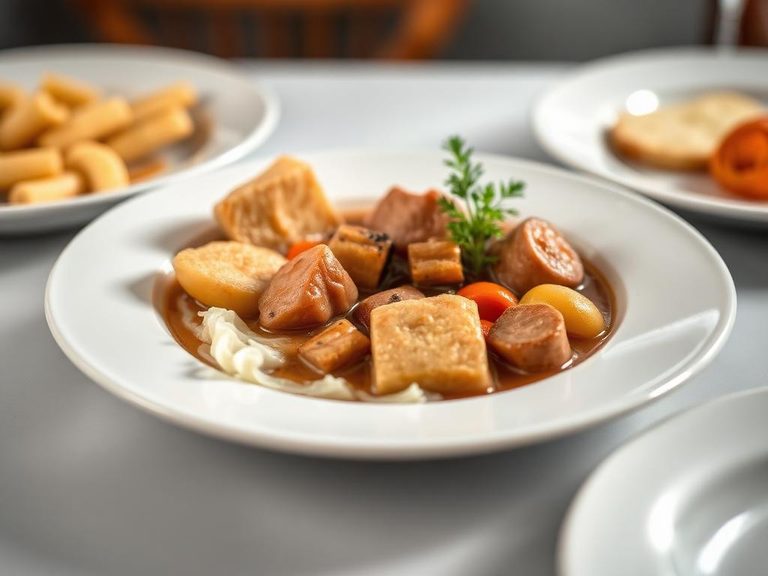
🍽️ Popular dishes
🌍 Where it's eaten
💡 Did you know?
The term 'pot roast' is a 20th-century American invention; the technique of braising tough meat in liquid is ancient, with roots in medieval European 'potted' meats.
Full nutrition (USDA data · scales with serving)
| Water | 54.9 g |
| Energy | 251 kcal |
| Protein | 28.4 g |
| Total lipid (fat) | 15.3 g |
| Carbohydrate, by difference | 0.00 g |
| Fiber, total dietary | 0.00 g |
| Total Sugars | 0.00 g |
| Calcium, Ca | 14.0 mg |
| Iron, Fe | 2.9 mg |
| Magnesium, Mg | 20.0 mg |
| Phosphorus, P | 188 mg |
| Potassium, K | 282 mg |
| Sodium, Na | 370 mg |
| Zinc, Zn | 10.2 mg |
| Copper, Cu | 0.09 mg |
| Selenium, Se | 32.9 ug |
| Vitamin C, total ascorbic acid | 0.00 mg |
| Thiamin | 0.07 mg |
| Riboflavin | 0.23 mg |
| Niacin | 3.7 mg |
| Vitamin B-6 | 0.30 mg |
| Folate, total | 7.0 ug |
| Folic acid | 0.00 ug |
| Folate, food | 7.0 ug |
| Folate, DFE | 7.0 ug |
| Choline, total | 89.4 mg |
| Vitamin B-12 | 3.2 ug |
| Vitamin B-12, added | 0.00 ug |
| Vitamin A, RAE | 5.0 ug |
| Retinol | 5.0 ug |
| Carotene, beta | 0.00 ug |
| Carotene, alpha | 0.00 ug |
| Cryptoxanthin, beta | 0.00 ug |
| Lycopene | 0.00 ug |
| Lutein + zeaxanthin | 0.00 ug |
| Vitamin E (alpha-tocopherol) | 0.08 mg |
| Vitamin E, added | 0.00 mg |
| Vitamin D (D2 + D3) | 0.10 ug |
| Vitamin K (phylloquinone) | 1.6 ug |
| Alcohol, ethyl | 0.00 g |
| Caffeine | 0.00 mg |
| Theobromine | 0.00 mg |
Fat & fatty acid profile (per 100g)
| Fatty acids, total saturated | 6.1 g |
| SFA 4:0 | 0.00 g |
| SFA 6:0 | 0.00 g |
| SFA 8:0 | 0.00 g |
| SFA 10:0 | 0.00 g |
| SFA 12:0 | 0.00 g |
| SFA 14:0 | 0.40 g |
| SFA 16:0 | 3.4 g |
| SFA 18:0 | 2.1 g |
| Fatty acids, total monounsaturated | 7.2 g |
| MUFA 16:1 | 0.47 g |
| MUFA 18:1 | 6.5 g |
| MUFA 20:1 | 0.04 g |
| MUFA 22:1 | 0.00 g |
| Fatty acids, total polyunsaturated | 0.68 g |
| PUFA 18:2 | 0.58 g |
| PUFA 18:3 | 0.03 g |
| PUFA 18:4 | 0.00 g |
| PUFA 20:4 | 0.06 g |
| PUFA 20:5 n-3 (EPA) | 0.00 g |
| PUFA 22:5 n-3 (DPA) | 0.00 g |
| PUFA 22:6 n-3 (DHA) | 0.00 g |
| Cholesterol | 101 mg |
Amino acid profile (per 100g)
Estimated from Beef, variety meats and by-products, mechanically separated beef, raw — USDA does not publish this profile for Beef.
| Tryptophan | 0.17 g |
| Threonine | 0.47 g |
| Isoleucine | 0.58 g |
| Leucine | 1.2 g |
| Lysine | 1.2 g |
| Methionine | 0.43 g |
| Cystine | 0.23 g |
| Phenylalanine | 0.64 g |
| Tyrosine | 0.38 g |
| Valine | 0.92 g |
| Arginine | 1.2 g |
| Histidine | 0.44 g |
| Alanine | 1.0 g |
| Aspartic acid | 1.3 g |
| Glutamic acid | 2.1 g |
| Glycine | 1.2 g |
| Proline | 0.92 g |
| Serine | 0.57 g |
FAQ
What's the best cut of beef for pot roast?
The best cuts are well-marbled, tough working muscles like beef chuck (shoulder), bottom round, or brisket. These have ample connective tissue that melts into gelatin during slow cooking, yielding tenderness and flavor.
Why is my pot roast tough?
It's likely undercooked. The collagen needs sustained heat (typically 300-325°F / 150-163°C) for several hours to fully convert to gelatin. Cooking it longer, until the meat easily shreds with a fork, is the solution.
Can I make pot roast in a slow cooker or Instant Pot?
Yes, both are excellent methods. A slow cooker on low for 8-10 hours works perfectly. An Instant Pot can achieve similar tenderness in about 60-90 minutes under high pressure, making it a faster alternative.
Nutrient density (calculated · NRF9.3)
Nutrient Rich Foods index: beneficial nutrients (protein, fiber, vitamins, minerals) minus saturated fat, added sugar & sodium, per 100 kcal.
NRF9.3 index — Fulgoni, Keast & Drewnowski, 2009. Computed from USDA nutrients.
Weight-loss friendliness (composite index)
Energy density 2.51 kcal/g · 45% calories from protein · 0.0 g fiber · 0.0 g sugar per 100 g.
Composite of energy density (Rolls et al., 1999), protein & fiber satiety, minus sugar. A calculated heuristic — ranks satiety-per-calorie, not a clinical measure.
Dietary load (calculated from USDA values)
Potential renal acid load. Positive = acid-forming, negative = alkaline-forming.
Sodium-to-potassium ratio: 1.31 (lower is better — aim for ≤ 1)
Sodium:potassium per WHO potassium guidance. Computed from USDA nutrients.