

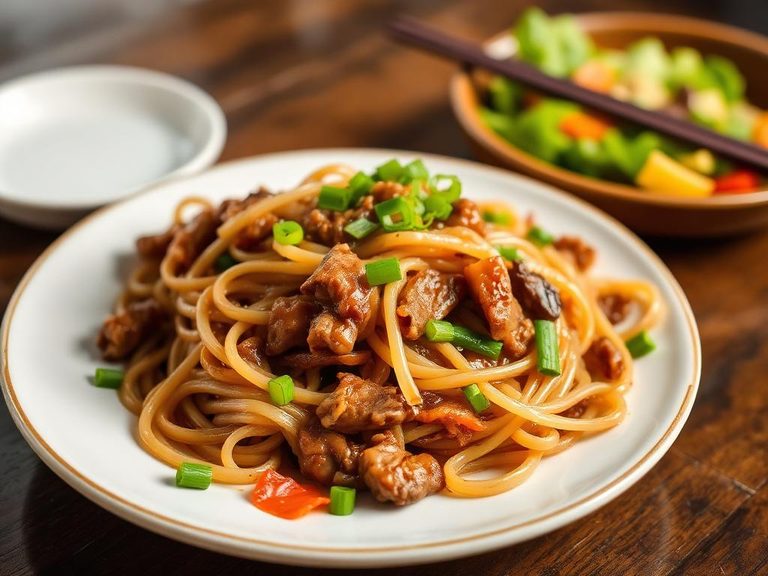
Beef, noodles, and vegetables including carrots, broccoli, and/or dark-green leafy; soy-based sauce
Common food

Photo: Wikipedia
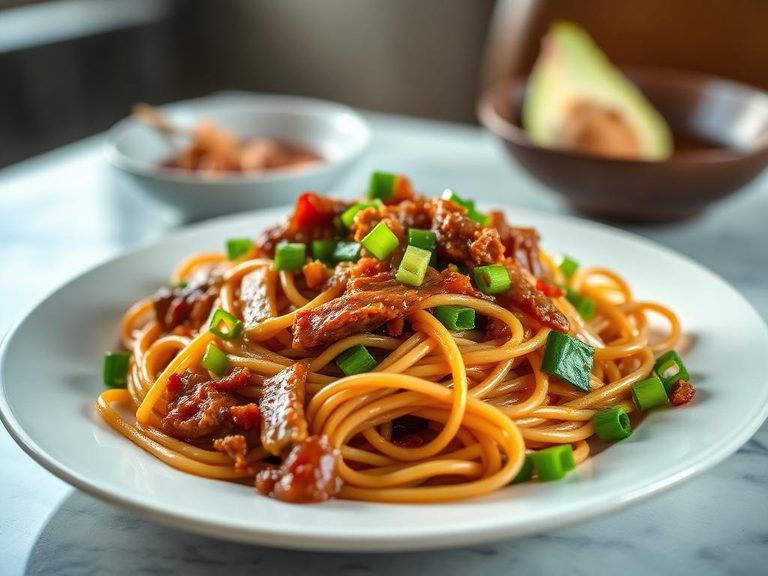
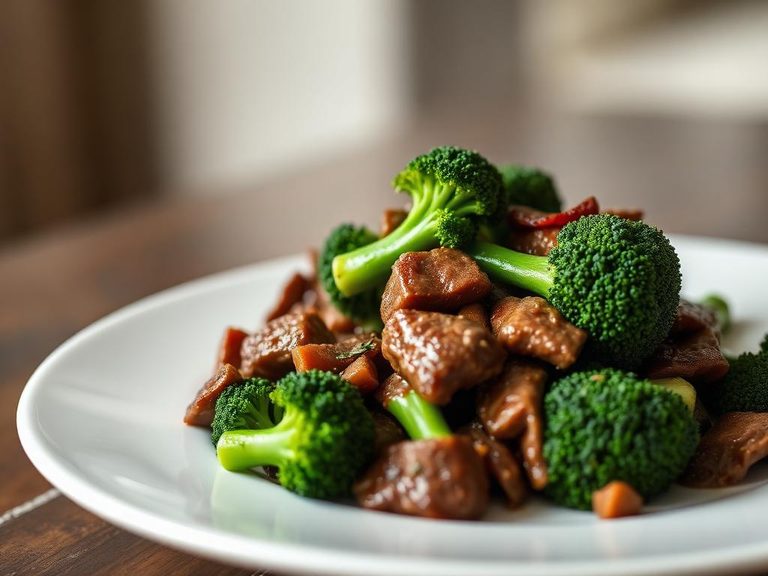
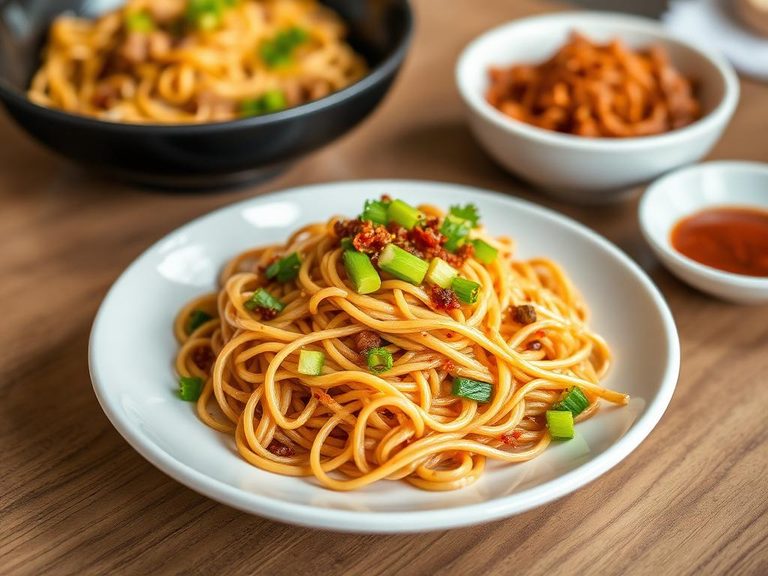
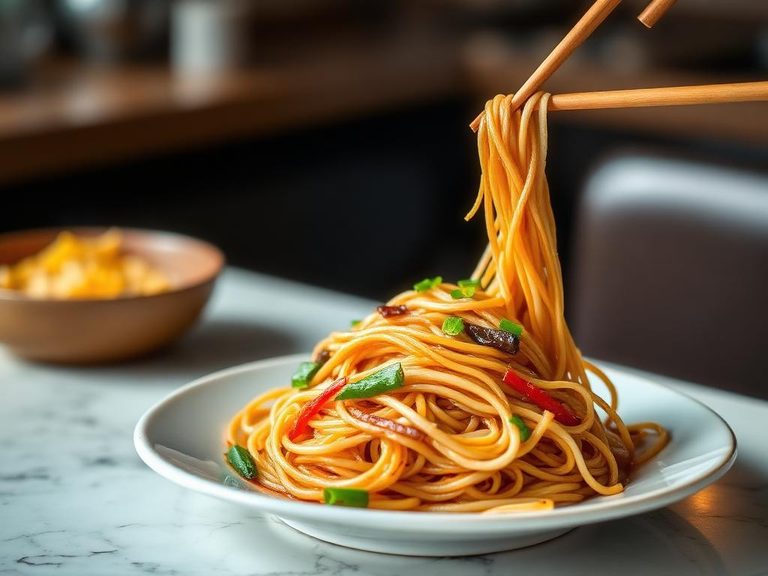
A savory stir-fry or noodle bowl featuring tender beef, springy noodles, and crisp-tender vegetables like carrots, broccoli, or dark greens, all coated in a savory soy-based sauce. The dish offers a satisfying contrast of textures—chewy, crunchy, and succulent—with a rich umami depth. It provides a balanced mix of protein, carbohydrates, and fats in a single, flavorful serving.
Calorie split: 29% protein · 22% carbs · 49% fat
↓ Full nutrition💚 Why it's loved
People love it for its deeply satisfying umami flavor from the soy sauce and the harmonious blend of textures in every bite. It's a beloved comfort food that's endlessly customizable and represents a staple of quick, flavorful home cooking and street food culture.
⚠️ Watch-outs & how to enjoy it better
The sodium content from soy sauce can be high, which may be a concern for those monitoring salt intake. The noodles can cause a quicker blood-sugar rise compared to whole grains. To counteract, choose low-sodium soy sauce, increase the vegetable-to-noodle ratio, and add a source of healthy fat like sesame oil to help slow digestion.
Key benefits
- Excellent source of high-quality protein from beef.
- Provides complex carbohydrates for sustained energy.
- Contains fiber and micronutrients from mixed vegetables.
- Offers a balanced macronutrient profile per serving.
- Quick to prepare, making it a practical meal option.
🍽️ Popular dishes

🌍 Where it's eaten
💡 Did you know?
The 'wok hei' or 'breath of the wok'—that prized, slightly smoky flavor in a perfect stir-fry—occurs when oil and moisture vaporize instantly at extremely high heat, creating a complex Maillard reaction in seconds.
Full nutrition (USDA data · scales with serving)
| Water | 73.4 g |
| Energy | 139 kcal |
| Protein | 10.3 g |
| Total lipid (fat) | 7.6 g |
| Carbohydrate, by difference | 7.6 g |
| Fiber, total dietary | 1.2 g |
| Total Sugars | 1.3 g |
| Calcium, Ca | 23.0 mg |
| Iron, Fe | 1.1 mg |
| Magnesium, Mg | 15.0 mg |
| Phosphorus, P | 86.0 mg |
| Potassium, K | 202 mg |
| Sodium, Na | 216 mg |
| Zinc, Zn | 1.7 mg |
| Copper, Cu | 0.06 mg |
| Selenium, Se | 10.5 ug |
| Vitamin C, total ascorbic acid | 12.6 mg |
| Thiamin | 0.05 mg |
| Riboflavin | 0.08 mg |
| Niacin | 1.9 mg |
| Vitamin B-6 | 0.20 mg |
| Folate, total | 17.0 ug |
| Folic acid | 0.00 ug |
| Folate, food | 17.0 ug |
| Folate, DFE | 17.0 ug |
| Choline, total | 40.2 mg |
| Vitamin B-12 | 0.50 ug |
| Vitamin B-12, added | 0.00 ug |
| Vitamin A, RAE | 116 ug |
| Retinol | 0.00 ug |
| Carotene, beta | 1140 ug |
| Carotene, alpha | 501 ug |
| Cryptoxanthin, beta | 0.00 ug |
| Lycopene | 0.00 ug |
| Lutein + zeaxanthin | 232 ug |
| Vitamin E (alpha-tocopherol) | 1.2 mg |
| Vitamin E, added | 0.00 mg |
| Vitamin D (D2 + D3) | 0.00 ug |
| Vitamin K (phylloquinone) | 29.8 ug |
| Alcohol, ethyl | 0.00 g |
| Caffeine | 0.00 mg |
| Theobromine | 0.00 mg |
Fat & fatty acid profile (per 100g)
| Fatty acids, total saturated | 1.7 g |
| SFA 4:0 | 0.00 g |
| SFA 6:0 | 0.00 g |
| SFA 8:0 | 0.00 g |
| SFA 10:0 | 0.01 g |
| SFA 12:0 | 0.01 g |
| SFA 14:0 | 0.08 g |
| SFA 16:0 | 1.1 g |
| SFA 18:0 | 0.43 g |
| Fatty acids, total monounsaturated | 3.2 g |
| MUFA 16:1 | 0.13 g |
| MUFA 18:1 | 3.0 g |
| MUFA 20:1 | 0.04 g |
| MUFA 22:1 | 0.00 g |
| Fatty acids, total polyunsaturated | 2.0 g |
| PUFA 18:2 | 1.7 g |
| PUFA 18:3 | 0.24 g |
| PUFA 18:4 | 0.00 g |
| PUFA 20:4 | 0.01 g |
| PUFA 20:5 n-3 (EPA) | 0.00 g |
| PUFA 22:5 n-3 (DPA) | 0.01 g |
| PUFA 22:6 n-3 (DHA) | 0.00 g |
| Cholesterol | 26.0 mg |
Amino acid profile (per 100g)
Estimated from Beef, variety meats and by-products, mechanically separated beef, raw — USDA does not publish this profile for Beef.
| Tryptophan | 0.17 g |
| Threonine | 0.47 g |
| Isoleucine | 0.58 g |
| Leucine | 1.2 g |
| Lysine | 1.2 g |
| Methionine | 0.43 g |
| Cystine | 0.23 g |
| Phenylalanine | 0.64 g |
| Tyrosine | 0.38 g |
| Valine | 0.92 g |
| Arginine | 1.2 g |
| Histidine | 0.44 g |
| Alanine | 1.0 g |
| Aspartic acid | 1.3 g |
| Glutamic acid | 2.1 g |
| Glycine | 1.2 g |
| Proline | 0.92 g |
| Serine | 0.57 g |
FAQ
Can I make this dish with chicken or tofu instead of beef?
Absolutely. Chicken, pork, shrimp, or firm tofu are excellent substitutes. Adjust cooking time accordingly—chicken and tofu cook faster than beef.
How do I keep the vegetables crisp and not soggy?
Cook the vegetables separately and very briefly over high heat, or add them to the stir-fry only in the final minute. They should be heated through but retain a bright color and crunch.
What type of noodles work best?
Fresh or dried egg noodles are classic for chow mein/lo mein. For a chewier texture, try udon or rice noodles. The choice often depends on the specific regional dish you're emulating.
Nutrient density (calculated · NRF9.3)
Nutrient Rich Foods index: beneficial nutrients (protein, fiber, vitamins, minerals) minus saturated fat, added sugar & sodium, per 100 kcal.
NRF9.3 index — Fulgoni, Keast & Drewnowski, 2009. Computed from USDA nutrients.
Weight-loss friendliness (composite index)
Energy density 1.39 kcal/g · 30% calories from protein · 1.2 g fiber · 1.3 g sugar per 100 g.
Composite of energy density (Rolls et al., 1999), protein & fiber satiety, minus sugar. A calculated heuristic — ranks satiety-per-calorie, not a clinical measure.
Dietary load (calculated from USDA values)
Potential renal acid load. Positive = acid-forming, negative = alkaline-forming.
Sodium-to-potassium ratio: 1.07 (lower is better — aim for ≤ 1)
Sodium:potassium per WHO potassium guidance. Computed from USDA nutrients.