

Beef, noodles, and vegetables including carrots, broccoli, and/or dark-green leafy; tomato-based sauce
Common food
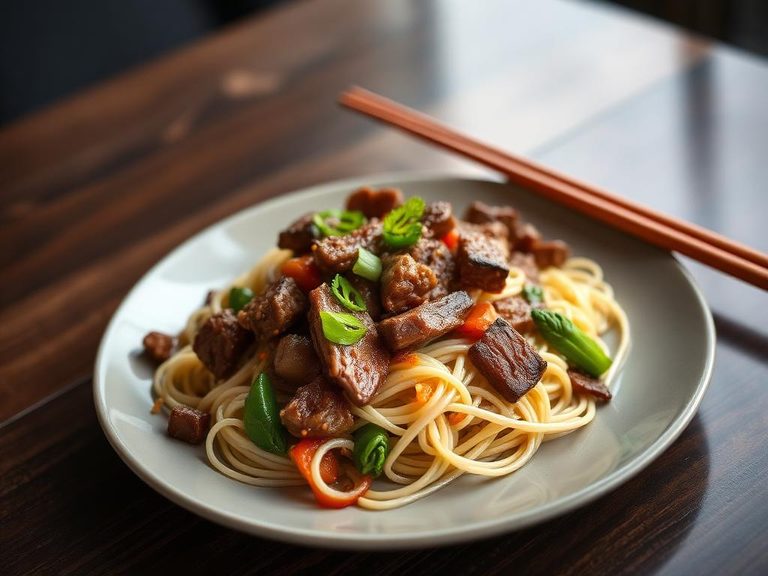
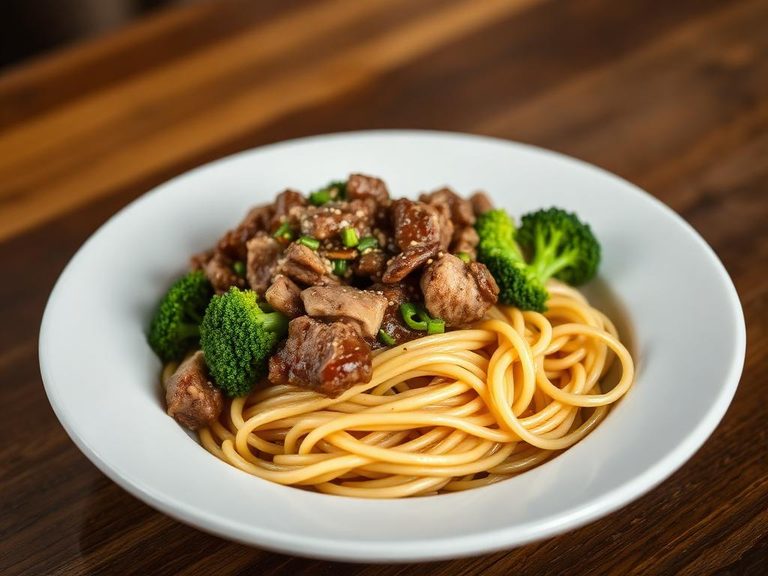
A hearty, savory bowl of tender beef, springy noodles, and vibrant vegetables like carrots, broccoli, and dark greens, all tossed in a rich, tangy tomato-based sauce. The texture is a satisfying mix of chewy noodles, crisp-tender vegetables, and soft beef, with the sauce providing a bright, umami-rich backdrop. At just 126 kcal per 100g, it's a surprisingly light yet nutrient-dense meal, offering a solid balance of protein and complex carbs.
Calorie split: 21% protein · 43% carbs · 36% fat
↓ Full nutrition💚 Why it's loved
People adore this dish for its comforting, all-in-one nature—it's a complete, flavorful meal that feels both nourishing and indulgent. The combination of savory beef, bright tomato sauce, and fresh vegetables creates a universally appealing taste profile that's both familiar and deeply satisfying.
⚠️ Watch-outs & how to enjoy it better
The tomato-based sauce can be high in sodium, which may concern those monitoring salt intake. To counteract this, opt for low-sodium broth or sauce and add fresh herbs like basil or oregano for flavor. The noodles, especially if refined, can cause blood-sugar spikes; pairing with the dish's protein and fiber-rich vegetables helps mitigate this. For those with gluten sensitivities, using rice or legume-based noodles is a simple swap.
Key benefits
- High in protein for muscle maintenance and satiety
- Rich in fiber from vegetables and noodles for digestive health
- Good source of vitamins A and C from carrots and tomato sauce
- Contains iron from beef and dark leafy greens
- Low in sugar, making it a balanced, savory option
🍽️ Popular dishes

🌍 Where it's eaten
💡 Did you know?
The tomato, a key ingredient in the sauce, was once feared as poisonous in Europe and was grown primarily as an ornamental plant before the 18th century.
Full nutrition (USDA data · scales with serving)
| Water | 73.1 g |
| Energy | 126 kcal |
| Protein | 6.7 g |
| Total lipid (fat) | 5.1 g |
| Carbohydrate, by difference | 13.7 g |
| Fiber, total dietary | 1.5 g |
| Total Sugars | 1.6 g |
| Calcium, Ca | 16.0 mg |
| Iron, Fe | 1.4 mg |
| Magnesium, Mg | 18.0 mg |
| Phosphorus, P | 74.0 mg |
| Potassium, K | 159 mg |
| Sodium, Na | 310 mg |
| Zinc, Zn | 1.1 mg |
| Copper, Cu | 0.09 mg |
| Selenium, Se | 15.1 ug |
| Vitamin C, total ascorbic acid | 5.6 mg |
| Thiamin | 0.15 mg |
| Riboflavin | 0.11 mg |
| Niacin | 2.0 mg |
| Vitamin B-6 | 0.12 mg |
| Folate, total | 47.0 ug |
| Folic acid | 34.0 ug |
| Folate, food | 13.0 ug |
| Folate, DFE | 71.0 ug |
| Choline, total | 31.8 mg |
| Vitamin B-12 | 0.27 ug |
| Vitamin B-12, added | 0.00 ug |
| Vitamin A, RAE | 88.0 ug |
| Retinol | 3.0 ug |
| Carotene, beta | 850 ug |
| Carotene, alpha | 331 ug |
| Cryptoxanthin, beta | 1.0 ug |
| Lycopene | 3698 ug |
| Lutein + zeaxanthin | 180 ug |
| Vitamin E (alpha-tocopherol) | 1.3 mg |
| Vitamin E, added | 0.00 mg |
| Vitamin D (D2 + D3) | 0.10 ug |
| Vitamin K (phylloquinone) | 12.8 ug |
| Alcohol, ethyl | 0.00 g |
| Caffeine | 0.00 mg |
| Theobromine | 0.00 mg |
Fat & fatty acid profile (per 100g)
| Fatty acids, total saturated | 1.0 g |
| SFA 4:0 | 0.00 g |
| SFA 6:0 | 0.00 g |
| SFA 8:0 | 0.00 g |
| SFA 10:0 | 0.00 g |
| SFA 12:0 | 0.00 g |
| SFA 14:0 | 0.04 g |
| SFA 16:0 | 0.72 g |
| SFA 18:0 | 0.25 g |
| Fatty acids, total monounsaturated | 2.0 g |
| MUFA 16:1 | 0.08 g |
| MUFA 18:1 | 1.9 g |
| MUFA 20:1 | 0.02 g |
| MUFA 22:1 | 0.00 g |
| Fatty acids, total polyunsaturated | 1.4 g |
| PUFA 18:2 | 1.3 g |
| PUFA 18:3 | 0.15 g |
| PUFA 18:4 | 0.00 g |
| PUFA 20:4 | 0.00 g |
| PUFA 20:5 n-3 (EPA) | 0.00 g |
| PUFA 22:5 n-3 (DPA) | 0.00 g |
| PUFA 22:6 n-3 (DHA) | 0.00 g |
| Cholesterol | 25.0 mg |
Amino acid profile (per 100g)
Estimated from Beef, variety meats and by-products, mechanically separated beef, raw — USDA does not publish this profile for Beef.
| Tryptophan | 0.17 g |
| Threonine | 0.47 g |
| Isoleucine | 0.58 g |
| Leucine | 1.2 g |
| Lysine | 1.2 g |
| Methionine | 0.43 g |
| Cystine | 0.23 g |
| Phenylalanine | 0.64 g |
| Tyrosine | 0.38 g |
| Valine | 0.92 g |
| Arginine | 1.2 g |
| Histidine | 0.44 g |
| Alanine | 1.0 g |
| Aspartic acid | 1.3 g |
| Glutamic acid | 2.1 g |
| Glycine | 1.2 g |
| Proline | 0.92 g |
| Serine | 0.57 g |
FAQ
Is this dish suitable for a low-carb diet?
The standard version with wheat noodles is not low-carb. However, you can easily adapt it by substituting the noodles with zucchini noodles (zoodles) or shirataki noodles to significantly reduce the carbohydrate content.
How can I make it healthier without losing flavor?
Use lean cuts of beef like sirloin or flank steak, load up on extra vegetables (bell peppers, snap peas, mushrooms), and choose whole-wheat or legume-based noodles. You can also reduce the sauce's sodium by using low-sodium soy sauce or tamari and adding a splash of vinegar or citrus for brightness.
What's the best way to store and reheat leftovers?
Store in an airtight container in the refrigerator for up to 3 days. Reheat gently in a skillet over medium heat with a splash of water or broth to prevent the noodles from drying out. Microwaving works too, but cover the dish to steam it evenly.
Nutrient density (calculated · NRF9.3)
Nutrient Rich Foods index: beneficial nutrients (protein, fiber, vitamins, minerals) minus saturated fat, added sugar & sodium, per 100 kcal.
NRF9.3 index — Fulgoni, Keast & Drewnowski, 2009. Computed from USDA nutrients.
Weight-loss friendliness (composite index)
Energy density 1.26 kcal/g · 21% calories from protein · 1.5 g fiber · 1.6 g sugar per 100 g.
Composite of energy density (Rolls et al., 1999), protein & fiber satiety, minus sugar. A calculated heuristic — ranks satiety-per-calorie, not a clinical measure.
Dietary load (calculated from USDA values)
Potential renal acid load. Positive = acid-forming, negative = alkaline-forming.
Sodium-to-potassium ratio: 1.95 (lower is better — aim for ≤ 1)
Sodium:potassium per WHO potassium guidance. Computed from USDA nutrients.