

Beef, corned
Common food

Photo: Wikipedia
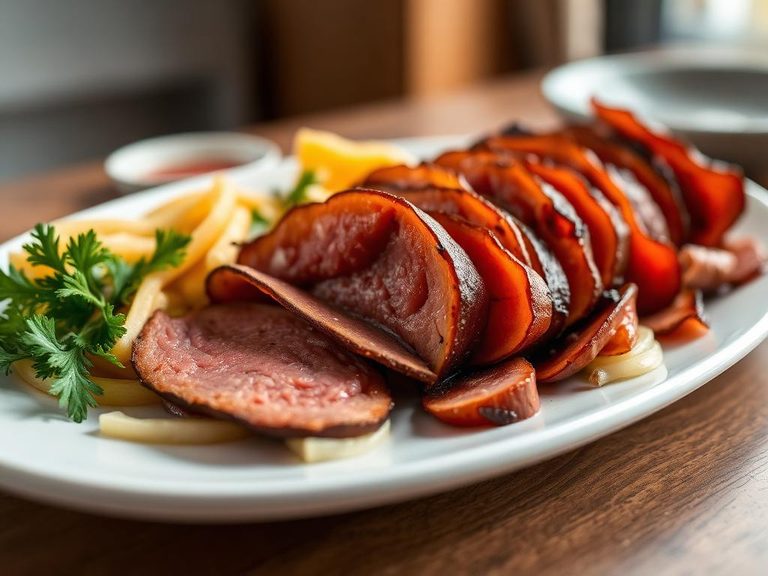
Corned beef is salt-cured brisket, typically from beef, that has been brined in a seasoned salt solution, often with spices like peppercorns, bay leaves, and mustard seeds. It has a distinct, salty, savory flavor with a tender, slightly fibrous texture when cooked properly, often served sliced. Nutritionally, it is a dense source of protein and fat, with virtually no carbohydrates.
Calorie split: 30% protein · 1% carbs · 70% fat
↓ Full nutrition💚 Why it's loved
People love corned beef for its bold, savory, umami-rich flavor that forms the hearty base of comfort dishes. Its cultural significance, especially in Irish-American and Jewish deli traditions, makes it a nostalgic and celebratory food.
⚠️ Watch-outs & how to enjoy it better
The primary concern is its very high sodium content from the curing process, which can contribute to water retention and is a consideration for those managing blood pressure. To counteract this, pair it with potassium-rich vegetables like cabbage or potatoes, and ensure ample water intake. It is also a fatty cut; portion control is key for those monitoring fat intake.
Key benefits
- Excellent source of high-quality protein for muscle maintenance.
- Provides significant amounts of iron and zinc.
- Contains B vitamins, particularly B12 and niacin.
- A long-lasting, shelf-stable meat when properly canned or cured.
🍽️ Popular dishes
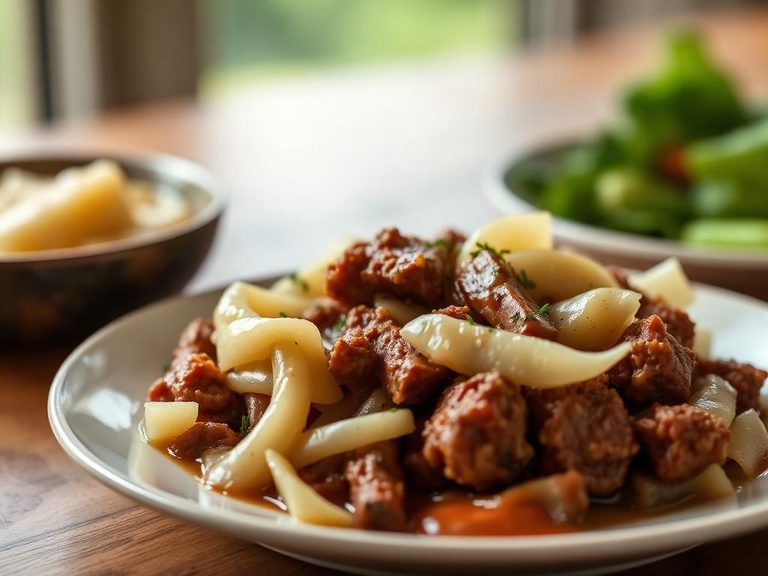
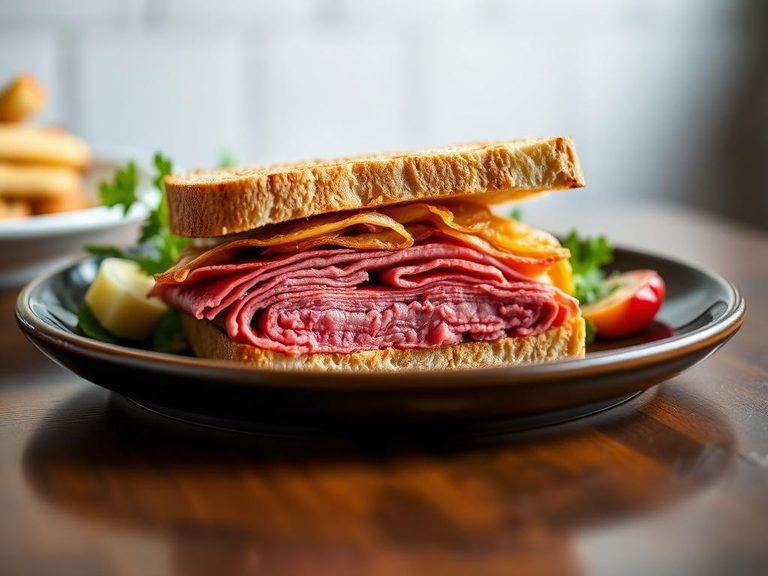
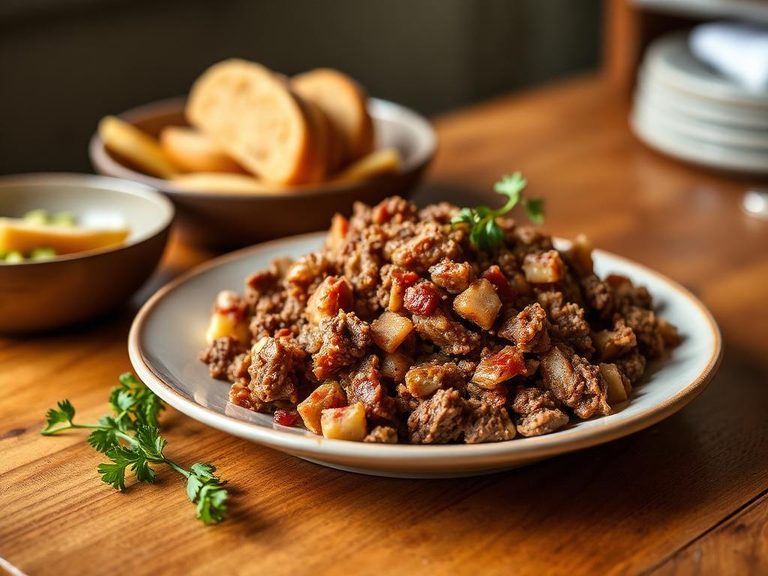
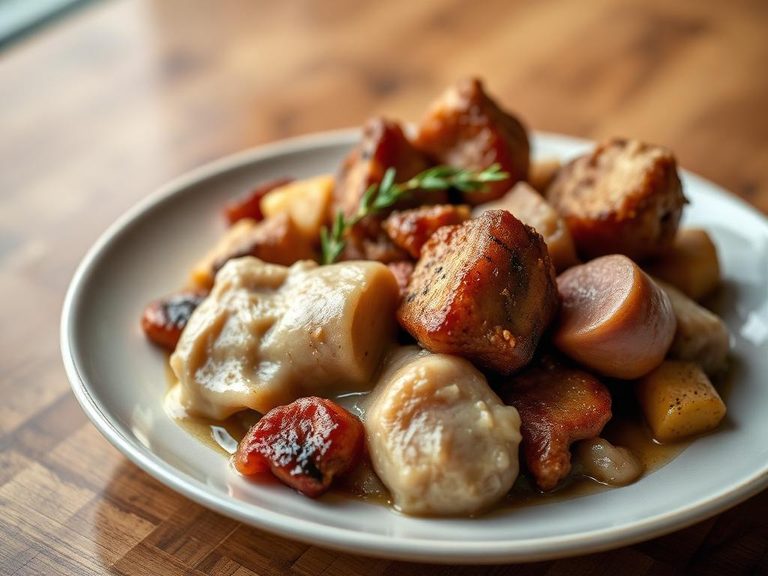
🌍 Where it's eaten
💡 Did you know?
The 'corn' in corned beef doesn't refer to the grain; it comes from the Old English word 'corn,' meaning a small, hard particle or grain, referring to the coarse salt crystals used in the curing brine.
Full nutrition (USDA data · scales with serving)
| Water | 59.8 g |
| Energy | 251 kcal |
| Protein | 18.2 g |
| Total lipid (fat) | 19.0 g |
| Carbohydrate, by difference | 0.47 g |
| Fiber, total dietary | 0.00 g |
| Total Sugars | 0.00 g |
| Calcium, Ca | 8.0 mg |
| Iron, Fe | 1.9 mg |
| Magnesium, Mg | 12.0 mg |
| Phosphorus, P | 125 mg |
| Potassium, K | 145 mg |
| Sodium, Na | 973 mg |
| Zinc, Zn | 4.6 mg |
| Copper, Cu | 0.15 mg |
| Selenium, Se | 32.8 ug |
| Vitamin C, total ascorbic acid | 0.00 mg |
| Thiamin | 0.03 mg |
| Riboflavin | 0.17 mg |
| Niacin | 3.0 mg |
| Vitamin B-6 | 0.23 mg |
| Folate, total | 6.0 ug |
| Folic acid | 0.00 ug |
| Folate, food | 6.0 ug |
| Folate, DFE | 6.0 ug |
| Choline, total | 69.2 mg |
| Vitamin B-12 | 1.6 ug |
| Vitamin B-12, added | 0.00 ug |
| Vitamin A, RAE | 0.00 ug |
| Retinol | 0.00 ug |
| Carotene, beta | 0.00 ug |
| Carotene, alpha | 0.00 ug |
| Cryptoxanthin, beta | 0.00 ug |
| Lycopene | 0.00 ug |
| Lutein + zeaxanthin | 0.00 ug |
| Vitamin E (alpha-tocopherol) | 0.16 mg |
| Vitamin E, added | 0.00 mg |
| Vitamin D (D2 + D3) | 0.10 ug |
| Vitamin K (phylloquinone) | 1.5 ug |
| Alcohol, ethyl | 0.00 g |
| Caffeine | 0.00 mg |
| Theobromine | 0.00 mg |
Fat & fatty acid profile (per 100g)
| Fatty acids, total saturated | 6.3 g |
| SFA 4:0 | 0.00 g |
| SFA 6:0 | 0.00 g |
| SFA 8:0 | 0.00 g |
| SFA 10:0 | 0.04 g |
| SFA 12:0 | 0.02 g |
| SFA 14:0 | 0.50 g |
| SFA 16:0 | 3.7 g |
| SFA 18:0 | 1.7 g |
| Fatty acids, total monounsaturated | 9.2 g |
| MUFA 16:1 | 1.4 g |
| MUFA 18:1 | 7.8 g |
| MUFA 20:1 | 0.00 g |
| MUFA 22:1 | 0.00 g |
| Fatty acids, total polyunsaturated | 0.67 g |
| PUFA 18:2 | 0.54 g |
| PUFA 18:3 | 0.13 g |
| PUFA 18:4 | 0.00 g |
| PUFA 20:4 | 0.00 g |
| PUFA 20:5 n-3 (EPA) | 0.00 g |
| PUFA 22:5 n-3 (DPA) | 0.00 g |
| PUFA 22:6 n-3 (DHA) | 0.00 g |
| Cholesterol | 98.0 mg |
Amino acid profile (per 100g)
Estimated from Beef, variety meats and by-products, mechanically separated beef, raw — USDA does not publish this profile for Beef.
| Tryptophan | 0.17 g |
| Threonine | 0.47 g |
| Isoleucine | 0.58 g |
| Leucine | 1.2 g |
| Lysine | 1.2 g |
| Methionine | 0.43 g |
| Cystine | 0.23 g |
| Phenylalanine | 0.64 g |
| Tyrosine | 0.38 g |
| Valine | 0.92 g |
| Arginine | 1.2 g |
| Histidine | 0.44 g |
| Alanine | 1.0 g |
| Aspartic acid | 1.3 g |
| Glutamic acid | 2.1 g |
| Glycine | 1.2 g |
| Proline | 0.92 g |
| Serine | 0.57 g |
FAQ
What's the difference between corned beef and pastrami?
Both are cured beef, but pastrami is typically smoked after curing and often coated in a spice rub, giving it a deeper, smokier flavor. Corned beef is usually boiled or braised after curing.
Is corned beef healthy?
It is a nutritious source of protein, iron, and B12. However, it is very high in sodium and saturated fat. Enjoying it in moderation, as part of a balanced diet rich in vegetables, is recommended.
Why is my corned beef tough?
Corned beef comes from the brisket, a tough, muscular cut. It requires slow, moist cooking (like boiling or braising) to break down the connective tissue and become tender. Cooking it too quickly at high heat will make it tough.
Nutrient density (calculated · NRF9.3)
Nutrient Rich Foods index: beneficial nutrients (protein, fiber, vitamins, minerals) minus saturated fat, added sugar & sodium, per 100 kcal.
NRF9.3 index — Fulgoni, Keast & Drewnowski, 2009. Computed from USDA nutrients.
Weight-loss friendliness (composite index)
Energy density 2.51 kcal/g · 29% calories from protein · 0.0 g fiber · 0.0 g sugar per 100 g.
Composite of energy density (Rolls et al., 1999), protein & fiber satiety, minus sugar. A calculated heuristic — ranks satiety-per-calorie, not a clinical measure.
Dietary load (calculated from USDA values)
Potential renal acid load. Positive = acid-forming, negative = alkaline-forming.
Sodium-to-potassium ratio: 6.71 (lower is better — aim for ≤ 1)
Sodium:potassium per WHO potassium guidance. Computed from USDA nutrients.