

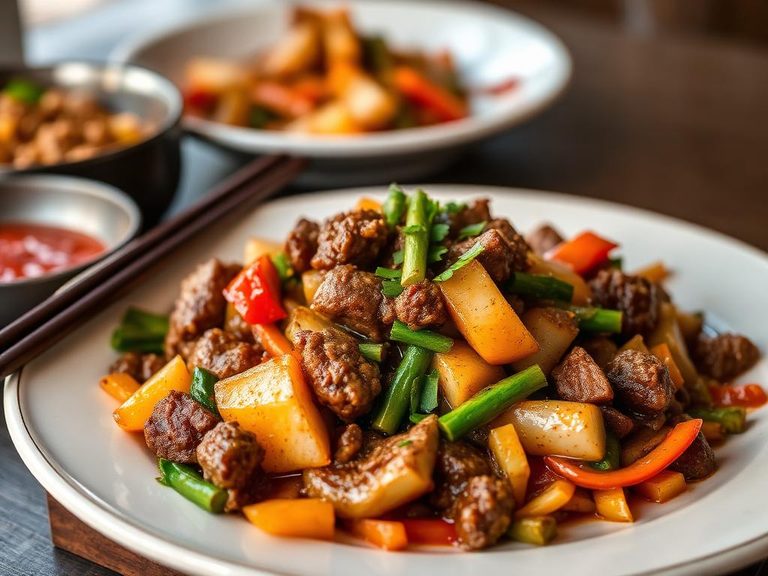
Beef and vegetables including carrots, broccoli, and/or dark-green leafy; no potatoes, soy-based sauce
Common food

Photo: Wikipedia
A hearty, savory stir-fry or sauté of tender beef slices and vibrant vegetables like carrots, broccoli, and dark greens, delivering a satisfying chew and crisp-tender bite. The dish is low in carbohydrates and sugar, with a balanced profile of protein and healthy fats that makes it a filling, nutrient-dense meal. Its flavor is rich and umami-forward, often enhanced by simple seasonings without relying on soy-based sauces.
Calorie split: 32% protein · 13% carbs · 55% fat
↓ Full nutrition💚 Why it's loved
People love this dish for its comforting, savory flavors and the satisfying contrast between tender beef and crisp vegetables. It's incredibly versatile, easily adapted to various cuisines and dietary preferences, making it a staple in home cooking and cultural celebrations.
⚠️ Watch-outs & how to enjoy it better
The dish can be high in saturated fat if using fatty cuts of beef, which may concern those monitoring heart health. To counteract this, choose lean cuts like sirloin or flank steak, and balance the meal with extra vegetables or a side of whole grains. Additionally, if using leafy greens like spinach, they contain oxalates that can affect mineral absorption; pairing with vitamin C-rich foods like broccoli or carrots can help mitigate this.
Key benefits
- High in protein for muscle maintenance and satiety
- Low in carbohydrates and sugar, suitable for low-carb diets
- Rich in fiber from vegetables for digestive health
- Contains iron and B vitamins from beef for energy
- Provides vitamins A, C, and K from carrots, broccoli, and leafy greens
🍽️ Popular dishes
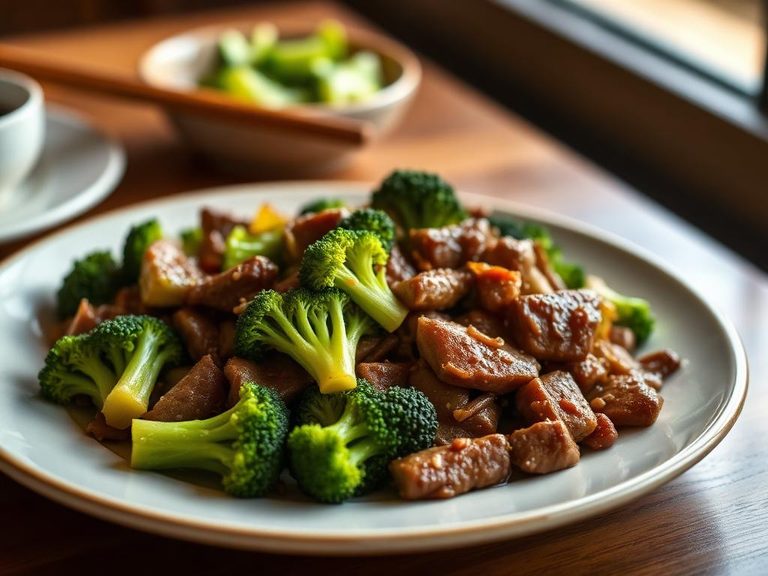
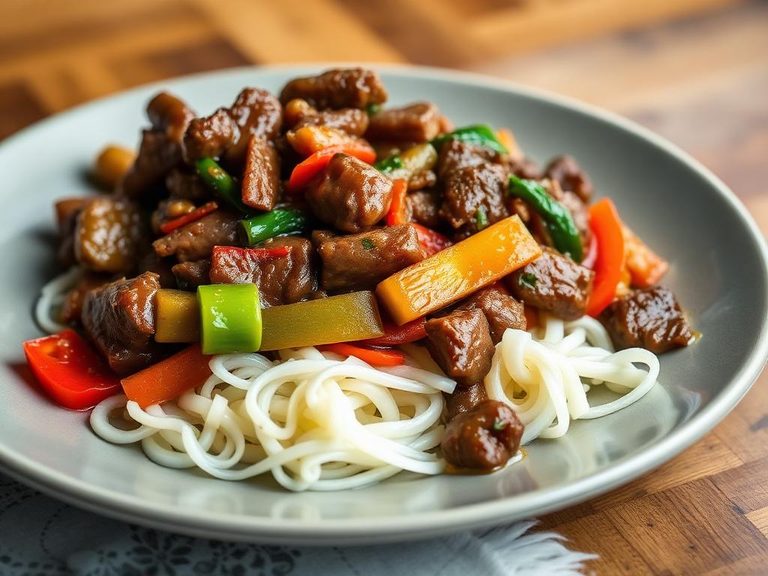
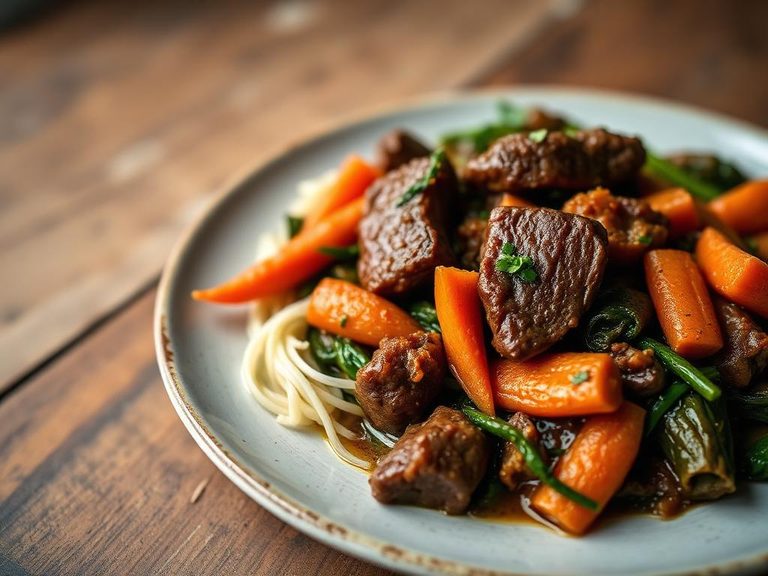
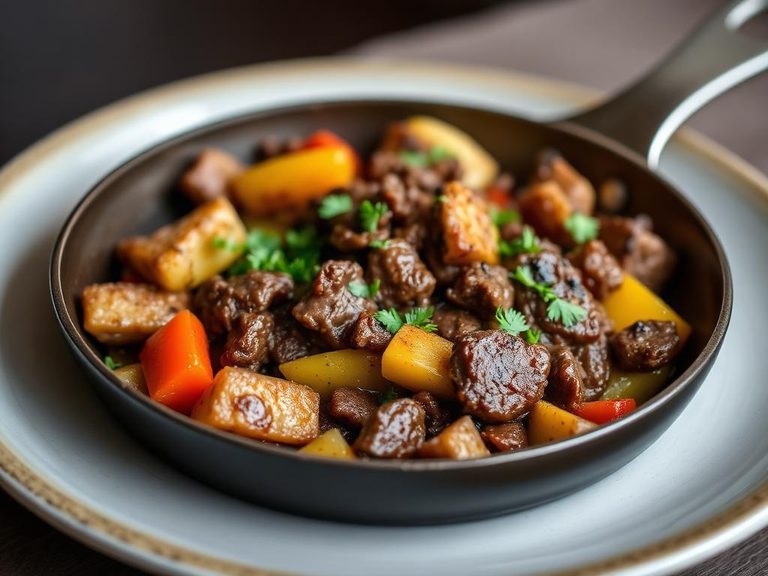
🌍 Where it's eaten
💡 Did you know?
Beef and broccoli became a popular Chinese-American dish in the 1970s, but the original Chinese version, 'Beef with Broccoli' (西兰花炒牛肉), was adapted from Cantonese cuisine and uses a different cut of beef and cooking technique.
Full nutrition (USDA data · scales with serving)
| Water | 73.6 g |
| Energy | 144 kcal |
| Protein | 11.7 g |
| Total lipid (fat) | 8.8 g |
| Carbohydrate, by difference | 4.7 g |
| Fiber, total dietary | 1.2 g |
| Total Sugars | 1.5 g |
| Calcium, Ca | 26.0 mg |
| Iron, Fe | 1.2 mg |
| Magnesium, Mg | 17.0 mg |
| Phosphorus, P | 97.0 mg |
| Potassium, K | 234 mg |
| Sodium, Na | 249 mg |
| Zinc, Zn | 2.0 mg |
| Copper, Cu | 0.06 mg |
| Selenium, Se | 11.5 ug |
| Vitamin C, total ascorbic acid | 14.8 mg |
| Thiamin | 0.06 mg |
| Riboflavin | 0.10 mg |
| Niacin | 2.2 mg |
| Vitamin B-6 | 0.23 mg |
| Folate, total | 20.0 ug |
| Folic acid | 0.00 ug |
| Folate, food | 20.0 ug |
| Folate, DFE | 20.0 ug |
| Choline, total | 46.6 mg |
| Vitamin B-12 | 0.59 ug |
| Vitamin B-12, added | 0.00 ug |
| Vitamin A, RAE | 135 ug |
| Retinol | 0.00 ug |
| Carotene, beta | 1330 ug |
| Carotene, alpha | 585 ug |
| Cryptoxanthin, beta | 0.00 ug |
| Lycopene | 0.00 ug |
| Lutein + zeaxanthin | 271 ug |
| Vitamin E (alpha-tocopherol) | 1.4 mg |
| Vitamin E, added | 0.00 mg |
| Vitamin D (D2 + D3) | 0.00 ug |
| Vitamin K (phylloquinone) | 34.8 ug |
| Alcohol, ethyl | 0.00 g |
| Caffeine | 0.00 mg |
| Theobromine | 0.00 mg |
Fat & fatty acid profile (per 100g)
| Fatty acids, total saturated | 1.9 g |
| SFA 4:0 | 0.00 g |
| SFA 6:0 | 0.00 g |
| SFA 8:0 | 0.00 g |
| SFA 10:0 | 0.01 g |
| SFA 12:0 | 0.01 g |
| SFA 14:0 | 0.10 g |
| SFA 16:0 | 1.3 g |
| SFA 18:0 | 0.50 g |
| Fatty acids, total monounsaturated | 3.7 g |
| MUFA 16:1 | 0.15 g |
| MUFA 18:1 | 3.5 g |
| MUFA 20:1 | 0.04 g |
| MUFA 22:1 | 0.00 g |
| Fatty acids, total polyunsaturated | 2.3 g |
| PUFA 18:2 | 2.0 g |
| PUFA 18:3 | 0.28 g |
| PUFA 18:4 | 0.00 g |
| PUFA 20:4 | 0.01 g |
| PUFA 20:5 n-3 (EPA) | 0.00 g |
| PUFA 22:5 n-3 (DPA) | 0.01 g |
| PUFA 22:6 n-3 (DHA) | 0.00 g |
| Cholesterol | 31.0 mg |
Amino acid profile (per 100g)
Estimated from Restaurant, Chinese, beef and vegetables — USDA does not publish this profile for Beef and vegetables including carrots.
| Tryptophan | 0.08 g |
| Threonine | 0.31 g |
| Isoleucine | 0.31 g |
| Leucine | 0.53 g |
| Lysine | 0.55 g |
| Methionine | 0.16 g |
| Cystine | 0.07 g |
| Phenylalanine | 0.32 g |
| Tyrosine | 0.27 g |
| Valine | 0.33 g |
| Arginine | 0.52 g |
| Histidine | 0.21 g |
| Alanine | 0.38 g |
| Aspartic acid | 0.67 g |
| Glutamic acid | 1.3 g |
| Glycine | 0.28 g |
| Proline | 0.26 g |
| Serine | 0.29 g |
FAQ
Is this dish suitable for a low-carb diet?
Yes, with only 4.65g of carbs per 100g, it's excellent for low-carb diets, especially when avoiding potatoes and soy-based sauces.
Can I use frozen vegetables in this dish?
Absolutely, frozen broccoli, carrots, and leafy greens work well; just thaw and drain to avoid excess moisture, which can make the dish soggy.
How can I reduce the fat content without losing flavor?
Use lean beef cuts, trim visible fat, and cook with minimal oil; adding herbs and spices like garlic, ginger, or black pepper can boost flavor without extra fat.
Nutrient density (calculated · NRF9.3)
Nutrient Rich Foods index: beneficial nutrients (protein, fiber, vitamins, minerals) minus saturated fat, added sugar & sodium, per 100 kcal.
NRF9.3 index — Fulgoni, Keast & Drewnowski, 2009. Computed from USDA nutrients.
Weight-loss friendliness (composite index)
Energy density 1.44 kcal/g · 33% calories from protein · 1.2 g fiber · 1.5 g sugar per 100 g.
Composite of energy density (Rolls et al., 1999), protein & fiber satiety, minus sugar. A calculated heuristic — ranks satiety-per-calorie, not a clinical measure.
Dietary load (calculated from USDA values)
Potential renal acid load. Positive = acid-forming, negative = alkaline-forming.
Sodium-to-potassium ratio: 1.06 (lower is better — aim for ≤ 1)
Sodium:potassium per WHO potassium guidance. Computed from USDA nutrients.