

Bacon, for use with vegetables
Common food

Photo: Wikipedia
Bacon is a cured and smoked pork product, prized for its intensely savory, salty flavor and a texture that ranges from chewy to shatteringly crisp. Its high fat content, particularly the rendered fat, is a key nutritional feature, delivering a dense 468 kcal per 100g. It's a powerhouse of protein (33.92g/100g) and fat (35.09g/100g), with negligible carbohydrates.
Calorie split: 30% protein · 1% carbs · 69% fat
↓ Full nutrition💚 Why it's loved
People love bacon for its irresistible combination of salty, smoky, and savory umami flavors that can elevate almost any dish. Its cultural status as a beloved comfort food and breakfast staple makes it a symbol of indulgence and satisfaction.
⚠️ Watch-outs & how to enjoy it better
Its high saturated fat and sodium content can be a concern for cardiovascular health and blood pressure management. To counteract this, practice strict portion control, choose lower-sodium varieties, and pair it with high-fiber vegetables or whole grains to balance the meal.
Key benefits
- High in complete protein for muscle maintenance
- Provides B vitamins like B12 and niacin
- Rich in selenium and phosphorus minerals
- Excellent source of energy-dense calories
- Adds profound umami depth to dishes
🍽️ Popular dishes
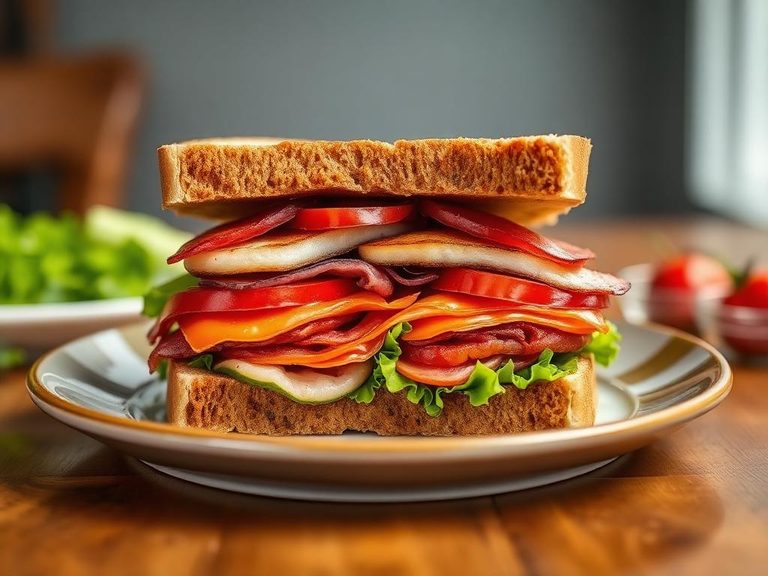



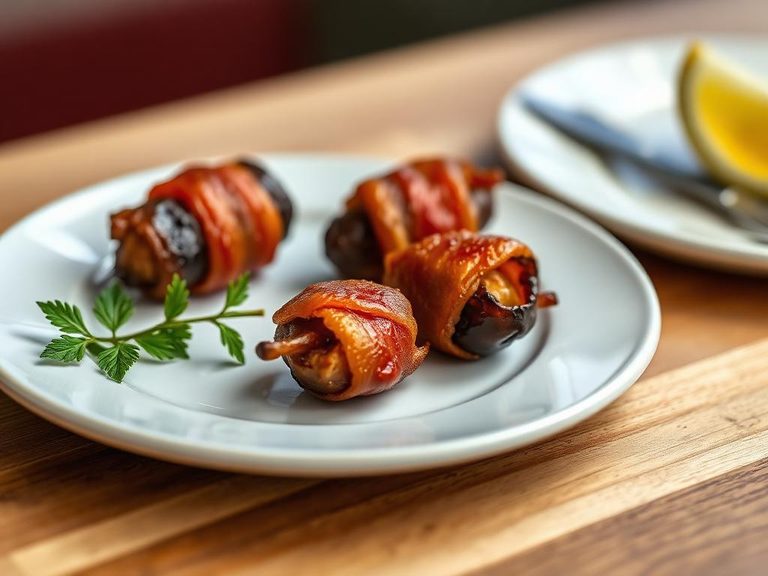

🌍 Where it's eaten
💡 Did you know?
The word 'bacon' comes from the Old High German 'bacho', meaning 'back', and the practice of curing pork with salt dates back to ancient China around 1500 BCE.
Full nutrition (USDA data · scales with serving)
| Water | 23.6 g |
| Energy | 468 kcal |
| Protein | 33.9 g |
| Total lipid (fat) | 35.1 g |
| Carbohydrate, by difference | 1.7 g |
| Fiber, total dietary | 0.00 g |
| Total Sugars | 0.00 g |
| Calcium, Ca | 11.0 mg |
| Iron, Fe | 0.95 mg |
| Magnesium, Mg | 31.0 mg |
| Phosphorus, P | 388 mg |
| Potassium, K | 499 mg |
| Sodium, Na | 1684 mg |
| Zinc, Zn | 3.1 mg |
| Copper, Cu | 0.10 mg |
| Selenium, Se | 50.7 ug |
| Vitamin C, total ascorbic acid | 0.00 mg |
| Thiamin | 0.56 mg |
| Riboflavin | 0.23 mg |
| Niacin | 10.5 mg |
| Vitamin B-6 | 0.54 mg |
| Folate, total | 0.00 ug |
| Folic acid | 0.00 ug |
| Folate, food | 0.00 ug |
| Folate, DFE | 0.00 ug |
| Choline, total | 89.5 mg |
| Vitamin B-12 | 1.1 ug |
| Vitamin B-12, added | 0.00 ug |
| Vitamin A, RAE | 11.0 ug |
| Retinol | 11.0 ug |
| Carotene, beta | 0.00 ug |
| Carotene, alpha | 0.00 ug |
| Cryptoxanthin, beta | 0.00 ug |
| Lycopene | 0.00 ug |
| Lutein + zeaxanthin | 0.00 ug |
| Vitamin E (alpha-tocopherol) | 0.42 mg |
| Vitamin E, added | 0.00 mg |
| Vitamin D (D2 + D3) | 0.40 ug |
| Vitamin K (phylloquinone) | 0.00 ug |
| Alcohol, ethyl | 0.00 g |
| Caffeine | 0.00 mg |
| Theobromine | 0.00 mg |
Fat & fatty acid profile (per 100g)
| Fatty acids, total saturated | 12.0 g |
| SFA 4:0 | 0.00 g |
| SFA 6:0 | 0.00 g |
| SFA 8:0 | 0.00 g |
| SFA 10:0 | 0.00 g |
| SFA 12:0 | 0.00 g |
| SFA 14:0 | 0.44 g |
| SFA 16:0 | 7.6 g |
| SFA 18:0 | 3.7 g |
| Fatty acids, total monounsaturated | 15.5 g |
| MUFA 16:1 | 0.78 g |
| MUFA 18:1 | 14.3 g |
| MUFA 20:1 | 0.29 g |
| MUFA 22:1 | 0.01 g |
| Fatty acids, total polyunsaturated | 6.1 g |
| PUFA 18:2 | 5.3 g |
| PUFA 18:3 | 0.23 g |
| PUFA 18:4 | 0.00 g |
| PUFA 20:4 | 0.17 g |
| PUFA 20:5 n-3 (EPA) | 0.00 g |
| PUFA 22:5 n-3 (DPA) | 0.03 g |
| PUFA 22:6 n-3 (DHA) | 0.01 g |
| Cholesterol | 99.0 mg |
Amino acid profile (per 100g)
Estimated from Bacon, turkey, low sodium — USDA does not publish this profile for Bacon.
| Tryptophan | 0.19 g |
| Threonine | 0.65 g |
| Isoleucine | 0.52 g |
| Leucine | 1.3 g |
| Lysine | 1.5 g |
| Methionine | 0.47 g |
| Cystine | 0.17 g |
| Phenylalanine | 0.59 g |
| Tyrosine | 0.53 g |
| Valine | 0.59 g |
| Arginine | 1.1 g |
| Histidine | 0.49 g |
| Alanine | 1.0 g |
| Aspartic acid | 1.5 g |
| Glutamic acid | 2.5 g |
| Glycine | 0.93 g |
| Proline | 1.1 g |
| Serine | 0.72 g |
FAQ
Is bacon a good source of protein?
Yes, bacon is very high in protein, containing about 34 grams per 100 grams, which is comparable to many lean meats.
Does bacon contain sugar?
While some curing processes may use sugar, the nutritional data shows 0g of sugar per 100g, indicating it is a low-sugar food in this form.
How can I reduce the fat content when cooking bacon?
You can reduce fat by baking bacon on a rack to allow the fat to drip away, or by pan-frying and then draining on paper towels to absorb excess grease.
Nutrient density (calculated · NRF9.3)
Nutrient Rich Foods index: beneficial nutrients (protein, fiber, vitamins, minerals) minus saturated fat, added sugar & sodium, per 100 kcal.
NRF9.3 index — Fulgoni, Keast & Drewnowski, 2009. Computed from USDA nutrients.
Weight-loss friendliness (composite index)
Energy density 4.68 kcal/g · 29% calories from protein · 0.0 g fiber · 0.0 g sugar per 100 g.
Composite of energy density (Rolls et al., 1999), protein & fiber satiety, minus sugar. A calculated heuristic — ranks satiety-per-calorie, not a clinical measure.
Dietary load (calculated from USDA values)
Potential renal acid load. Positive = acid-forming, negative = alkaline-forming.
Sodium-to-potassium ratio: 3.37 (lower is better — aim for ≤ 1)
Sodium:potassium per WHO potassium guidance. Computed from USDA nutrients.