

Wheat bread as ingredient in sandwiches
Common food
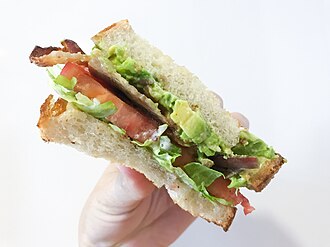
Photo: Wikipedia
Wheat bread is the foundational canvas of the sandwich, offering a mild, nutty flavor and a soft, springy texture that cradles fillings without overpowering them. Its golden-brown crust provides a satisfying contrast to the tender crumb. Nutritionally, it's a solid source of plant-based protein and complex carbohydrates, with a notable fiber content that supports sustained energy.
Calorie split: 17% protein · 69% carbs · 14% fat
↓ Full nutrition💚 Why it's loved
People love wheat bread for its comforting, familiar taste and its incredible versatility—it's the reliable, neutral partner that lets the star fillings shine, from classic deli meats to fresh vegetables. It's deeply embedded in lunchtime culture worldwide, symbolizing a simple, satisfying meal.
⚠️ Watch-outs & how to enjoy it better
The primary downsides are its high carbohydrate load, which can cause blood-sugar spikes, and its potential as a common gluten allergen. To counteract blood-sugar impacts, pair it with protein (like turkey or hummus) and healthy fats (like avocado or cheese), and opt for whole-wheat varieties with higher fiber. Those with celiac disease or gluten sensitivity must choose certified gluten-free bread.
Key benefits
- Provides sustained energy from complex carbohydrates
- Good source of plant-based protein for muscle maintenance
- Contains dietary fiber to support digestive health
- Versatile base that complements both sweet and savory fillings
- Often fortified with B vitamins and minerals like iron
🍽️ Popular dishes






🌍 Where it's eaten
💡 Did you know?
The modern sandwich is named after the 4th Earl of Sandwich, John Montagu, who supposedly demanded meat between slices of bread so he could eat without leaving his gambling table.
Full nutrition (USDA data · scales with serving)
| Water | 37.0 g |
| Energy | 264 kcal |
| Protein | 11.4 g |
| Total lipid (fat) | 4.0 g |
| Carbohydrate, by difference | 45.4 g |
| Fiber, total dietary | 5.4 g |
| Total Sugars | 5.2 g |
| Calcium, Ca | 161 mg |
| Iron, Fe | 3.1 mg |
| Magnesium, Mg | 56.0 mg |
| Phosphorus, P | 166 mg |
| Potassium, K | 189 mg |
| Sodium, Na | 440 mg |
| Zinc, Zn | 1.4 mg |
| Copper, Cu | 0.19 mg |
| Selenium, Se | 27.6 ug |
| Vitamin C, total ascorbic acid | 0.10 mg |
| Thiamin | 0.40 mg |
| Riboflavin | 0.21 mg |
| Niacin | 4.9 mg |
| Vitamin B-6 | 0.16 mg |
| Folate, total | 72.0 ug |
| Folic acid | 14.0 ug |
| Folate, food | 58.0 ug |
| Folate, DFE | 82.0 ug |
| Choline, total | 21.3 mg |
| Vitamin B-12 | 0.00 ug |
| Vitamin B-12, added | 0.00 ug |
| Vitamin A, RAE | 0.00 ug |
| Retinol | 0.00 ug |
| Carotene, beta | 2.0 ug |
| Carotene, alpha | 0.00 ug |
| Cryptoxanthin, beta | 0.00 ug |
| Lycopene | 0.00 ug |
| Lutein + zeaxanthin | 64.0 ug |
| Vitamin E (alpha-tocopherol) | 0.35 mg |
| Vitamin E, added | 0.00 mg |
| Vitamin D (D2 + D3) | 0.00 ug |
| Vitamin K (phylloquinone) | 5.5 ug |
| Alcohol, ethyl | 0.00 g |
| Caffeine | 0.00 mg |
| Theobromine | 0.00 mg |
Fat & fatty acid profile (per 100g)
| Fatty acids, total saturated | 0.72 g |
| SFA 4:0 | 0.00 g |
| SFA 6:0 | 0.00 g |
| SFA 8:0 | 0.00 g |
| SFA 10:0 | 0.00 g |
| SFA 12:0 | 0.01 g |
| SFA 14:0 | 0.01 g |
| SFA 16:0 | 0.44 g |
| SFA 18:0 | 0.24 g |
| Fatty acids, total monounsaturated | 0.65 g |
| MUFA 16:1 | 0.02 g |
| MUFA 18:1 | 0.63 g |
| MUFA 20:1 | 0.01 g |
| MUFA 22:1 | 0.00 g |
| Fatty acids, total polyunsaturated | 1.6 g |
| PUFA 18:2 | 1.4 g |
| PUFA 18:3 | 0.15 g |
| PUFA 18:4 | 0.00 g |
| PUFA 20:4 | 0.00 g |
| PUFA 20:5 n-3 (EPA) | 0.00 g |
| PUFA 22:5 n-3 (DPA) | 0.00 g |
| PUFA 22:6 n-3 (DHA) | 0.00 g |
| Cholesterol | 0.00 mg |
Amino acid profile (per 100g)
Estimated from Bread, whole-wheat, prepared from recipe, toasted — USDA does not publish this profile for Wheat bread as ingredient in sandwiches.
| Tryptophan | 0.13 g |
| Threonine | 0.27 g |
| Isoleucine | 0.34 g |
| Leucine | 0.63 g |
| Lysine | 0.27 g |
| Methionine | 0.15 g |
| Cystine | 0.20 g |
| Phenylalanine | 0.44 g |
| Tyrosine | 0.28 g |
| Valine | 0.41 g |
| Arginine | 0.42 g |
| Histidine | 0.21 g |
| Alanine | 0.33 g |
| Aspartic acid | 0.48 g |
| Glutamic acid | 2.9 g |
| Glycine | 0.36 g |
| Proline | 0.95 g |
| Serine | 0.44 g |
FAQ
What's the difference between white and wheat bread?
Wheat bread is made from flour that includes the bran and germ of the wheat kernel, giving it a brown color, nuttier flavor, and higher fiber, vitamin, and mineral content compared to refined white bread, which uses only the endosperm.
Is wheat bread good for weight loss?
It can be part of a weight-loss diet due to its fiber and protein, which promote fullness. However, portion control is key, as it is calorie-dense. Choosing whole-grain varieties and pairing with lean protein and vegetables makes a more balanced, satisfying meal.
Why does my wheat bread get soggy in sandwiches?
Sogginess occurs when moist fillings (like tomatoes, cucumbers, or wet spreads) release water into the bread. To prevent this, pat wet ingredients dry, create a barrier with a fat-based spread (mayo, butter, or hummus), or assemble the sandwich just before eating.
Nutrient density (calculated · NRF9.3)
Nutrient Rich Foods index: beneficial nutrients (protein, fiber, vitamins, minerals) minus saturated fat, added sugar & sodium, per 100 kcal.
NRF9.3 index — Fulgoni, Keast & Drewnowski, 2009. Computed from USDA nutrients.
Weight-loss friendliness (composite index)
Energy density 2.64 kcal/g · 17% calories from protein · 5.4 g fiber · 5.2 g sugar per 100 g.
Composite of energy density (Rolls et al., 1999), protein & fiber satiety, minus sugar. A calculated heuristic — ranks satiety-per-calorie, not a clinical measure.
Dietary load (calculated from USDA values)
Potential renal acid load. Positive = acid-forming, negative = alkaline-forming.
Sodium-to-potassium ratio: 2.33 (lower is better — aim for ≤ 1)
Sodium:potassium per WHO potassium guidance. Computed from USDA nutrients.