

Turkey with gravy, dressing, potatoes, vegetable, frozen meal
Common food

Photo: Wikipedia
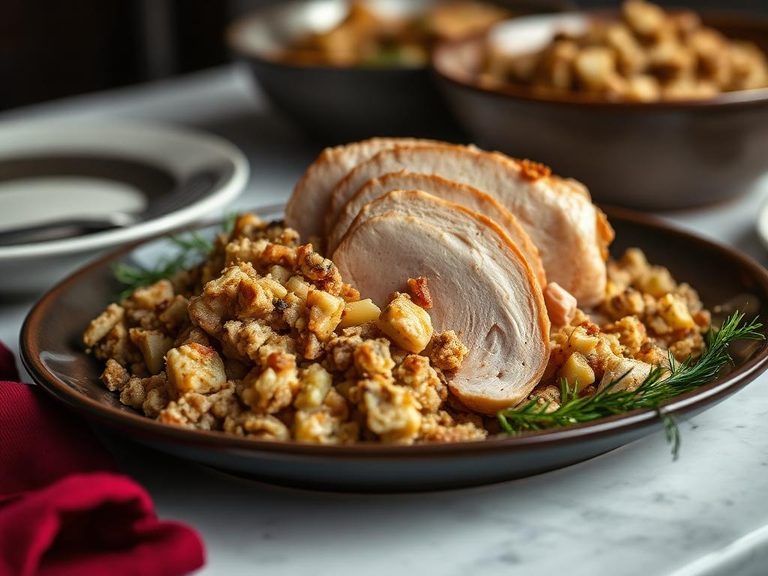
This is a classic American frozen TV dinner, a complete meal of sliced turkey, savory gravy, bread-based dressing, mashed potatoes, and a vegetable, all in one compartmentalized tray. The texture is soft and homogenous, with the rich, salty-savory flavors of the gravy and dressing dominating the mild turkey and starchy sides. At just 128 kcal per 100g, it is a surprisingly light, protein-rich option for a full meal.
Calorie split: 22% protein · 51% carbs · 27% fat
↓ Full nutrition💚 Why it's loved
People love it for its nostalgic, comforting flavors that evoke holiday feasts and home cooking, all delivered with unmatched convenience. The combination of savory gravy, soft dressing, and tender turkey is a familiar, satisfying taste that requires zero effort to prepare.
⚠️ Watch-outs & how to enjoy it better
The meal can be high in sodium and may cause blood-sugar spikes due to its high carbohydrate content (16.32g per 100g) and low fiber. To counteract this, pair it with a side of fresh, non-starchy vegetables or a small salad to add fiber and slow digestion, and be mindful of portion size if watching sodium intake.
Key benefits
- Complete, balanced meal in one serving
- High protein-to-calorie ratio (6.97g protein per 100g)
- Convenient, no-prep comfort food
- Low in total fat (3.89g per 100g)
- Provides a mix of protein, carbs, and fiber
🍽️ Popular dishes
🌍 Where it's eaten
💡 Did you know?
The first TV dinner was introduced by Swanson in 1953 and was originally a Thanksgiving-themed meal featuring turkey, stuffing, peas, and sweet potatoes, sold in a tray designed to look like a TV set.
Full nutrition (USDA data · scales with serving)
| Water | 71.2 g |
| Energy | 128 kcal |
| Protein | 7.0 g |
| Total lipid (fat) | 3.9 g |
| Carbohydrate, by difference | 16.3 g |
| Fiber, total dietary | 1.3 g |
| Total Sugars | 4.8 g |
| Calcium, Ca | 27.0 mg |
| Iron, Fe | 0.79 mg |
| Magnesium, Mg | 18.0 mg |
| Phosphorus, P | 106 mg |
| Potassium, K | 230 mg |
| Sodium, Na | 326 mg |
| Zinc, Zn | 0.48 mg |
| Copper, Cu | 0.06 mg |
| Selenium, Se | 7.9 ug |
| Vitamin C, total ascorbic acid | 0.80 mg |
| Thiamin | 0.14 mg |
| Riboflavin | 0.25 mg |
| Niacin | 3.1 mg |
| Vitamin B-6 | 0.18 mg |
| Folate, total | 24.0 ug |
| Folic acid | 7.0 ug |
| Folate, food | 16.0 ug |
| Folate, DFE | 29.0 ug |
| Choline, total | 17.1 mg |
| Vitamin B-12 | 0.33 ug |
| Vitamin B-12, added | 0.00 ug |
| Vitamin A, RAE | 44.0 ug |
| Retinol | 34.0 ug |
| Carotene, beta | 124 ug |
| Carotene, alpha | 0.00 ug |
| Cryptoxanthin, beta | 0.00 ug |
| Lycopene | 0.00 ug |
| Lutein + zeaxanthin | 327 ug |
| Vitamin E (alpha-tocopherol) | 0.24 mg |
| Vitamin E, added | 0.00 mg |
| Vitamin D (D2 + D3) | 0.10 ug |
| Vitamin K (phylloquinone) | 11.5 ug |
| Alcohol, ethyl | 0.00 g |
| Caffeine | 0.00 mg |
| Theobromine | 0.00 mg |
Fat & fatty acid profile (per 100g)
| Fatty acids, total saturated | 0.88 g |
| SFA 4:0 | 0.00 g |
| SFA 6:0 | 0.00 g |
| SFA 8:0 | 0.00 g |
| SFA 10:0 | 0.01 g |
| SFA 12:0 | 0.01 g |
| SFA 14:0 | 0.05 g |
| SFA 16:0 | 0.57 g |
| SFA 18:0 | 0.24 g |
| Fatty acids, total monounsaturated | 1.2 g |
| MUFA 16:1 | 0.06 g |
| MUFA 18:1 | 1.2 g |
| MUFA 20:1 | 0.00 g |
| MUFA 22:1 | 0.00 g |
| Fatty acids, total polyunsaturated | 1.1 g |
| PUFA 18:2 | 0.96 g |
| PUFA 18:3 | 0.10 g |
| PUFA 18:4 | 0.00 g |
| PUFA 20:4 | 0.02 g |
| PUFA 20:5 n-3 (EPA) | 0.00 g |
| PUFA 22:5 n-3 (DPA) | 0.00 g |
| PUFA 22:6 n-3 (DHA) | 0.00 g |
| Cholesterol | 14.0 mg |
Amino acid profile (per 100g)
Estimated from Turkey, stuffing, mashed potatoes w/gravy, assorted vegetables, frozen, microwaved — USDA does not publish this profile for Turkey with gravy.
| Tryptophan | 0.10 g |
| Threonine | 0.27 g |
| Isoleucine | 0.29 g |
| Leucine | 0.51 g |
| Lysine | 0.50 g |
| Methionine | 0.16 g |
| Cystine | 0.09 g |
| Phenylalanine | 0.28 g |
| Tyrosine | 0.18 g |
| Valine | 0.32 g |
| Arginine | 0.39 g |
| Histidine | 0.20 g |
| Alanine | 0.35 g |
| Aspartic acid | 0.66 g |
| Glutamic acid | 1.3 g |
| Glycine | 0.27 g |
| Proline | 0.34 g |
| Serine | 0.28 g |
FAQ
Is this frozen meal healthy?
It's a balanced meal with a good protein-to-calorie ratio, but it can be high in sodium and refined carbs. It's a convenient option, but not necessarily a low-sodium or low-glycemic choice.
Can I make this from scratch?
Yes, you can replicate the components: roast turkey, make gravy from pan drippings, prepare bread dressing, and serve with mashed potatoes and a vegetable like green beans or corn.
How does the nutrition compare to a homemade version?
Homemade versions often have less sodium and more fiber, especially if you use whole-grain bread for dressing and add more vegetables. The frozen meal is designed for convenience and consistency, which can mean added preservatives and salt.
Nutrient density (calculated · NRF9.3)
Nutrient Rich Foods index: beneficial nutrients (protein, fiber, vitamins, minerals) minus saturated fat, added sugar & sodium, per 100 kcal.
NRF9.3 index — Fulgoni, Keast & Drewnowski, 2009. Computed from USDA nutrients.
Weight-loss friendliness (composite index)
Energy density 1.28 kcal/g · 22% calories from protein · 1.3 g fiber · 4.8 g sugar per 100 g.
Composite of energy density (Rolls et al., 1999), protein & fiber satiety, minus sugar. A calculated heuristic — ranks satiety-per-calorie, not a clinical measure.
Dietary load (calculated from USDA values)
Potential renal acid load. Positive = acid-forming, negative = alkaline-forming.
Sodium-to-potassium ratio: 1.42 (lower is better — aim for ≤ 1)
Sodium:potassium per WHO potassium guidance. Computed from USDA nutrients.